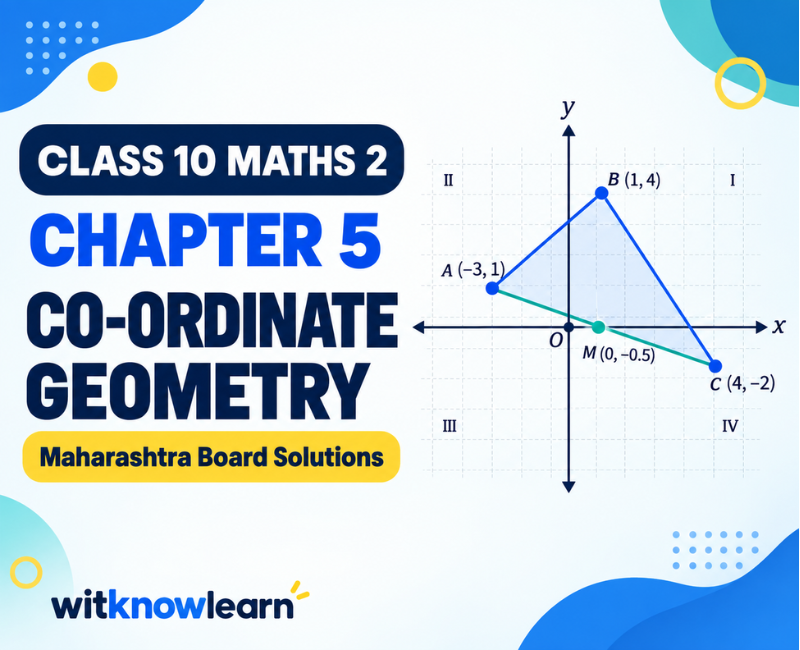
Class 10 Maths 2 Chapter 5 Co-ordinate Geometry Solutions
Study Maharashtra Board Class 10 Maths 2 Chapter 5 Co-ordinate Geometry with simple explanations and clear step-by-step methods. This guide covers slope, distance formula, section formula, midpoint, collinear points, geometrical figures and Problem Set 5.
Class 10 Maths 2 Chapter 5 Co-ordinate Geometry
Select the required practice set to study its formulas, concepts and solution method.
What Will You Learn in Co-ordinate Geometry?
Co-ordinate Geometry connects algebra with geometry. A geometrical point is represented by an ordered pair written as (x, y). The horizontal number line is called the X-axis, and the vertical number line is called the Y-axis. Their point of intersection is the origin, represented by O(0, 0).
The coordinate plane is divided into four quadrants. The signs of the x-coordinate and y-coordinate depend on the quadrant in which the point lies. Students must always write the x-coordinate first and the y-coordinate second.
This chapter also explains how formulas can be used to calculate the slope of a line, distance between points, midpoint of a line segment and coordinates of a point dividing a segment in a given ratio. These concepts are useful for proving whether points are collinear and identifying triangles and quadrilaterals.
Slope of a Line
Calculate the slope of a line from two points and use slopes to identify parallel, perpendicular and collinear lines.
Distance Formula
Find the exact distance between two points and use the calculated side lengths to identify different geometrical figures.
Section Formula
Find the coordinates of a point dividing a line segment in a given ratio, including midpoint and internal division.
Important Co-ordinate Geometry Formulas
Before applying a formula, write the given points as A(x₁, y₁) and B(x₂, y₂). Substitute each coordinate with its correct sign. Negative coordinates should always be written inside brackets during calculation.
- Parallel non-vertical lines have equal slopes.
- If the product of the slopes of two lines is −1, the lines are perpendicular.
- If slope AB equals slope BC, points A, B and C are collinear.
- Every point on the X-axis has y-coordinate equal to zero.
- Every point on the Y-axis has x-coordinate equal to zero.
Practice Set-wise Chapter 5 Solutions
Practice Set 5.1 Solutions
Practice Set 5.1 introduces the slope of a line. The slope tells us how steep a line is and whether it rises or falls as we move from left to right. Students calculate the slope by finding the difference between the y-coordinates and dividing it by the difference between the x-coordinates.
Slope is also used to check whether two lines are parallel. When two non-vertical lines have equal slopes, they are parallel. When the product of their slopes is −1, the lines are perpendicular. If the slopes of AB and BC are equal and point B is common, points A, B and C lie on the same straight line.
Write the coordinates in the same order in the numerator and denominator. If y₂ − y₁ is used in the numerator, then x₂ − x₁ must be used in the denominator.
Practice Set 5.2 Solutions
Practice Set 5.2 focuses on the distance formula. This formula is derived from the Pythagoras theorem and gives the length of the line segment joining two points. Students should simplify the differences first, square them separately and then find the positive square root.
The distance formula can be used to determine whether three points form an isosceles, equilateral, scalene or right-angled triangle. It can also help prove that a quadrilateral is a parallelogram, rectangle, rhombus or square by comparing its sides and diagonals.
Distance can never be negative. If the final simplified value is written with a negative sign, the calculation should be checked again.
Practice Set 5.3 Solutions
Practice Set 5.3 covers the section formula and midpoint formula. The section formula is used when a point divides the line segment joining two known points in a given ratio. The ratio must be matched carefully with the opposite endpoint while substituting values.
The midpoint formula is a special case of the section formula in which the ratio is 1:1. It is commonly used for diagonals of parallelograms, rectangles and squares because the diagonals of a parallelogram bisect each other.
Questions may also ask for the ratio in which the X-axis or Y-axis divides a segment. Use y = 0 for a point on the X-axis and x = 0 for a point on the Y-axis.
Problem Set 5 Solutions
Problem Set 5 provides complete revision of the Co-ordinate Geometry chapter. It combines slope, distance, midpoint, section formula, collinearity, triangle classification and coordinate proofs involving quadrilaterals.
Some questions require more than one calculation. For example, proving that four points form a rectangle may require the lengths of all sides followed by the lengths of the diagonals. Write each calculation separately and compare the results before stating the final geometrical conclusion.
Questions involving a circumcentre require a point that is equidistant from all three vertices of a triangle. Assume the circumcentre to be O(h, k), equate the squared distances and solve the resulting simultaneous equations step by step.
How to Solve Co-ordinate Geometry Questions
- Write the given coordinates clearly and identify the quantity that must be calculated.
- Represent the points as (x₁, y₁) and (x₂, y₂).
- Select the correct slope, distance, midpoint or section formula.
- Substitute negative coordinates inside brackets.
- Simplify the numerator, denominator, squares or ratio terms one step at a time.
- Compare the calculated values when proving a geometrical property.
- Write the final coordinates inside brackets in the correct order.
- Include the unit when the final answer represents a distance or length.
Common Mistakes Students Should Avoid
- Do not interchange the x-coordinate and y-coordinate.
- Do not change the order of subtraction halfway through the slope calculation.
- Remember that the square of a negative number is positive.
- Do not forget the square root in the final distance formula.
- Match the ratio terms correctly while using the section formula.
- Do not write a negative value for distance.
- State the geometrical reason after comparing slopes, sides or diagonals.
Complete Chapter 5 Solutions
These Maharashtra Board Class 10 Maths 2 Chapter 5 Co-ordinate Geometry solutions cover Practice Sets 5.1, 5.2 and 5.3 along with Problem Set 5. Follow every formula, substitution and calculation carefully. Attempt each question independently before checking the solution.
Frequently Asked Questions
Select any question to view its answer.
What is Co-ordinate Geometry?
What is the slope formula for two points?
What is the distance formula?
What is the midpoint formula?
How do we check whether three points are collinear?
How do we prove that two lines are parallel?
How do we prove that two lines are perpendicular?
What are the coordinates of a point on the X-axis?
What are the coordinates of a point on the Y-axis?
How can coordinates be used to identify a triangle?
Which exercises are covered in Chapter 5?
How should I prepare Co-ordinate Geometry for the SSC examination?
 Download