Class 10 Maths 2 Chapter 2 Pythagoras Theorem Solutions
Learn Pythagoras Theorem with complete Maharashtra Board textbook solutions written in clear, student-friendly steps. This chapter includes Practice Set 2.1, Practice Set 2.2 and Problem Set 2 with theorem explanations, formulas and carefully worked answers.
What Will You Learn in Pythagoras Theorem?
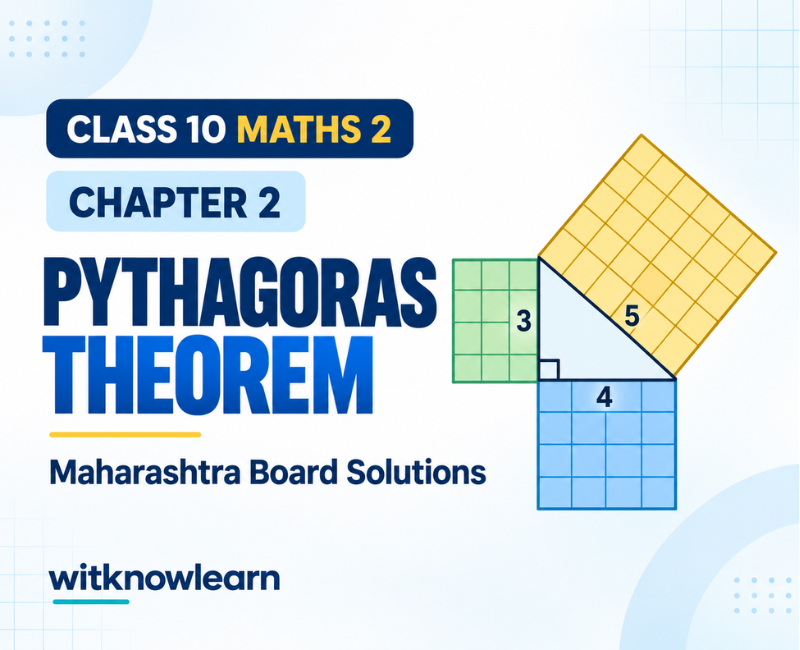
Pythagoras Theorem explains the relationship between the three sides of a right-angled triangle. It helps students calculate an unknown side, identify whether a triangle is right angled and solve practical problems involving lengths, heights and diagonals.
Pythagoras Theorem
Learn the relationship between the hypotenuse and the two sides forming the right angle.
Converse Theorem
Check whether three given side lengths form a right-angled triangle.
Applications
Solve questions involving diagonals, heights, distances and special right triangles.
Hypotenuse² = Base² + Perpendicular²
AC² = AB² + BC²
Important Concepts Covered
- Right-angled triangles
- Identification of the hypotenuse
- Pythagoras Theorem
- Converse of Pythagoras Theorem
- Pythagorean triplets
- Finding an unknown side
- Geometric mean theorem
- Median drawn to the hypotenuse
- Special right-angled triangles
- Practical applications of the theorem
Practice Set 2.1 Solutions
Practice Set 2.1 contains questions based on Pythagoras Theorem and its converse. Students learn to identify right-angled triangles and calculate missing side lengths.
How to Check Whether a Triangle Is Right Angled
c² = a² + b²
then the triangle is right angled.
Example Using the 3, 4, 5 Triplet
3² = 9
4² = 16
3² + 4² = 9 + 16
3² + 4² = 25
Therefore, 5² = 3² + 4².
Hence, the triangle is right angled.
Practice Set 2.2 Solutions
Practice Set 2.2 develops the chapter through properties of right-angled triangles, geometric mean relationships and application-based questions.
Geometric Mean Theorem
When a perpendicular is drawn from the right-angle vertex to the hypotenuse, the square of the perpendicular is equal to the product of the two segments formed on the hypotenuse.
BD² = AD × DC
BC² = AC × DC
How to Solve Geometric Mean Questions
Median Drawn to the Hypotenuse
In a right-angled triangle, the midpoint of the hypotenuse is equidistant from all three vertices.
BM = AM = CM = ½ AC
Special Right-Angled Triangle
Side opposite 30° = ½ × Hypotenuse
Hypotenuse = Equal side × √2
Problem Set 2 Solutions
Problem Set 2 combines the important concepts from the complete chapter. It contains questions based on Pythagoras Theorem, its converse, Pythagorean triplets, geometric mean, special right triangles and practical applications.
How to Write the Solution Step by Step
- Selecting the wrong side as the hypotenuse
- Using the theorem without establishing a right angle
- Forgetting to square one of the side lengths
- Adding when subtraction is required
- Making an error while taking the square root
- Writing several calculation steps on the same line
- Writing the final answer without a unit
Frequently Asked Questions
1. What is Pythagoras Theorem?
Pythagoras Theorem states that in a right-angled triangle, the square of the hypotenuse is equal to the sum of the squares of the other two sides.
2. What is the formula for Pythagoras Theorem?
The formula is Hypotenuse² = Base² + Perpendicular². It can also be written as c² = a² + b², where c is the hypotenuse.
3. How do I identify the hypotenuse?
Locate the right angle first. The side directly opposite the right angle is the hypotenuse. It is also the longest side of the right-angled triangle.
4. What is the converse of Pythagoras Theorem?
If the square of the longest side equals the sum of the squares of the other two sides, then the triangle is right angled.
5. What is a Pythagorean triplet?
A Pythagorean triplet is a set of three positive integers satisfying a² + b² = c². Examples include 3, 4, 5 and 5, 12, 13.
6. Can Pythagoras Theorem be used for every triangle?
No. The theorem can be applied directly only to a right-angled triangle. A right angle must be given or proved before using it.
7. What is the geometric mean theorem?
When a perpendicular is drawn from the right-angle vertex to the hypotenuse, the square of that perpendicular equals the product of the two segments formed on the hypotenuse.
8. Which questions are important for the SSC examination?
Students should practise theorem proofs, converse theorem questions, Pythagorean triplets, unknown-side problems, geometric mean questions and practical applications.
9. What mistakes should students avoid?
Avoid selecting the wrong hypotenuse, missing square symbols, using an incorrect operation and forgetting to take the square root in the final step.
10. Are all Chapter 2 textbook exercises covered?
Yes. The solutions cover Practice Set 2.1, Practice Set 2.2 and Problem Set 2 in the correct Maharashtra Board textbook order.
11. How should students use these solutions?
First solve the question independently. Then compare every step with the provided answer, correct your mistakes and solve the question again without looking at the solution.
Prepare Chapter 2 with Confidence
Use these Maharashtra Board Class 10 Maths 2 Pythagoras Theorem solutions to understand the correct method, revise important properties and improve your answer presentation. Regular practice will help you solve theorem-based and numerical questions accurately.
 Download