Class 9 Coordinates Solutions with Online Practice Sums
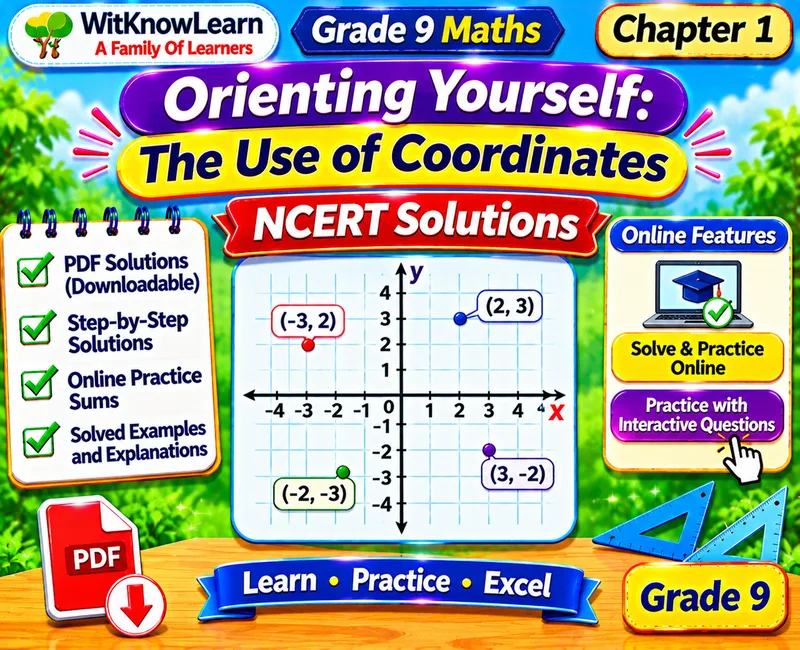
Step by step solutions for all 29 questions of the Ganita Manjari Chapter 1 worksheet: Orienting Yourself, the Use of Coordinates. Try each question first, check your answer online, then reveal the solution one step at a time. Finish with the formula sheet and a 40 mark test.
Chapter 1 worksheet with online quiz and games →
Mistake spotter
Each solution has one wrong line. Tap it.One-page formula sheet
Everything from Chapter 1 for last-minute revisionPractice test paper: 40 marks, 90 minutes
CBSE style. Section A is checked for you. Write Sections B to D on paper, then open the solutions and tick the marks you earned.Practise this chapter and more
📍 Chapter 1 worksheet: Coordinates with online quiz and games
More NCERT Ganita Manjari Class 9 Maths worksheets:
NCERT Class 9 Math Chapter 1: Coordinates, Solutions and Extra Sums
NCERT Class 9 math chapter 1 is Orienting Yourself: The Use of Coordinates, the opening chapter of the new Ganita Manjari textbook. This page gives NCERT Class 9 math chapter 1 solutions for all 29 worksheet questions, written step by step in the way CBSE examiners expect. Every answer shows the formula, the substitution, the simplification and a clear final statement, so you can see exactly where each mark is earned.
The chapter covers the coordinate plane, quadrants, distance from the axes, the distance formula, the midpoint formula, reflections in the axes, collinear points and proving the shape of a quadrilateral from its vertices.
What makes these NCERT Class 9 math chapter 1 solutions different is that you practise online instead of just reading. Try each question first, type your answer and check it instantly. If you are stuck, reveal the solution one step at a time. Each solution has a Where students go wrong note, and the longer questions have a CBSE marks checklist so you can score your own written answer honestly.
Looking for NCERT Class 9 math chapter 1 extra sums? The page includes higher-level questions marked HOTS, assertion and reason questions, a case study on a floor plan, and mistake spotter exercises where you find the one wrong line in a worked solution. A one-page formula sheet gives quick revision of every formula in the chapter, and a full 90 minute, 40 mark practice test paper lets you check your preparation under exam conditions. Section A is marked for you, and the rest comes with a marking scheme.
These extra sums for Class 9 coordinates go beyond the textbook. You will meet parameter problems such as finding k from a given distance, locus problems such as a point equidistant from two points, and construction problems such as finding the fourth vertex of a parallelogram or the vertices of a triangle from its midpoints.
How to use this page: read the question, attempt it on paper, check your answer online, then open the steps and compare your method. Finish by taking the practice test. The page works on phones, tablets and computers, so you can revise anywhere. Use the links at the bottom to open the matching WitKnowLearn worksheet and the other Class 9 maths chapters.
Coordinates Class 9 questions students ask
How do I find the distance between two points?
Use the distance formula: the distance between (x1, y1) and (x2, y2) is the square root of (x2 - x1)^2 + (y2 - y1)^2. For (0, 0) and (3, 4) it is 5.
How do I find the midpoint of a segment?
Average the coordinates: the midpoint of (x1, y1) and (x2, y2) is ((x1 + x2)/2, (y1 + y2)/2). The midpoint of (4, 7) and (16, -2) is (10, 2.5).
How can I check if three points are collinear without plotting?
Find the three distances. If the two shorter distances add up to the longest, the points lie on one straight line. For A(-1, -1), B(2, 3) and C(8, 11): 5 + 10 = 15.
Which quadrant is a point in?
Look at the signs: (+, +) is Quadrant I, (-, +) is Quadrant II, (-, -) is Quadrant III and (+, -) is Quadrant IV.
How do the diagonals help to prove a quadrilateral is a parallelogram or a square?
If the diagonals bisect each other, it is a parallelogram. A parallelogram with equal diagonals and equal adjacent sides is a square.
WitKnowLearn: worksheets, notes and solutions for NCERT and CBSE. Solutions follow the Class 9 Maths Ganita Manjari Chapter 1 worksheet.
 Download