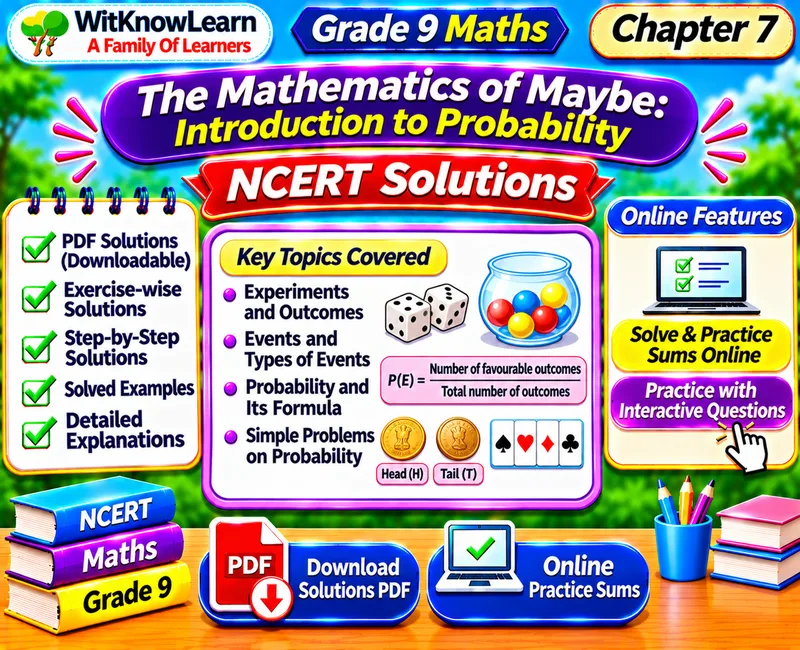
Class 9 Probability Solutions with Online Practice Sums
Step by step solutions for all 29 questions of the Ganita Manjari Chapter 7 worksheet: The Mathematics of Maybe, Introduction to Probability. Try each question first, check your answer online, then reveal the solution one step at a time. Finish with the formula sheet, the simulation lab and a 40 mark test.
Chapter 7 worksheet with online quiz and games →
Mistake spotter
Each solution has one wrong line. Tap it.Construction lab
Do the construction yourself with the online ruler and compassAlgebra tiles lab
Build the rectangles yourself with online tilesExplore lab
Move the sliders and watch the numbers and the picture changeOne-page formula sheet
Everything from Chapter 7 for last-minute revisionPractice test paper: 40 marks, 90 minutes
CBSE style. Section A is checked for you. Write Sections B to D on paper, then open the solutions and tick the marks you earned.Practise this chapter and more
📍 Chapter 7 worksheet: Probability with online quiz and games
More NCERT Ganita Manjari Class 9 Maths worksheets:
NCERT Class 9 Math Chapter 7: Probability, Solutions and Extra Sums
NCERT Class 9 math chapter 7 is The Mathematics of Maybe: Introduction to Probability, the seventh chapter of the new Ganita Manjari textbook. This page gives NCERT Class 9 math chapter 7 solutions for all 29 worksheet questions, written step by step in a clean exam style. Each answer lists the sample space, counts the favourable outcomes and ends with a clear result.
The chapter covers random experiments, sample space, events, equally likely outcomes, theoretical probability, experimental probability and relative frequency, probability of coins, dice and spinners, drawing balls with and without replacement, and estimating from a sample.
What makes these NCERT Class 9 math chapter 7 solutions different is that you practise online. Try each question first, type your answer as a fraction or a decimal and check it instantly. If you are stuck, reveal the solution one step at a time, then read where students go wrong. For two, three and four mark questions a marks checklist shows how a CBSE examiner awards marks.
The online Simulation Lab lets you run the experiments yourself. You roll a die thousands of times, roll two dice and add, draw balls without replacement and toss three coins. Bars show the results so far against the theoretical probability, so you see the experimental value settle near it.
Looking for NCERT Class 9 math chapter 7 extra sums? You get higher-level HOTS questions, assertion and reason questions and a school club survey case study. You will find probabilities for two dice, compare drawing with and without replacement and estimate numbers from a sample. Mistake spotters ask you to find the wrong line in a worked solution.
How to use this page: read the question, attempt it on paper, check your answer online, then open the steps and compare. Finish with the practice test. The page works on phones, tablets and computers. Take the free 90 minute test of 40 marks and get your total score out of 40.
Probability Class 9 questions students ask
What is the difference between theoretical and experimental probability?
Theoretical probability is the number of favourable outcomes divided by the number of equally likely outcomes. Experimental probability is found from trials: the number of times the event happened divided by the number of trials. With many trials the two get close.
How do I find the probability of at least one head?
Use the complement. P(at least one head) = 1 - P(no head). For two coins P(no head) = 1/4, so the answer is 3/4.
How many outcomes are there when two dice are rolled?
There are 6 x 6 = 36 outcomes. A sum of 7 can happen in 6 ways, so its probability is 6/36 = 1/6.
What is the difference between drawing with and without replacement?
With replacement the ball goes back, so the second draw has the same number of balls. Without replacement the second draw has one ball fewer, so the second fraction changes. For 4 red and 5 blue balls, P(both blue) without replacement is 5/9 x 4/8 = 5/18.
Can the probability of an event be more than 1?
No. A probability always lies between 0 and 1. An impossible event has probability 0 and a certain event has probability 1.
WitKnowLearn: worksheets, notes and solutions for NCERT and CBSE. Solutions follow the Class 9 Maths Ganita Manjari Chapter 7 worksheet.
 Download