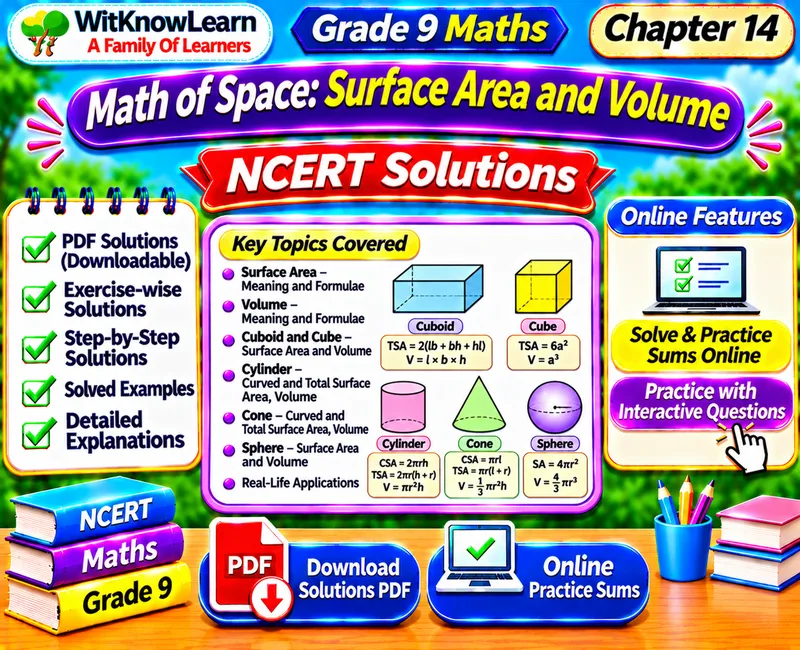
Class 9 Surface Area and Volume Solutions Online Practice
Step by step solutions for all 29 questions of the Ganita Manjari Chapter 14 worksheet: Math of Space, Surface Area and Volume. Try each question first, check your answer online, then reveal the solution one step at a time. Finish with the formula sheet, the explore labs and a 40 mark test.
Chapter 14 worksheet with online quiz and games →
Mistake spotter
Each solution has one wrong line. Tap it.Construction lab
Do the construction yourself with the online ruler and compassAlgebra tiles lab
Build the rectangles yourself with online tilesExplore lab
Move the sliders and watch the numbers and the picture changeOne-page formula sheet
Everything from Chapter 14 for last-minute revisionPractice test paper: 40 marks, 90 minutes
CBSE style. Section A is checked for you. Write Sections B to D on paper, then open the solutions and tick the marks you earned.Practise this chapter and more
📍 Chapter 14 worksheet: Surface Area and Volume with online quiz and games
More NCERT Ganita Manjari Class 9 Maths worksheets:
NCERT Class 9 Math Chapter 14: Surface Area and Volume, Solutions and Extra Sums
NCERT Class 9 math chapter 14 is Math of Space: Surface Area and Volume, the last chapter of the new Ganita Manjari textbook. This page gives NCERT Class 9 math chapter 14 solutions for all 29 worksheet questions, written step by step in a clean exam style. Every answer shows the formula, the substitution and the unit.
The chapter covers the surface area and volume of cubes and cuboids, cylinders, cones, spheres and hemispheres, pyramids, how cutting a solid changes its surface area, scaling a radius, melting and recasting solids, packing cubes and spheres in boxes, solids made by rotating a triangle, and word problems on tanks, glasses and milk or juice for a school.
What makes these NCERT Class 9 math chapter 14 solutions different is that you practise online. Try each question first, type your answer and check it at once. If you are stuck, reveal the solution one step at a time, then read where students go wrong. For two, three and four mark questions a marks checklist shows how a CBSE examiner awards marks.
The Explore Labs let you cut a painted cube and count the faces, compare a cone, cylinder and sphere with sliders, change a radius by a percentage, test the string around a planet and drop marbles for the thirsty crow. You see why volume grows with the cube and area with the square.
Looking for NCERT Class 9 math chapter 14 extra sums? You get higher-level HOTS questions, assertion and reason questions, painted cube counts, melting and recasting, a cone from a rotating triangle and a juice case study. Mistake spotters ask you to find the wrong line in a worked solution.
How to use this page: read the question, attempt it on paper, check your answer online, then open the steps and compare. Finish with the practice test. The page works on phones, tablets and computers. Take the free 90 minute test of 40 marks and get your total score out of 40.
Surface Area and Volume Class 9 questions students ask
What are the formulas for the volume and surface area of a cone, cylinder and sphere?
Cylinder: volume pi r squared h, curved surface area 2 pi r h. Cone: volume one third pi r squared h, curved surface area pi r l. Sphere: volume four thirds pi r cubed, surface area 4 pi r squared.
How is the volume of a cone related to a cylinder?
A cone has exactly one third of the volume of a cylinder with the same base and height. A sphere has two thirds of the volume of the cylinder that just encloses it.
What happens to surface area and volume when lengths are scaled?
If every length is multiplied by k, the surface area is multiplied by k squared and the volume by k cubed. A 10 percent increase in radius raises the volume of a sphere by 33.1 percent.
How do I solve melting and recasting problems?
The volume does not change. Divide the volume of the big solid by the volume of one small piece and take only the complete pieces. Use consistent units.
How many painted faces do the small cubes of a cut cube have?
For a cube cut into n parts along each edge, 8 cubes have three painted faces, 12 times (n minus 2) have two, 6 times (n minus 2) squared have one, and (n minus 2) cubed have none.
WitKnowLearn: worksheets, notes and solutions for NCERT and CBSE. Solutions follow the Class 9 Maths Ganita Manjari Chapter 14 worksheet.
 Download