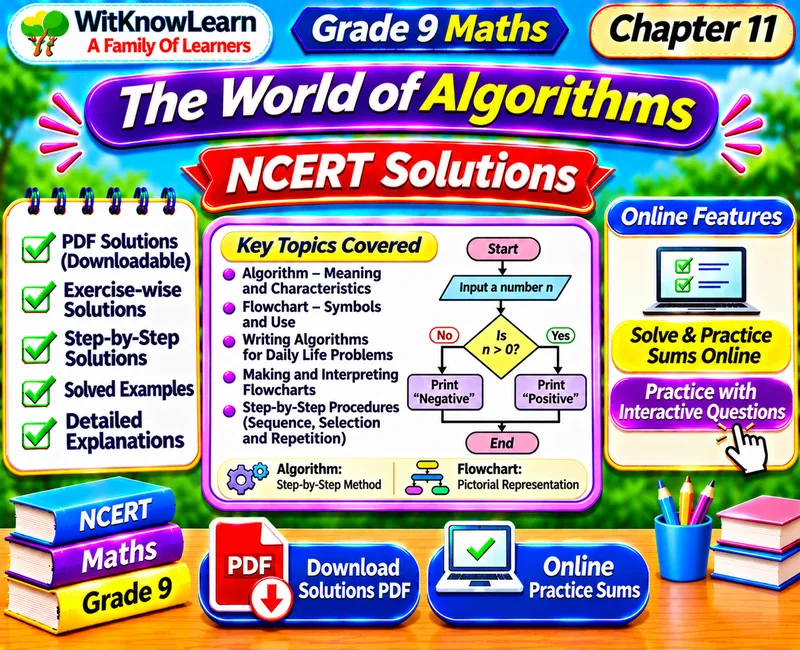
Class 9 Algorithms Solutions with Online Practice Sums
Step by step solutions for all 29 questions of the Ganita Manjari Chapter 11 worksheet: The World of Algorithms. Try each question first, check your answer online, then reveal the solution one step at a time. Finish with the formula sheet, the algorithm labs and a 40 mark test.
Chapter 11 worksheet with online quiz and games →
Mistake spotter
Each solution has one wrong line. Tap it.Construction lab
Do the construction yourself with the online ruler and compassAlgebra tiles lab
Build the rectangles yourself with online tilesExplore lab
Move the sliders and watch the numbers and the picture changeOne-page formula sheet
Everything from Chapter 11 for last-minute revisionPractice test paper: 40 marks, 90 minutes
CBSE style. Section A is checked for you. Write Sections B to D on paper, then open the solutions and tick the marks you earned.Practise this chapter and more
📍 Chapter 11 worksheet: Algorithms with online quiz and games
More NCERT Ganita Manjari Class 9 Maths worksheets:
NCERT Class 9 Math Chapter 11: The World of Algorithms, Solutions and Extra Sums
NCERT Class 9 math chapter 11 is The World of Algorithms, the eleventh chapter of the new Ganita Manjari textbook. This page gives NCERT Class 9 math chapter 11 solutions for all 29 worksheet questions, written step by step in a clean exam style. Every answer shows each division, each remainder and the reason behind the rule.
The chapter covers what an algorithm is, column addition with carries, the divisors algorithm, listing divisors in pairs up to the square root, the prime test, the first gcd algorithm, Euclid's subtraction rule, Euclid's long division rule gcd(m, n) = gcd(n, m mod n), finding the lcm, and how the time taken grows for different methods.
What makes these NCERT Class 9 math chapter 11 solutions different is that you practise online. Try each question first, type your answer and check it at once. If you are stuck, reveal the solution one step at a time, then read where students go wrong. For two, three and four mark questions a marks checklist shows how a CBSE examiner awards marks.
The Explore Labs let you run the algorithms yourself. A stepper writes every division of Euclid's method, a timer compares counting dots with column addition, a floor lets you try tile sizes, a picture shows Euclid's method with squares, and a divisor pair tool shows why the square root is enough.
Looking for NCERT Class 9 math chapter 11 extra sums? You get higher-level HOTS questions, assertion and reason questions, mod and calendar sums, a proof question and a tiling case study. Mistake spotters ask you to find the wrong line in a worked solution, such as giving the quotient for mod or the lcm for the tile size.
How to use this page: read the question, attempt it on paper, check your answer online, then open the steps and compare. Finish with the practice test. The page works on phones, tablets and computers. Take the free 90 minute test of 40 marks and get your total score out of 40.
The World of Algorithms Class 9 questions students ask
What is an algorithm?
An algorithm is a precise step-by-step procedure, built from basic steps we already know, that solves a whole class of problems. Column addition, finding the gcd and testing for primes are all algorithms.
What is Euclid's algorithm for the gcd?
Replace gcd(m, n) by gcd(n, m mod n) again and again until the second number is 0. The last non-zero remainder is the gcd. For example gcd(1260, 198) = 18 after 4 divisions.
What does m mod n mean?
m mod n is the remainder when m is divided by n. If m = qn + r with r less than n, then m mod n = r. For example 250 mod 12 = 10.
Why do we test divisors only up to the square root?
Divisors come in pairs d and n divided by d, and one number in every pair is at most the square root of n. Testing 1 up to the square root finds every pair.
Why is Euclid's method faster than checking every number?
Checking every number from 1 to min(m, n) does work that grows with the size of the numbers. Euclid's method needs work that grows with the number of digits, so it stays fast for huge numbers.
WitKnowLearn: worksheets, notes and solutions for NCERT and CBSE. Solutions follow the Class 9 Maths Ganita Manjari Chapter 11 worksheet.
 Download