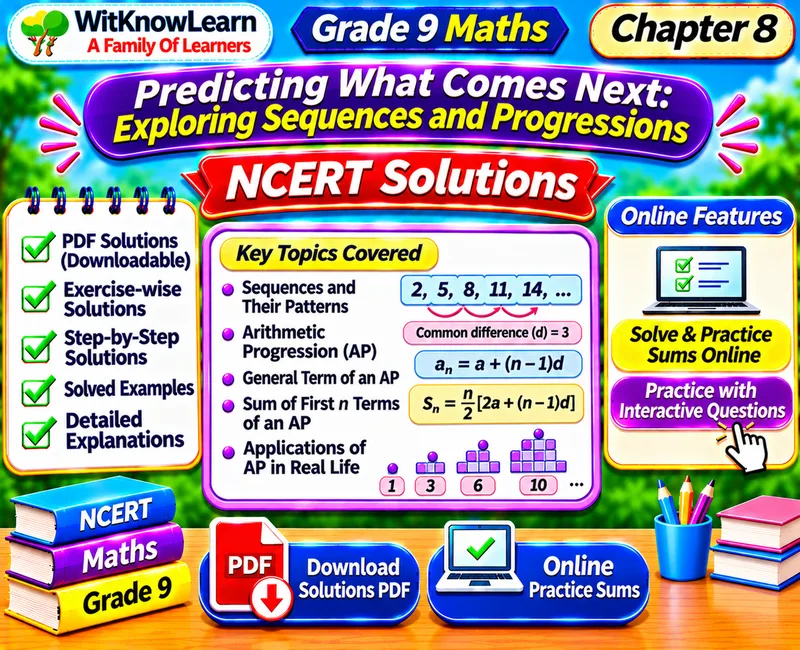
Class 9 Sequences and Progressions Solutions Online Practice
Step by step solutions for all 29 questions of the Ganita Manjari Chapter 8 worksheet: Predicting What Comes Next, Sequences and Progressions. Try each question first, check your answer online, then reveal the solution one step at a time. Finish with the formula sheet, the explore lab and a 40 mark test.
Chapter 8 worksheet with online quiz and games →
Mistake spotter
Each solution has one wrong line. Tap it.Construction lab
Do the construction yourself with the online ruler and compassAlgebra tiles lab
Build the rectangles yourself with online tilesExplore lab
Move the sliders and watch the numbers and the picture changeOne-page formula sheet
Everything from Chapter 8 for last-minute revisionPractice test paper: 40 marks, 90 minutes
CBSE style. Section A is checked for you. Write Sections B to D on paper, then open the solutions and tick the marks you earned.Practise this chapter and more
📍 Chapter 8 worksheet: Sequences and Progressions with online quiz and games
More NCERT Ganita Manjari Class 9 Maths worksheets:
NCERT Class 9 Math Chapter 8: Sequences and Progressions, Solutions and Extra Sums
NCERT Class 9 math chapter 8 is Predicting What Comes Next: Sequences and Progressions, the eighth chapter of the new Ganita Manjari textbook. This page gives NCERT Class 9 math chapter 8 solutions for all 29 worksheet questions, written step by step in a clean exam style. Each answer names the formula, shows the substitution and ends with a clear result.
The chapter covers sequences with explicit and recursive rules, arithmetic progressions, geometric progressions, the n-th term formulas, the sum of the first n natural numbers, triangular numbers, deciding whether a number is a term, and patterns such as the Sierpinski triangle and carpet.
What makes these NCERT Class 9 math chapter 8 solutions different is that you practise online. Try each question first, type your answer and check it instantly. If you are stuck, reveal the solution one step at a time, then read where students go wrong. For two, three and four mark questions a marks checklist shows how a CBSE examiner awards marks.
The online Explore Lab lets you move sliders and see the pattern at once. You build an AP and a GP and read any term, watch a bouncing ball whose heights form a GP, and open the Sierpinski carpet stage by stage to see the number of squares grow while the red area shrinks.
Looking for NCERT Class 9 math chapter 8 extra sums? You get higher-level HOTS questions, assertion and reason questions and a Sierpinski carpet case study. You will find an AP from two given terms, count multiples in a range, find the smallest n for a sum and find both GPs that meet two conditions. Mistake spotters ask you to find the wrong line in a worked solution.
How to use this page: read the question, attempt it on paper, check your answer online, then open the steps and compare. Finish with the practice test. The page works on phones, tablets and computers. Take the free 90 minute test of 40 marks and get your total score out of 40.
Sequences and Progressions Class 9 questions students ask
What is the formula for the n-th term of an AP?
t_n = a + (n - 1)d, where a is the first term and d is the common difference. For the AP 3, 8, 13, ... the 10th term is 3 + 9 x 5 = 48.
How do I find the n-th term of a GP?
t_n = a x r^(n - 1), where r is the common ratio. For 5, 25, 125, ... the n-th term is 5^n.
How do I check whether a number is a term of a sequence?
Put the rule equal to the number and solve for n. The number is a term only if n is a positive whole number. For t_n = 5n - 3, the number 172 gives n = 35, so it is a term.
What is the sum of the first n natural numbers?
It is n(n + 1)/2. For n = 100 the sum is 5050. To add a block like 31 to 70, subtract the sum up to 30 from the sum up to 70.
What is the difference between an explicit rule and a recursive rule?
An explicit rule gives t_n directly from n, such as t_n = 3n - 4. A recursive rule gives the first term and says how each term comes from the one before, such as t_1 = 3 and t_n = 10 x t_(n-1).
WitKnowLearn: worksheets, notes and solutions for NCERT and CBSE. Solutions follow the Class 9 Maths Ganita Manjari Chapter 8 worksheet.
 Download