Playing with Numbers Class 6 Maths Worksheet with Quiz and Activities
In this chapter: factors, primes, HCF and LCM. Arrange squares into rows and race two frogs to find the LCM. On WitKnowLearn you get the Playing with Numbers Class 6 online quiz, online activities and interactive games, a number lab, a virtual lab and a worksheet-style practice sheet for Class 6 Maths.
Playing with Numbers Class 6 Online Quiz
Includes assertion and reason, case study and higher order thinking questions. Tap an answer and the next question comes up.
Playing with Numbers Class 6 Activities
👆 Tap a tab to switch: Learn, Games, Labs, Challenges, Virtual Lab and Practice sheet
Playing with Numbers: factors, multiples, HCF and LCM
A short read for Class 6 before you play. These notes cover Playing with Numbers: factors and multiples, prime and composite numbers, divisibility tests, HCF and LCM.
🔢 Factors and multiples
A factor divides a number exactly and a multiple is what we get by multiplying. 12 has the factors 1, 2, 3, 4, 6 and 12.
⭐ Prime and composite
A prime number has exactly two factors. 2, 3, 5 and 7 are primes. A number with more than two factors is composite and 1 is neither.
🔎 HCF and LCM
The highest common factor helps us share things equally. The lowest common multiple tells us when two repeating events meet again.
Playing with Numbers Class 6 Maths Activities
Follow every step on the Number Train. Earn up to 3 stars in every activity.
This page covers Playing with Numbers: factors and multiples, prime and composite numbers, divisibility tests, HCF and LCM for Class 6 maths. It covers factors and multiples, prime and composite numbers, divisibility tests, HCF, LCM and prime factorisation.
The activities are pitched at Class 6 level. Arrange squares in rows to find factors and race two frogs along a number line to find the LCM. Explore more Class 6 maths worksheets on WitKnowLearn after this chapter.
Key ideas and facts to know
| Number | Divisible if | Example |
|---|---|---|
| 2 | last digit is even | 348 |
| 3 | digit sum divisible by 3 | 123 |
| 5 | ends in 0 or 5 | 715 |
| 9 | digit sum divisible by 9 | 5,238 |
How to use this page
- Flip the six cards and try the Number Lab in the Learn tab.
- Play the five games and do the hands-on labs, where you drag and move things, to see each idea at work.
- Finish the five challenges to collect up to 15 points.
- Do two virtual experiments and jump along a number line in the studio.
- Take the online quiz, with assertion and reason and case study questions, and fill in the practice sheet.
Worked examples
Factors of 12: 1, 2, 3, 4, 6, 12. Factors of 18: 1, 2, 3, 6, 9, 18. The HCF is 6.
Multiples of 4: 4, 8, 12. 12 is also a multiple of 6 so the LCM is 12.
This Playing with Numbers worksheet for Class 6 maths gives you online activities and interactive games that make the chapter clear. Every activity has a goal, a hint and a short fact, so students learn while they enjoy.
Complete Guide: Class 6 Maths Playing with Numbers
This guide is for Class 6 students, parents and teachers. It covers Playing with Numbers: factors and multiples, prime and composite numbers, divisibility tests, HCF and LCM for Class 6 maths and shows how to use the quiz, labs and games on this page.
Introduction to Playing with Numbers
Factors and multiples help us share, group and schedule. This chapter builds primes, divisibility tests, HCF and LCM.
What is there in this chapter
- Factors and multiples
- Prime and composite numbers
- Tests for divisibility
- Common factors and multiples
- Prime factorisation
- HCF and LCM
Learning objectives
- Find factors and multiples.
- Identify prime and composite numbers.
- Use divisibility tests.
- Find the HCF and LCM.
- Reason with assertions and case studies.
Learning outcomes
- I can find the HCF and LCM.
- I can test divisibility.
- I can write prime factors.
Playing with Numbers Class 6 resources on this page
| Resource | What it gives |
|---|---|
| Online quiz | Assertion and reason, case study and higher order thinking questions with a full review |
| Flip cards | 6 picture cards with one-line rules |
| Number Lab | A hands-on lab with 3 rounds |
| Games | 5 interactive games |
| Labs | Interactive labs where you drag, move and watch what happens |
| Virtual Lab | 2 experiments plus a studio that jumps by 4 on a number line |
| Challenges | 5 challenges, 15 points in all |
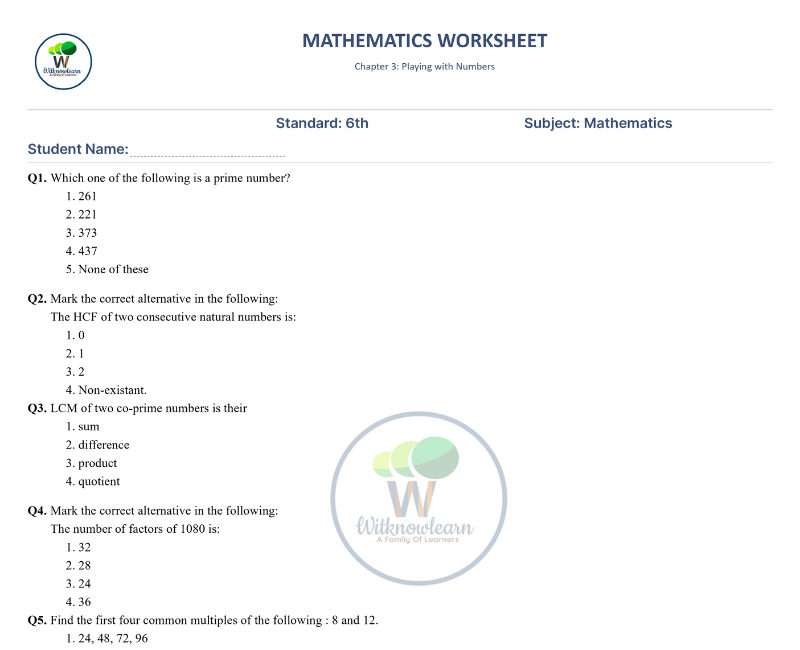
| Practice sheet | A worksheet-style sheet with 16 questions, name and date lines and a live score |
Key facts
| Idea | Rule |
|---|---|
| Smallest prime | 2 |
| Number 1 | neither prime nor composite |
| Co-prime | HCF is 1 |
| LCM | multiple of every number |
Types of questions you may see
- Factors and multiples
- Prime and composite
- HCF and LCM word problems
- Divisibility tests
Solved examples
5 + 2 + 3 + 8 = 18, a multiple of 9, so yes.
The LCM of 12 and 15 is 60, so after 60 minutes.
Common mistakes
| Mistake | Correct idea |
|---|---|
| Calling 1 a prime number | 1 has only one factor |
| Mixing up HCF and LCM | HCF is a factor and LCM is a multiple |
| Saying all odd numbers are prime | 9 and 15 are odd but composite |
Playing with Numbers in daily life
HCF helps share items equally and LCM helps with timetables, bell timings and traffic lights.
Tips for parents and teachers
- Ask your child to find factor pairs of the date.
- Use arrays of buttons to show factors.
- Practise one assertion and one case study each week.
Playing with Numbers Class 6 FAQs
What are factors of a number?
Numbers that divide it exactly, such as 1, 2, 3, 4, 6 and 12 for 12.
What is a prime number?
A number with exactly two factors, 1 and itself.
What is a composite number?
A number with more than two factors.
Is 1 prime or composite?
Neither. It has only one factor.
What is the only even prime number?
It is 2.
What are co-prime numbers?
Numbers whose only common factor is 1, like 8 and 15.
How do you find the HCF?
List the factors of the numbers and pick the greatest common one.
How do you find the LCM?
List the multiples and pick the smallest common one.
What is the divisibility rule for 9?
A number is divisible by 9 if the sum of its digits is divisible by 9.
What is the divisibility rule for 3?
A number is divisible by 3 if the sum of its digits is divisible by 3.
What is prime factorisation?
Writing a number as a product of primes, such as 60 = 2 × 2 × 3 × 5.
What is the relation between HCF and LCM?
The HCF is a factor of both numbers and the LCM is a multiple of both.
What topics are in Class 6 Maths Playing with Numbers?
It covers factors, multiples, primes, divisibility, HCF and LCM.
What can students do on this page?
Students can take an online quiz with assertion and reason and case study questions, play five games, try five online activities, finish five challenges, run the Number Lab, do two virtual experiments, jump by 4 on a number line in the studio,, and fill in a 16-question practice sheet with a Show answers button.
 Download