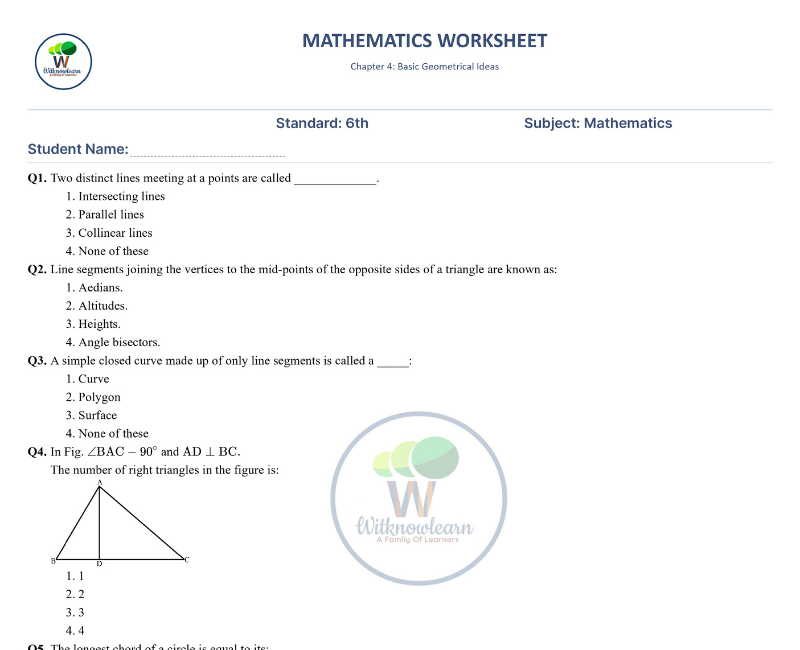
Basic Geometrical Ideas Class 6 Maths Worksheet with Quiz and Activities
In this chapter: points, lines, rays, polygons and circles. Drag points to make figures and see the parts of a circle. On WitKnowLearn you get the Basic Geometrical Ideas Class 6 online quiz, online activities and interactive games, a geometry lab, a virtual lab and a worksheet-style practice sheet for Class 6 Maths.
Basic Geometrical Ideas Class 6 Online Quiz
Includes assertion and reason, case study and higher order thinking questions. Tap an answer and the next question comes up.
Basic Geometrical Ideas Class 6 Activities
👆 Tap a tab to switch: Learn, Games, Labs, Challenges, Virtual Lab and Practice sheet
Basic Geometrical Ideas: points, lines and shapes
A short read for Class 6 before you play. These notes cover Basic Geometrical Ideas: points, line segments, rays, lines, curves, polygons, angles, triangles, quadrilaterals and circles.
📏 Points, lines and rays
A point marks a position. A line segment joins two points, a ray starts at one point and goes on forever and a line has no end points.
⬠ Curves and polygons
Curves can be open or closed. A polygon is a closed figure made of line segments, like a triangle with 3 sides or a quadrilateral with 4 sides.
⭕ The circle
A circle has a centre, a radius, a diameter, chords and arcs. The diameter is twice the radius and is the longest chord.
Basic Geometrical Ideas Class 6 Maths Activities
Follow every step on the Number Train. Earn up to 3 stars in every activity.
This page covers Basic Geometrical Ideas: points, line segments, rays, lines, curves, polygons, angles, triangles, quadrilaterals and circles for Class 6 maths. It covers points, line segments, rays and lines, curves, polygons, angles, triangles, quadrilaterals and the parts of a circle.
The activities are pitched at Class 6 level. Drag points to make a segment, ray and line and drag points on a circle to make chords and diameters. Explore more Class 6 maths worksheets on WitKnowLearn after this chapter.
Key ideas and facts to know
| Figure | End points | Example |
|---|---|---|
| Line segment | 2 | edge of a ruler |
| Ray | 1 | beam of a torch |
| Line | 0 | a never ending road |
| Circle | none (closed) | a wheel |
How to use this page
- Flip the six cards and try the Geometry Lab in the Learn tab.
- Play the five games and do the hands-on labs, where you drag and move things, to see each idea at work.
- Finish the five challenges to collect up to 15 points.
- Do two virtual experiments and join points in the studio.
- Take the online quiz, with assertion and reason and case study questions, and fill in the practice sheet.
Worked examples
2 × 7 = 14 cm.
AB, AC, AD, BC, BD and CD make 6.
This Basic Geometrical Ideas worksheet for Class 6 maths gives you online activities and interactive games that make the chapter clear. Every activity has a goal, a hint and a short fact, so students learn while they enjoy.
Complete Guide: Class 6 Maths Basic Geometrical Ideas
This guide is for Class 6 students, parents and teachers. It covers Basic Geometrical Ideas: points, line segments, rays, lines, curves, polygons, angles, triangles, quadrilaterals and circles for Class 6 maths and shows how to use the quiz, labs and games on this page.
Introduction to Basic Geometrical Ideas
Geometry begins with simple ideas like points and lines. This chapter builds the vocabulary used for every shape you will meet next.
What is there in this chapter
- Points
- Line segment, ray and line
- Curves
- Polygons
- Angles
- Triangles and quadrilaterals
- Circles
Learning objectives
- Tell a segment, ray and line apart.
- Name polygons.
- Identify parts of a circle.
- Use the vocabulary of geometry.
- Reason with assertions and case studies.
Learning outcomes
- I can name basic figures.
- I can label parts of a circle.
- I can count sides and vertices.
Basic Geometrical Ideas Class 6 resources on this page
| Resource | What it gives |
|---|---|
| Online quiz | Assertion and reason, case study and higher order thinking questions with a full review |
| Flip cards | 6 picture cards with one-line rules |
| Geometry Lab | A hands-on lab with 3 rounds |
| Games | 5 interactive games |
| Labs | Interactive labs where you drag, move and watch what happens |
| Virtual Lab | 2 experiments plus a studio that counts segments between points |
| Challenges | 5 challenges, 15 points in all |
| Practice sheet | A worksheet-style sheet with 16 questions, name and date lines and a live score |
Key facts
| Idea | Rule |
|---|---|
| Segment | 2 end points |
| Ray | 1 end point |
| Diameter | 2 × radius |
| Quadrilateral | 4 sides |
Types of questions you may see
- Segment, ray and line
- Open and closed curves
- Polygons
- Parts of a circle
Solved examples
Diameter = 2 × 7 = 14 cm.
It is a pentagon.
Common mistakes
| Mistake | Correct idea |
|---|---|
| Saying a ray has two end points | A ray has one |
| Calling a chord a diameter | A diameter passes through the centre |
| Mixing up radius and diameter | Diameter is twice the radius |
Basic Geometrical Ideas in daily life
Rulers show segments, torch beams show rays, wheels show circles and windows show quadrilaterals.
Tips for parents and teachers
- Ask your child to find circles and polygons at home.
- Use a string and pencil to draw circles.
- Practise one assertion and one case study each week.
Basic Geometrical Ideas Class 6 FAQs
What is a line segment?
A straight path between two points with two end points.
What is a ray?
A straight path that starts at one point and goes on forever in one direction.
What is a line?
A straight path that goes on forever in both directions.
What is a polygon?
A closed figure made only of line segments.
What is a closed curve?
A curve that starts and ends at the same point, like a circle.
What is the radius of a circle?
The distance from the centre to any point on the circle.
What is the diameter of a circle?
A chord through the centre. It is twice the radius.
What is a chord?
A line segment joining two points on a circle.
What is an arc?
A part of a circle between two points.
What is a vertex?
The corner where two sides or rays meet.
How many diagonals does a quadrilateral have?
It has 2 diagonals.
What are collinear points?
Points that lie on the same straight line.
What topics are in Class 6 Maths Basic Geometrical Ideas?
It covers points, lines, curves, polygons, angles, triangles, quadrilaterals and circles.
What can students do on this page?
Students can take an online quiz with assertion and reason and case study questions, play five games, try five online activities, finish five challenges, run the Geometry Lab, do two virtual experiments, join points and count the segments in the studio,, and fill in a 16-question practice sheet with a Show answers button.
 Download