
Lines and Angles Class 6 Maths Worksheet with Quiz and Activities
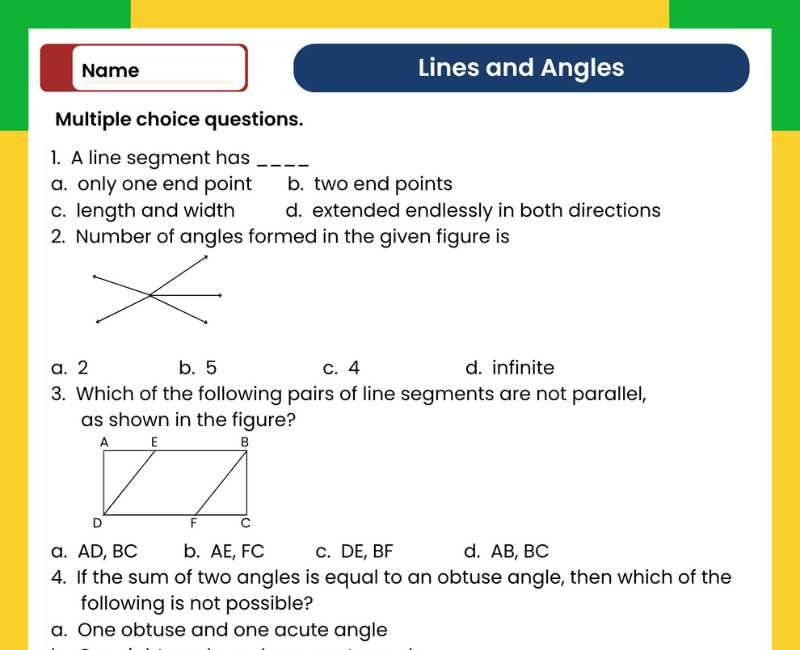
In this chapter: points, segments, lines, rays and angles measured in degrees. Turn a clock hand and move two arms to see reflex angles. On WitKnowLearn you get the Lines and Angles Class 6 online quiz, online activities and interactive games, a lines and angles lab, a virtual lab and a worksheet-style practice sheet for Class 6 Maths.
Lines and Angles Class 6 Online Quiz
Includes assertion and reason, case study and higher order thinking questions. Tap an answer and the next question comes up.
Lines and Angles Class 6 Activities
👆 Tap a tab to switch: Learn, Games, Labs, Challenges, Virtual Lab and Practice sheet
Lines and Angles: the first ideas of plane geometry
A short read for Class 6 before you play. These notes cover Lines and Angles: points, line segments, lines, rays, angles and their measures in degrees.
• Points, segments, lines and rays
A point shows a location. A line segment is the shortest path between two points. A line extends endlessly both ways and a ray starts at one point and goes on without end.
📐 Angles, vertex and arms
Two rays from a common starting point form an angle. That common point is the vertex and the rays are the arms. In the angle DBE the middle letter B names the vertex.
🔄 Measuring angles in degrees
The size of an angle is the amount of rotation about the vertex. A full turn is 360 degrees, which gives acute, right, obtuse, straight and reflex angles.
Lines and Angles Class 6 Maths Activities
Follow every step on the Number Train. Earn up to 3 stars in every activity.
This page covers Lines and Angles: points, line segments, lines, rays, angles and their measures in degrees for Class 6 maths. It covers points, line segments, lines, rays, angles with their vertex and arms, and measuring angles in degrees.
The activities are pitched at Class 6 level. Turn a clock hand to measure a rotation in degrees and move two arms to see an angle and its reflex partner. Explore more Class 6 maths worksheets on WitKnowLearn after this chapter.
Key ideas and facts to know
| Figure | End points | Can we measure it |
|---|---|---|
| Line segment | 2 | yes, its length |
| Ray | 1 starting point | no |
| Line | none | no |
How to use this page
- Flip the six cards and try the Lines and Angles Lab in the Learn tab.
- Play the five games and do the hands-on labs, where you drag and move things, to see each idea at work.
- Finish the five challenges to collect up to 15 points.
- Do two virtual experiments and a clock turn studio.
- Take the online quiz, with assertion and reason and case study questions, and fill in the practice sheet.
Worked examples
360 − 140 = 220 degrees.
Five marks of 30 degrees each, so 150 degrees.
This Lines and Angles worksheet for Class 6 maths gives you online activities and interactive games that make the chapter clear. Every activity has a goal, a hint and a short fact, so students learn while they enjoy.
Complete Guide: Class 6 Maths Lines and Angles
This guide is for Class 6 students, parents and teachers. It covers Lines and Angles: points, line segments, lines, rays, angles and their measures in degrees for Class 6 maths and shows how to use the quiz, labs and games on this page.
Introduction to Lines and Angles
This chapter of Ganita Prakash builds the first ideas of plane geometry, from a single point to angles measured in degrees.
What is there in this chapter
- Point
- Line segment and line
- Ray
- Angle with vertex and arms
- Comparing angles by rotation
- Measuring and drawing angles
Learning objectives
- Name points, segments, lines and rays correctly.
- Identify the vertex and arms of an angle.
- Measure a turn in degrees.
- Classify angles including reflex angles.
- Reason with assertions and case studies.
Learning outcomes
- I can name geometric figures.
- I can find the vertex of an angle.
- I can measure a turn in degrees.
Lines and Angles Class 6 resources on this page
| Resource | What it gives |
|---|---|
| Online quiz | Assertion and reason, case study and higher order thinking questions with a full review |
| Flip cards | 6 picture cards with one-line rules |
| Lines and Angles Lab | A hands-on lab with 3 rounds |
| Games | 5 interactive games |
| Labs | Interactive labs where you drag, move and watch what happens |
| Virtual Lab | 2 experiments plus a studio that measures clock turns in degrees |
| Challenges | 5 challenges, 15 points in all |
| Practice sheet | A worksheet-style sheet with 16 questions, name and date lines and a live score |
Key facts
| Idea | Rule |
|---|---|
| Two points | fix one line |
| Full turn | 360 degrees |
| Vertex | the middle letter |
| Reflex | more than 180 degrees |
Types of questions you may see
- Naming figures
- Vertex and arms
- Turns in degrees
- Reflex angles
Solved examples
Yes, because the starting point is still O and B is another point on the same ray.
360 ÷ 3 = 120 degrees.
Common mistakes
| Mistake | Correct idea |
|---|---|
| Writing the ray AO in place of the ray OA | The starting point comes first |
| Taking the first letter as the vertex | The middle letter is the vertex |
| Thinking longer arms make a bigger angle | Only the rotation matters |
Lines and Angles in daily life
Angles and turns appear in opening doors, clock hands, scissors, ramps and road junctions.
Tips for parents and teachers
- Ask your child to show a quarter turn and a half turn with a book cover.
- Read clock hand turns together as degrees.
- Practise one assertion and one case study each week.
Lines and Angles Class 6 FAQs
What is a point in geometry?
A point shows an exact location and has no length, breadth or height.
What is a line segment?
The shortest path between two points, including both end points.
How is a line different from a line segment?
A line goes on endlessly in both directions while a segment stops at two end points.
What is a ray?
A part of a line that starts at one point and goes on endlessly in one direction.
Is the ray AB the same as the ray BA?
No. The starting point is written first, so they are different rays.
How many lines pass through two given points?
Exactly one.
How many lines pass through one given point?
As many as we like.
What is the vertex of an angle?
The common starting point of the two arms, written as the middle letter of the name.
How is the size of an angle decided?
By the amount of rotation about the vertex, not by the length of the arms.
How many degrees are there in a full turn?
360 degrees.
What is a reflex angle?
An angle more than 180 degrees and less than 360 degrees.
How many degrees does a clock hand turn between two hour marks?
30 degrees, because 360 divided by 12 is 30.
What topics are in Class 6 Maths Lines and Angles?
It covers points, line segments, lines, rays, angles and measuring angles in degrees.
What can students do on this page?
Students can take an online quiz with assertion and reason and case study questions, play five games, try five online activities, finish five challenges, run the Lines and Angles Lab, do two virtual experiments, move a clock hand one mark at a time and add the degrees in the studio,, and fill in a 16-question practice sheet with a Show answers button.
Related Class 6 Maths Worksheets
- 🔢Patterns in Mathematics Class 6 Worksheet
- ⭐Number Play Class 6 Worksheet
- 📊Data Handling and Presentation Class 6 Worksheet
- 🔒Prime Time Class 6 Worksheet
- 🔲Perimeter and Area Class 6 Worksheet
- 🥧Fractions Class 6 Worksheet
- 🧭Playing with Constructions Class 6 Worksheet
- 🪞Symmetry Class 6 Worksheet
- 🌡The Other Side of Zero Class 6 Worksheet
 Download


