
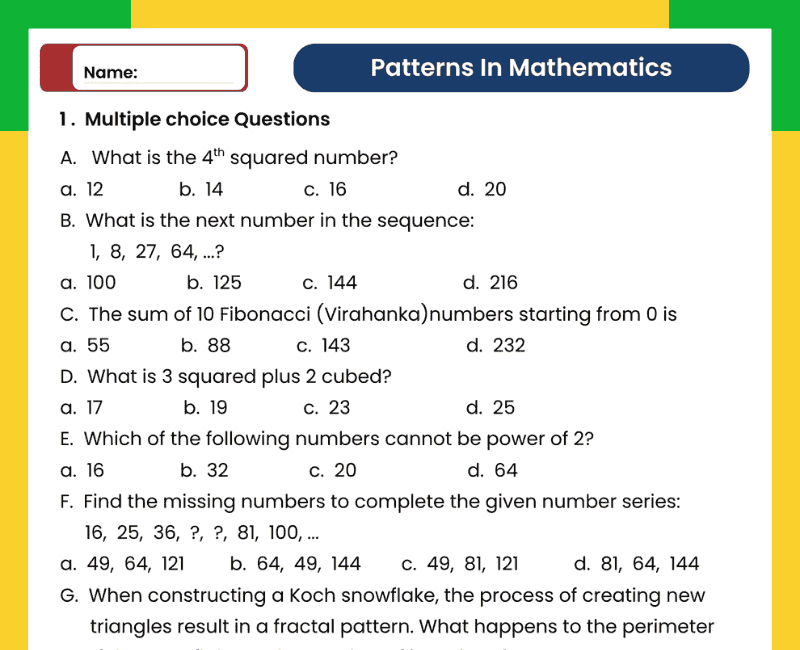
Patterns in Mathematics Class 6 Maths Worksheet with Quiz and Activities
In this chapter: number sequences, shape sequences and the links between them. Build squares from odd numbers and join dots to count lines. On WitKnowLearn you get the Patterns in Mathematics Class 6 online quiz, online activities and interactive games, a pattern lab, a virtual lab and a worksheet-style practice sheet for Class 6 Maths.
Patterns in Mathematics Class 6 Online Quiz
Includes assertion and reason, case study and higher order thinking questions. Tap an answer and the next question comes up.
Patterns in Mathematics Class 6 Activities
👆 Tap a tab to switch: Learn, Games, Labs, Challenges, Virtual Lab and Practice sheet
Patterns in Mathematics: how patterns are found and explained
A short read for Class 6 before you play. These notes cover Patterns in Mathematics: number sequences, shape sequences and the links between them.
🔢 Number sequences
Mathematics is the search for patterns and for the reasons behind them. Number sequences such as the odd numbers, triangular numbers, square numbers, cube numbers and Virahanka numbers are the most basic patterns of all.
🟨 Links between sequences
Sequences are joined to each other in surprising ways. Adding the odd numbers from 1 gives square numbers, adding counting numbers gives triangular numbers and adding hexagonal numbers gives cubes.
🔷 Shape sequences
Shapes also follow patterns. Regular polygons, complete graphs, stacked squares and the Koch snowflake each give a number sequence when we count their sides, lines or pieces.
Patterns in Mathematics Class 6 Maths Activities
Follow every step on the Number Train. Earn up to 3 stars in every activity.
This page covers Patterns in Mathematics: number sequences, shape sequences and the links between them for Class 6 maths. It covers number sequences, how sequences are linked and shape sequences such as regular polygons and complete graphs.
The activities are pitched at Class 6 level. Build a square from odd numbers of dots and join dots in a complete graph to find triangular numbers. Explore more Class 6 maths worksheets on WitKnowLearn after this chapter.
Key ideas and facts to know
| Sequence | First terms | Dots make |
|---|---|---|
| Triangular | 1, 3, 6, 10 | a triangle |
| Square | 1, 4, 9, 16 | a square |
| Cube | 1, 8, 27, 64 | a cube |
How to use this page
- Flip the six cards and try the Pattern Lab in the Learn tab.
- Play the five games and do the hands-on labs, where you drag and move things, to see each idea at work.
- Finish the five challenges to collect up to 15 points.
- Do two virtual experiments and a square builder studio.
- Take the online quiz, with assertion and reason and case study questions, and fill in the practice sheet.
Worked examples
It is 7 × 7 = 49.
10 lines, the triangular number after 6.
This Patterns in Mathematics worksheet for Class 6 maths gives you online activities and interactive games that make the chapter clear. Every activity has a goal, a hint and a short fact, so students learn while they enjoy.
Complete Guide: Class 6 Maths Patterns in Mathematics
This guide is for Class 6 students, parents and teachers. It covers Patterns in Mathematics: number sequences, shape sequences and the links between them for Class 6 maths and shows how to use the quiz, labs and games on this page.
Introduction to Patterns in Mathematics
This first chapter of Ganita Prakash shows mathematics as the search for patterns. It also asks why each pattern happens.
What is there in this chapter
- What is mathematics
- Patterns in numbers
- Visualising sequences
- Relations among sequences
- Patterns in shapes
- Shapes and numbers
Learning objectives
- Recognise key number sequences.
- Draw dots to picture a sequence.
- Explain why odd numbers add to squares.
- Link shape sequences with number sequences.
- Reason with assertions and case studies.
Learning outcomes
- I can name the main sequences.
- I can picture a sequence with dots.
- I can explain a pattern.
Patterns in Mathematics Class 6 resources on this page
| Resource | What it gives |
|---|---|
| Online quiz | Assertion and reason, case study and higher order thinking questions with a full review |
| Flip cards | 6 picture cards with one-line rules |
| Pattern Lab | A hands-on lab with 3 rounds |
| Games | 5 interactive games |
| Labs | Interactive labs where you drag, move and watch what happens |
| Virtual Lab | 2 experiments plus a studio that builds squares from odd numbers |
| Challenges | 5 challenges, 15 points in all |
| Practice sheet | A worksheet-style sheet with 16 questions, name and date lines and a live score |
Key facts
| Idea | Rule |
|---|---|
| Triangular | 1, 3, 6, 10 |
| Square | 1, 4, 9, 16 |
| Odd sums | give squares |
| Complete graph | lines are triangular |
Types of questions you may see
- Next term questions
- Sums of sequences
- Shape sequence counting
- Reason and explain
Solved examples
A 4 by 4 square of dots splits into bent strips of 1, 3, 5 and 7 dots, so the total is 4 × 4 = 16.
Take the triangular number 10, multiply by 6 and add 1 to get 61.
Common mistakes
| Mistake | Correct idea |
|---|---|
| Mixing triangular and square numbers | Draw the dots to check |
| Thinking the powers of 2 start at 2 | They start at 1, 2, 4, 8 |
| Giving a pattern with no reason | Always explain why it works |
Patterns in Mathematics in daily life
Patterns appear in rangoli, music beats, honeycombs, calendars and the growth of plants.
Tips for parents and teachers
- Ask your child to draw dots for 1, 3, 6 and 10.
- Count the handshakes in your family and find the triangular number.
- Practise one assertion and one case study each week.
Patterns in Mathematics Class 6 FAQs
What is a number sequence?
A list of numbers made by a rule, such as 1, 3, 5, 7 for the odd numbers.
Why are 1, 3, 6, 10 called triangular numbers?
That many dots can be arranged in the shape of a triangle.
Why are 1, 4, 9, 16 called square numbers?
That many dots can be arranged in the shape of a square.
What do we get by adding odd numbers from 1?
Square numbers. The first n odd numbers add to n × n.
What are the Virahanka numbers?
The sequence 1, 2, 3, 5, 8, 13 where each term is the sum of the two before it.
What are cube numbers?
The numbers 1, 8, 27, 64 made by multiplying a number by itself three times.
Which number is both triangular and square?
36 is both, since it makes a triangle and a 6 by 6 square.
What is a shape sequence?
Shapes arranged by a rule, such as regular polygons or stacked squares.
What sequence do complete graphs give?
The number of lines gives the triangular numbers 1, 3, 6, 10.
What are hexagonal numbers?
The numbers 1, 7, 19, 37, found by multiplying a triangular number by 6 and adding 1.
What is the Koch snowflake sequence?
Its line segments are 3, 12, 48, 192, which is 3 times the powers of 4.
Why do we draw pictures of sequences?
A picture shows why the pattern happens, not just that it happens.
What topics are in Class 6 Maths Patterns in Mathematics?
It covers number sequences, pictures of sequences, links between sequences and shape sequences.
What can students do on this page?
Students can take an online quiz with assertion and reason and case study questions, play five games, try five online activities, finish five challenges, run the Pattern Lab, do two virtual experiments, add one odd number at a time and watch squares appear in the studio,, and fill in a 16-question practice sheet with a Show answers button.
Related Class 6 Maths Worksheets
- 📐Lines and Angles Class 6 Worksheet
- ⭐Number Play Class 6 Worksheet
- 📊Data Handling and Presentation Class 6 Worksheet
- 🔒Prime Time Class 6 Worksheet
- 🔲Perimeter and Area Class 6 Worksheet
- 🥧Fractions Class 6 Worksheet
- 🧭Playing with Constructions Class 6 Worksheet
- 🪞Symmetry Class 6 Worksheet
- 🌡The Other Side of Zero Class 6 Worksheet
 Download


