
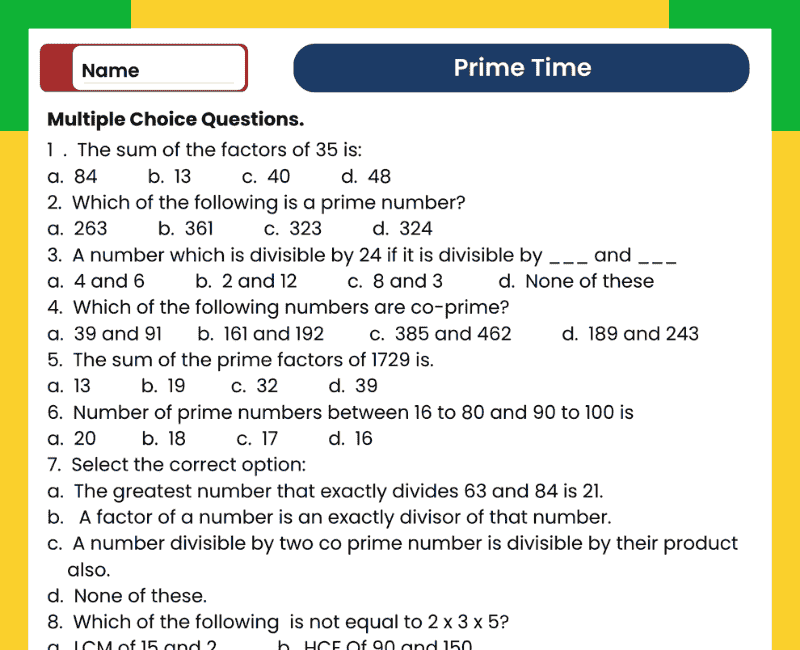
Prime Time Class 6 Maths Worksheet with Quiz and Activities
In this chapter: common multiples, primes, co-primes, prime factorisation and divisibility tests. Play idli-vada and build co-prime thread art. On WitKnowLearn you get the Prime Time Class 6 online quiz, online activities and interactive games, a prime time lab, a virtual lab and a worksheet-style practice sheet for Class 6 Maths.
Prime Time Class 6 Online Quiz
Includes assertion and reason, case study and higher order thinking questions. Tap an answer and the next question comes up.
Prime Time Class 6 Activities
👆 Tap a tab to switch: Learn, Games, Labs, Challenges, Virtual Lab and Practice sheet
Prime Time: primes, co-primes and factorisation
A short read for Class 6 before you play. These notes cover Prime Time: common multiples, prime and composite numbers, co-primes, prime factorisation and divisibility tests.
🍲 Common multiples and factors
In the idli-vada game children say idli on a multiple of 3 and vada on a multiple of 5. Idli-vada falls on the common multiples, the first being 15.
🔐 Primes and co-primes
A prime number has exactly two factors while a composite number has more. Two numbers with no common factor other than 1 are co-prime, such as 4 and 9.
🌳 Prime factorisation and divisibility
Every number greater than 1 is a product of primes in just one way, as 84 = 2 × 2 × 3 × 7. The last two digits test for 4 and the last three test for 8.
Prime Time Class 6 Maths Activities
Follow every step on the Number Train. Earn up to 3 stars in every activity.
This page covers Prime Time: common multiples, prime and composite numbers, co-primes, prime factorisation and divisibility tests for Class 6 maths. It covers common multiples and factors, prime and composite numbers, co-prime pairs, prime factorisation and divisibility tests.
The activities are pitched at Class 6 level. Play the idli-vada game with any pair of numbers and build co-prime thread art on a ring of pegs. Explore more Class 6 maths worksheets on WitKnowLearn after this chapter.
Key ideas and facts to know
| Idea | Example | Why |
|---|---|---|
| Prime | 7 | only 1 and 7 |
| Composite | 9 | 3 is a factor |
| Co-prime pair | 4 and 9 | no shared factor |
How to use this page
- Flip the six cards and try the Prime Time Lab in the Learn tab.
- Play the five games and do the hands-on labs, where you drag and move things, to see each idea at work.
- Finish the five challenges to collect up to 15 points.
- Do two virtual experiments and an idli-vada studio.
- Take the online quiz, with assertion and reason and case study questions, and fill in the practice sheet.
Worked examples
56 = 2 × 2 × 2 × 7 and 63 = 3 × 3 × 7 share the prime 7, so they are not co-prime.
Its last two digits make 60 and 60 ÷ 4 = 15, so yes.
This Prime Time worksheet for Class 6 maths gives you online activities and interactive games that make the chapter clear. Every activity has a goal, a hint and a short fact, so students learn while they enjoy.
Complete Guide: Class 6 Maths Prime Time
This guide is for Class 6 students, parents and teachers. It covers Prime Time: common multiples, prime and composite numbers, co-primes, prime factorisation and divisibility tests for Class 6 maths and shows how to use the quiz, labs and games on this page.
Introduction to Prime Time
This chapter of Ganita Prakash turns factors and multiples into games, from idli-vada counting to hiding treasure on co-prime numbers.
What is there in this chapter
- Common multiples and factors
- Prime numbers
- Co-prime numbers
- Prime factorisation
- Divisibility tests
- Fun with numbers
Learning objectives
- Find common multiples and factors.
- Tell a prime from a composite number.
- Test a pair for co-primality.
- Use divisibility tests for 4 and 8.
- Reason with assertions and case studies.
Learning outcomes
- I can list primes.
- I can find a prime factorisation.
- I can test a co-prime pair.
Prime Time Class 6 resources on this page
| Resource | What it gives |
|---|---|
| Online quiz | Assertion and reason, case study and higher order thinking questions with a full review |
| Flip cards | 6 picture cards with one-line rules |
| Prime Time Lab | A hands-on lab with 3 rounds |
| Games | 5 interactive games |
| Labs | Interactive labs where you drag, move and watch what happens |
| Virtual Lab | 2 experiments plus a studio that counts idli-vada turns |
| Challenges | 5 challenges, 15 points in all |
| Practice sheet | A worksheet-style sheet with 16 questions, name and date lines and a live score |
Key facts
| Idea | Rule |
|---|---|
| Prime | exactly two factors |
| 1 | neither prime nor composite |
| Co-prime | common factor only 1 |
| 84 | 2 × 2 × 3 × 7 |
Types of questions you may see
- Common multiple questions
- Prime and composite questions
- Co-prime questions
- Prime factorisation and divisibility
Solved examples
They are co-prime, so nothing can be cancelled and the first common multiple is the product.
18 = 2 × 3 × 3.
Common mistakes
| Mistake | Correct idea |
|---|---|
| Calling 1 a prime number | It has only one factor |
| Thinking co-primes must be prime | 4 and 9 are co-prime |
| Using the last digit to test for 4 | Use the last two digits |
Prime Time in daily life
Primes and co-primes are used in gear teeth, calendars, music patterns and the codes that keep messages safe.
Tips for parents and teachers
- Play idli-vada at home with the numbers 4 and 6 and compare it with 4 and 5.
- Draw thread art with 12 pins and different gaps.
- Practise one assertion and one case study each week.
Prime Time Class 6 FAQs
What is a prime number?
A number with exactly two factors, 1 and itself.
What is a composite number?
A number with more than two factors, such as 4, 6, 8 or 9.
Is 1 a prime number?
No. It is neither prime nor composite because it has only one factor.
What are co-prime numbers?
Two numbers with no common factor other than 1, such as 4 and 9.
Must co-prime numbers be prime?
No. Both 4 and 9 are composite yet the pair is co-prime.
What is prime factorisation?
Writing a number as a product of prime numbers, such as 84 = 2 × 2 × 3 × 7.
How many prime factorisations does a number have?
Only one, apart from the order of the factors.
How do you check if two numbers are co-prime?
Compare their prime factorisations and look for a common prime factor.
What is the first idli-vada number?
15, the first common multiple of 3 and 5.
How do you test divisibility by 4?
Check whether the number made by the last two digits is divisible by 4.
How do you test divisibility by 8?
Check whether the number made by the last three digits is divisible by 8.
Why does thread art touch every peg sometimes?
Because the number of pegs and the thread gap are co-prime.
What topics are in Class 6 Maths Prime Time?
It covers common multiples and factors, primes, co-primes, prime factorisation and divisibility tests.
What can students do on this page?
Students can take an online quiz with assertion and reason and case study questions, play five games, try five online activities, finish five challenges, run the Prime Time Lab, do two virtual experiments, count the idli-vada turns step by step in the studio,, and fill in a 16-question practice sheet with a Show answers button.
Related Class 6 Maths Worksheets
- 🔢Patterns in Mathematics Class 6 Worksheet
- 📐Lines and Angles Class 6 Worksheet
- ⭐Number Play Class 6 Worksheet
- 📊Data Handling and Presentation Class 6 Worksheet
- 🔲Perimeter and Area Class 6 Worksheet
- 🥧Fractions Class 6 Worksheet
- 🧭Playing with Constructions Class 6 Worksheet
- 🪞Symmetry Class 6 Worksheet
- 🌡The Other Side of Zero Class 6 Worksheet
 Download


