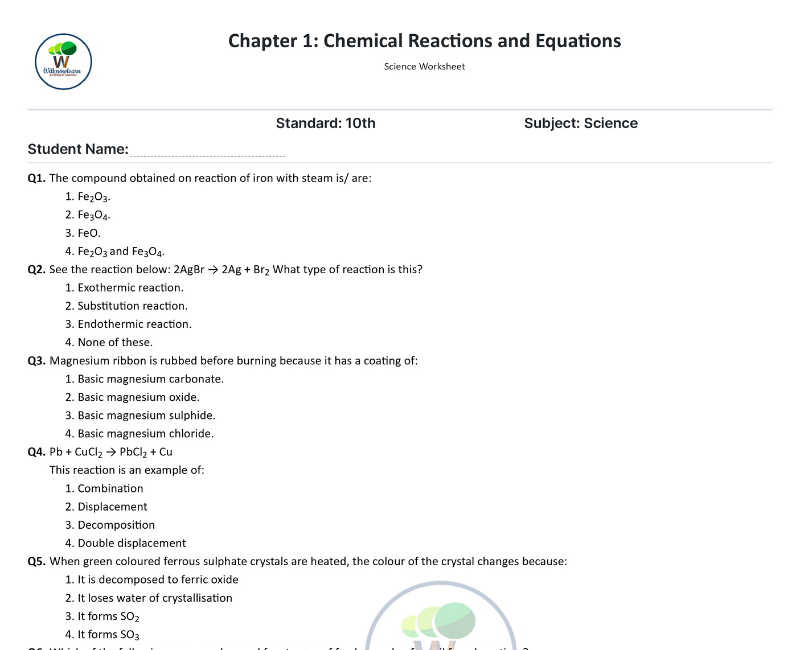
CLASS 10 SCIENCE • VISION AND LIGHT DISCOVERY LAB
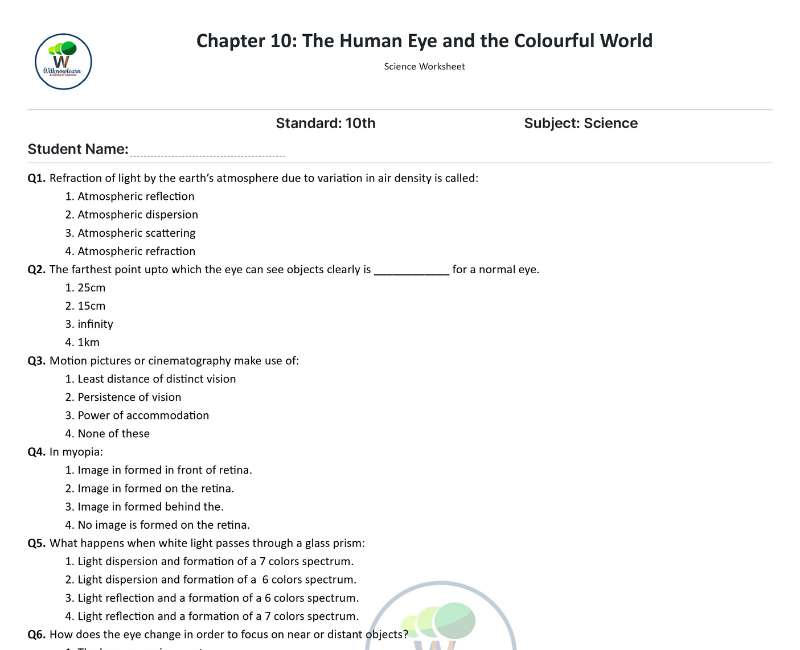
Human Eye and Colourful World Worksheet
with Online Quiz and Activities
Focus an eye, choose a correcting lens and investigate the colours of light. Build understanding through labelled diagrams, hands-on models and step-by-step explanations.
Discover the Eye
Connect eye structures, accommodation and sharp retinal images.
↗Play with Light
Adjust the focus, compare correcting lenses and investigate colours.
±Explain and Calculate
Use signed powers and support each answer with clear reasoning.
Human Eye and Colourful World Online Quiz
Question 1 / 20 • Easy
Which surface supplies most of the refraction in the human eye?
Choose an answer to continue, or use the question numbers.
Quiz instructions
Answer 10 easy, five average and five HOTS questions. The 20-minute timer starts with your first answer or question-navigation action. Choosing an answer advances to the next question except at the end. Review answers using the numbered buttons. One mark per correct answer, no negative marking. Submission or timeout reveals every explanation. Restart clears the quiz and pauses the timer.
Interactive Human Eye and Light Games
Choose a game using the raised selector. The topic, diagram and controls share one activity frame.
Eye Structure Hunt
Read the function and choose the matching letter on the schematic.
Find the transparent front surface that bends incoming light.
Choose a diagram letter. The line connects it to an eye structure.
Human Eye and Colourful World Activities
Choose an activity from the raised selector, adjust the controls and explain the result. Each lab has five missions.
About these learning models
Games and labs share one active main workspace. Extra practice is independent. Your entries remain while this page stays open. Diagrams are teaching models, not anatomical measurements. Reduced-eye labs combine the cornea and lens into one equivalent optical element, with a fixed 2 cm image distance. Prism paths and scattering displays are qualitative; colours represent bands within a continuous spectrum. Virtual controls do not replace an eye examination.
Human Eye Class 10 Extra Questions and Numericals
Lens Power Numericals
Enter signed answers. Fractions and values rounded to two decimal places are accepted.
A concave correcting lens has f = −40 cm. Find its power.
Use signed distances and convert to metres. A positive result indicates convergence; a negative result indicates divergence.
Accepts fractions or rounding to two decimal places. Tolerance ±0.0051 in the stated units.
Eight study tips for students
- Connect each eye part with its function, not just its label.
- Compare near viewing with distant viewing using lens curvature.
- Draw the retina before deciding whether a focus is in front or behind it.
- Link concave correction with negative lens power.
- Convert centimetres to metres before using P = 1/f.
- Write virtual image distances with the correct sign.
- Keep dispersion, scattering and atmospheric refraction distinct.
- Explain the observation after completing each interactive task.
Five teaching tips for parents and teachers
- Ask for a prediction before changing a slider.
- Use the same retina position when comparing eye models.
- Ask students to justify the sign of a correcting lens power.
- Compare the controls that change focusing with those that change brightness.
- Use the official sample paper for question format and avoid predicting fixed chapter marks.
Human Eye and Colourful World Class 10 Notes Important Questions and Solved Examples
How can the same eye focus on a book and then on a distant building? Why does a prism produce a spectrum, while a dusty room makes a beam of light visible? This Human Eye and Colourful World Class 10 worksheet connects these observations with the chapter's key ideas. Practise the written worksheet, try the online quiz and use the interactive models to explain what happens to light.
The revision guide below covers the human eye diagram with labels, power of accommodation, myopia and hypermetropia correction, presbyopia, lens-power numericals, dispersion and scattering. It also includes extra questions with answers, worked examples and case-based practice. Read a short explanation, solve a question independently and then check the reasoning.
Human Eye and Colourful World Class 10 Short Notes
The human eye is an optical system that directs light onto a sensitive surface. The cornea provides most of its refraction, while the flexible crystalline lens adjusts the focus. A clear optical image should form on the retina. Photoreceptors respond to light, and information travels through the optic nerve to the brain. The optical image on the retina is real and inverted; visual perception involves further processing by the nervous system.
Three distinctions make this chapter easier. Accommodation changes focusing power, pupil adjustment controls light entry, and spectacle correction compensates for a refractive mismatch. These functions are related to vision, but they are not interchangeable.
Human Eye Diagram Class 10 with Labels and Functions
| Part | Function to remember | Common mistake to avoid |
|---|---|---|
| Cornea | Transparent curved front surface; provides most of the eye's refraction. | Giving all refraction credit to the eye lens. |
| Iris | Changes pupil size to regulate light entry. | Calling the iris the opening itself. |
| Pupil | Opening through which light enters. | Describing it as a separate focusing lens. |
| Eye lens | Changes curvature to adjust focus. | Assuming its focal length is always fixed. |
| Ciliary muscles | Help control lens shape during accommodation. | Assuming the retina moves to focus on a book. |
| Retina | Contains light-sensitive receptors; receives the optical image. | Calling the retinal image virtual. |
| Optic nerve | Carries visual information towards the brain. | Calling it the surface on which the image forms. |
Diagram-answer method Draw the outline clearly, place the lens towards the front and mark the retina along the inner back surface. Use straight label lines that do not obscure the structures. If a question asks for functions, write a function beside each named part rather than providing labels alone.
Power of Accommodation Class 10 Explained
The power of accommodation is the eye's ability to change its lens power so that objects at different distances remain in focus on the retina. Light arriving from a nearby object is more divergent than light from a distant object. The eye therefore needs a greater converging power for near viewing.
| Viewing condition | Ciliary muscles | Lens and focal length |
|---|---|---|
| Distant object | Relax | Lens becomes less curved; focal length increases and power decreases. |
| Nearby object | Contract | Lens becomes more curved; focal length decreases and power increases. |
Common question Does the distance between the lens and retina change when we look from a tree to a book? In the Class 10 model, this distance remains essentially fixed. The lens changes its curvature and optical power instead. Do not confuse power of accommodation with the instantaneous power of the lens.
Near Point Far Point and Least Distance of Distinct Vision
The near point is the closest position at which an object can be viewed clearly without excessive strain. The conventional value for a normal young eye is about 25 cm, called the least distance of distinct vision. The far point is the most distant point seen clearly; for the standard normal eye it is at infinity.
These are reference values for school problems. Near points vary between people and with age. An object brought too close may remain blurred because the eye cannot increase its power sufficiently. Opening the pupil wider does not solve this focusing limitation.
Myopia Class 10 Causes Correction and Ray Diagram
In myopia, or short-sightedness, distant objects appear blurred while nearer objects may be seen clearly. Parallel light from a distant object would come to focus in front of the retina. In the school model, the eye may have excessive converging power for its length or an elongated eyeball.
A concave lens of suitable negative power diverges the light before it enters the eye. The corrected system then focuses the light on the retina. For a distant object, the spectacle lens forms a virtual image at the person's finite far point.
Ray-diagram explanation Draw the correcting concave lens in front of the eye. Show parallel incident rays becoming divergent at that lens, followed by convergence through the eye optics onto the retina. Label the correcting lens and retinal plane. Do not draw the correcting lens itself producing a real image inside the eye.
Hypermetropia Class 10 Causes Correction and Ray Diagram
In hypermetropia, or long-sightedness, near objects are difficult to see clearly in the standard school example. Light from a nearby object would focus behind the retina. This can result from insufficient converging power for the eye's length or a relatively short eyeball.
A convex lens of suitable positive power adds convergence. It can make an object at the desired reading distance appear as a virtual image at the person's more distant near point. The eye can then bring this light to focus on the retina.
Important distinction The expression “behind the retina” describes where the rays would meet if extended in the optical model. It does not mean that a useful image is formed beyond the eye. The retina intercepts the light before that projected meeting point.
Difference Between Myopia Hypermetropia and Presbyopia
| Feature | Myopia | Hypermetropia | Presbyopia |
|---|---|---|---|
| Main difficulty | Distant vision. | Near vision in the school model. | Near focusing becomes harder with age. |
| Main explanation | Excess convergence relative to eye length. | Insufficient convergence relative to eye length. | Reduced accommodation, especially as the lens loses flexibility. |
| Correction | Concave lens. | Convex lens. | Suitable near-vision correction; distance correction is considered separately. |
| Power to remember | Negative. | Positive for the stated near-vision correction. | Depends on the complete prescription and viewing needs. |
Presbyopia is not simply another name for hypermetropia. A person can have age-related loss of accommodation together with myopia or hypermetropia. Bifocal or progressive lenses may be useful when different corrections are needed for distance and near work. Do not assume that every older person requires the same lens arrangement.
Human Eye Class 10 Formula Sheet and Sign Convention
| Relationship | How to use it |
|---|---|
| P = 1/f | Use focal length f in metres to obtain power P in dioptres. |
| 1/f = 1/v − 1/u | Use signed object and image distances in a consistent unit. |
| P = −1/F | Myopia correction for a far-point distance F in metres and an object at infinity. |
| P = 1/d − 1/N | Near-vision correction for desired reading distance d and near-point distance N, both in metres. |
These spectacle-correction relationships assume a thin lens very close to the eye. With incident light travelling from left to right, a real object on the left has negative u. The required virtual image on that same side has negative v. A positive power indicates a converging lens in air; a negative power indicates a diverging lens.
Human Eye Class 10 Numericals with Step-by-Step Solutions
Example 1 - find power from focal length
A concave lens has a focal length of 50 cm. Find its power.
f = −50 cm = −0.50 m.
P = 1/f.
P = 1/(−0.50) = −2 D.
The negative sign agrees with the diverging action of a concave lens.
Example 2 - correct myopia using the far point
A person's far point is 1.25 m. Estimate the correcting power for distant vision.
u = −∞ and v = −1.25 m.
1/f = 1/v − 1/u.
1/f = −1/1.25 − 0 = −0.80 m⁻¹.
P = −0.80 D.
A concave lens makes the distant object appear at the person's far point.
Example 3 - correct a displaced near point
A person's near point is 75 cm. Find the power needed to read at 25 cm.
u = −0.25 m and v = −0.75 m.
P = 1/v − 1/u.
P = −1/0.75 + 1/0.25.
P = −1.333… + 4 = +2.666… D.
The approximate correcting power is +2.67 D, supplied by a convex lens.
Example 4 - find focal length from power
A correcting lens has power −1.6 D. Find its focal length.
f = 1/P = 1/(−1.6).
f = −0.625 m = −62.5 cm.
The lens is diverging. Keep the negative sign when converting units.
Numerical checklist Identify the defect, decide where the correcting lens must form its virtual image, assign signs, convert to metres and substitute. Finish with the unit and lens type. A correct number with the wrong sign can describe the opposite optical action.
Dispersion of White Light Through a Glass Prism
Dispersion is the separation of mixed light into its constituent wavelengths. Ordinary glass has different refractive indices for different visible wavelengths. The components therefore deviate by different amounts as they pass through a prism. In the usual experiment, red deviates least and violet deviates most, towards the prism's base.
VIBGYOR gives the familiar sequence violet, indigo, blue, green, yellow, orange and red. The spectrum is continuous; the colour names describe regions, not seven isolated wavelengths. A single ideal monochromatic input can change direction through a prism without producing the full white-light spectrum.
Why can a second prism produce white light? A suitably reversed second prism can bring the separated components together again. This supports the explanation that white light already contains different wavelengths. The first prism separates them; it does not permanently manufacture the colours.
Scattering of Light Class 10 and Tyndall Effect
Scattering redirects light from its original direction. Its appearance depends on the wavelength and the size and properties of the particles. When suspended particles send some light towards a side observer, a beam path may become visible. This is the principle behind familiar Tyndall-effect examples such as a beam in dusty air or a suitable colloidal mixture.
Dispersion and scattering must not be used as interchangeable answers. A prism spectrum is explained by wavelength-dependent refraction. A beam visible from the side in a colloid is explained by light being redirected by particles. Absorption removes energy from the beam through a different process.
Why Is the Sky Blue and the Sky in Space Dark?
Small atmospheric particles and molecules scatter shorter visible wavelengths more strongly. Scattered light from many directions reaches our eyes and gives the clear daytime sky its blue appearance. The final perceived colour also depends on the sunlight spectrum and human visual sensitivity, so the sky need not appear violet simply because violet wavelengths scatter strongly.
Without a substantial atmosphere, very little sunlight is redirected into the background viewing direction. An astronaut may therefore see a dark sky even when nearby objects are illuminated. This does not mean that visible sunlight is absent in space.
Atmospheric Refraction and Rainbow Questions
Textbook enrichment Atmospheric refraction is bending through air whose refractive index varies. Changing refractive conditions can alter the light received from a star, contributing to twinkling. Planets are extended sources, so contributions from different parts tend to average out; they usually twinkle less than stars.
A primary rainbow involves refraction, dispersion and internal reflection in water droplets. The Sun is behind the observer, with droplets ahead. Red is on the outer edge and violet on the inner edge of the primary rainbow. These explanations add context; use the current official syllabus to decide examination scope.
Human Eye and Colourful World Important Questions with Answers
- Why does the eye need accommodation?
Objects at different distances send light with different divergence. Changing lens curvature adjusts optical power so that their images remain on the retina.
- Why does a concave lens help a myopic eye?
It supplies negative power and reduces excessive convergence. Distant light that would focus before the retina can then be focused on it.
- Why is a convex lens used for hypermetropia?
It adds convergence for near viewing and can form a virtual image at the person's more distant near point.
- Why can we not read clearly with a book extremely close to the eye?
The eye cannot increase its power indefinitely. Within its near point, the required accommodation exceeds its available range.
- Why do clouds often look white?
Relatively large droplets scatter a broad range of visible wavelengths, so the combined light can appear white.
- Why are red danger signals used?
Red has a longer visible wavelength and is generally scattered less strongly by fine particles than shorter visible wavelengths. Practical visibility also depends on intensity and viewing conditions; do not claim that red passes through every fog unchanged.
Human Eye Class 10 Case-Based Questions with Solutions
A student can read a nearby book but cannot see the distant board clearly. In an optical model, distant light converges before the retina.
Identify the defect Myopia.
Choose the lens A concave lens of suitable power.
Explain the correction The lens diverges incoming light before the eye refracts it, moving the final focus back to the retinal plane.
White light forms a spectrum after passing through a prism. Separately, a beam becomes visible from the side in a colloidal sample.
First observation Dispersion caused by different refraction of the wavelength components.
Second observation Scattering by particles, demonstrating the Tyndall effect.
Reasoning check A colourful output and a visible beam do not automatically have the same cause.
Current CBSE Syllabus and Official Sample-Paper Practice
The CBSE Science syllabus for 2026–27 lists eye-lens functioning, defects and correction, prism refraction, dispersion and scattering. It explicitly excludes the colour of the Sun at sunrise and sunset. Atmospheric examples above are labelled enrichment rather than presented as a separate guaranteed examination requirement.
Question 39 of the official Science sample paper includes alternatives involving accommodation, near point, correcting distant vision, dispersion, least-deviated colour and the dark sky in space, together with accessible alternatives. Practise labelled diagrams and explanations alongside numericals.
The worksheet's interactive questions are original practice. “Important questions” here means useful revision themes, not a prediction of fixed marks or a claim of repeated past-board appearances. Genuine previous-year labels require the actual paper and year to be checked.
Further reading NCERT chapter, National Eye Institute eye guide and NASA wave behaviours. Reviewed 23 October 2026.
Related Class 10 Science Worksheets and Notes
Frequently Asked Questions
What does this Human Eye Class 10 worksheet page include?
A 20-question online quiz, five games, five virtual activities, five extra-practice sets, diagrams and revision explanations. Use the existing worksheet download separately for written work.
What is power of accommodation?
It is the ability to change eye-lens power to focus on objects at different distances. It concerns focusing, not simply changing pupil size.
What are the near and far points of a normal eye?
In the usual young-eye model, the near point is about 25 cm and the far point is infinity. Individual values vary.
What is the difference between myopia and hypermetropia?
Myopia blurs distant objects and is corrected with a concave lens. Hypermetropia makes near viewing difficult in the school model and is corrected with a convex lens.
Why does a concave lens correct myopia?
It diverges incident light so that the eye can bring it to focus on the retina instead of in front of it.
How is presbyopia different from hypermetropia?
Presbyopia is an age-related loss of accommodation. Hypermetropia is a refractive mismatch between the eye's optical power and length. They can coexist.
How do I solve human eye lens-power numericals?
Identify the required virtual image position, use signed distances in 1/f = 1/v − 1/u, and express f in metres before calculating P = 1/f.
Which colour deviates least through a glass prism?
Red deviates least and violet most in the usual ordinary-glass prism experiment.
Why does the sky look blue instead of violet?
Short wavelengths scatter strongly, but perceived colour also depends on the spectrum reaching the eye and the eye's wavelength sensitivity. The result is a blue-looking daytime sky.
What is the difference between dispersion and Tyndall effect?
Dispersion separates wavelengths through differing refraction. The Tyndall effect makes a beam visible through scattering by particles.
Which diagrams should I practise for this chapter?
Practise the labelled eye, image formation relative to the retina, correction of myopia and hypermetropia, and white-light dispersion through a prism.
Which important questions are supported by the current sample paper?
The official paper includes accommodation, near point, correction of distant vision, dispersion, least-deviated colour and a dark space sky. Practise explanations and diagrams together; a sample paper is not a prediction.
 Download