Class 4 Science
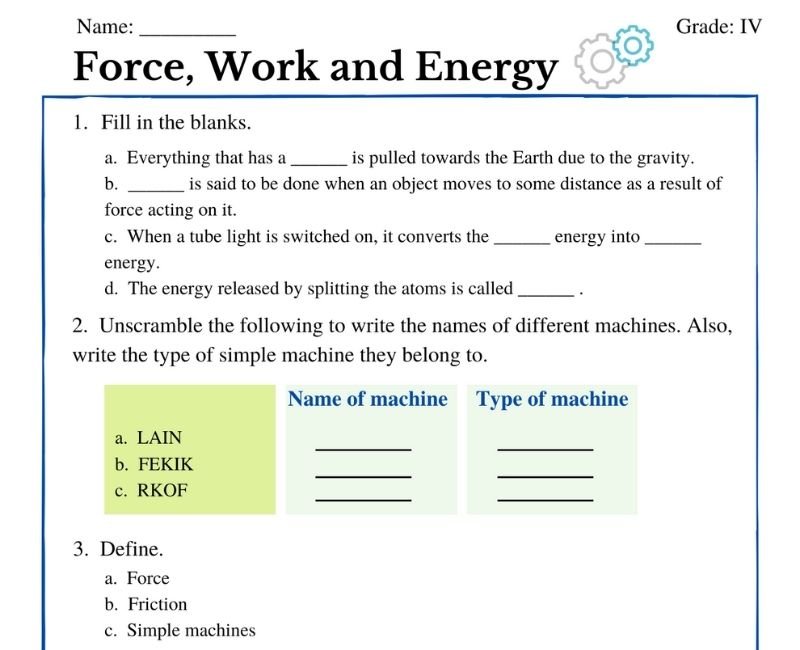
Force, Work and Energy Class 4 Science Worksheet with Quiz and Activities
What makes a ball start, stop or turn, when is work really done and where does energy come from? Explore with this Force, Work and Energy worksheet for Class 4: take the Force, Work and Energy Class 4 online quiz, build a circuit in the Virtual Lab and play the Force, Work and Energy Class 4 activities and interactive games online.
Flip the cards and try the Force Lab, then tap the Games, Labs, Challenges or Virtual Lab island.
Force, Work and Energy Class 4 Online Quiz
20 questions · tap an answer to move on · full review at the end
Flip the cards, try the Force Lab, then play the games, do the labs and take the challenges. Earn up to 3 stars in every activity.
Fact cards: tap a card to flip it
Force Lab
Test three forces. In each one, drag the action you think will work onto the picture and watch what happens. A wrong choice shows what goes wrong, so you can try again.
Challenge marks: 0 / 15 (0 of 5 challenges done)
Finish all 5 challenges to see your comment.
Virtual Lab: do real experiments step by step
Practice sheet
Force, Work and Energy Class 4 Activities
Push, pull, roll, launch and light a bulb in real-looking experiments and the Virtual Lab. Earn up to 3 stars in every activity.
What is a force?
Every time you open a door, kick a football or pull your school bag onto your shoulder, you are using a force. A force is simply a push or a pull. When you push, the object moves away from you; when you pull, it comes towards you. We cannot see a force itself, but we can always see what it does.
What can a force do?
- Make a still object start moving, like pushing a swing.
- Make a moving object go faster or slower, like pedalling harder or braking on a cycle.
- Stop a moving object, like a goalkeeper catching a ball.
- Change the direction of a moving object, like a batter hitting a cricket ball.
- Change the shape of an object, like pressing dough into a flat roti.
Kinds of force
| Force | What it does | Example |
|---|---|---|
| Muscular force | Force from our muscles | Lifting a bucket, climbing stairs |
| Gravity | Pulls everything towards the Earth | A mango falling from a tree |
| Friction | Acts between rubbing surfaces and slows things | A rolling ball stopping on grass |
| Magnetic force | Pulls iron and steel, even without touching | A magnet picking up pins |
Some forces, like muscular force and friction, need touch. Others, like gravity and magnetic force, can act from a distance.
What is work?
In everyday life we call homework or housework "work". In science, the word has a special meaning: work is done only when a force makes an object move. Pushing a cart along the road is work. Pushing hard against a wall that does not move is not work in science, even if it makes you tired!
Simple machines make work easier
People have invented simple machines to do work with less effort. A lever, such as a see-saw or a bottle opener, helps lift or open things. A pulley helps raise a bucket from a well or a flag up a pole. A ramp (inclined plane) lets us push heavy loads up instead of lifting them, and a wheel makes carrying loads much easier.
What is energy?
Energy is the ability to do work. We need energy to run, think, grow and keep warm, and machines need energy to run. Energy comes in many forms:
- Heat energy from the Sun, fire and stoves.
- Light energy from the Sun, bulbs and torches.
- Sound energy from drums, bells and voices.
- Electrical energy that runs fans, televisions and computers.
- Chemical energy stored in food, fuels and cells.
- Energy of motion in moving things, and stored energy in a stretched rubber band or water held high in a tank.
Energy changes form
Energy is never used up out of nowhere; it changes from one form to another. A torch changes chemical energy in its cells into light. A fan changes electrical energy into movement. Our body changes the chemical energy in food into movement and heat. Almost all of this energy first came from the Sun, which plants capture to make food.
Sources of energy
Some sources, such as sunlight, wind and flowing water, will never run out. They are called renewable sources. Others, such as coal, petrol and diesel, took millions of years to form and will one day run out. These are non-renewable sources, and burning them also makes smoke that pollutes the air. That is why it is important to save energy: switch off lights and fans when you leave a room, walk or cycle for short trips, and use sunlight whenever you can.
This Force, Work and Energy worksheet for Class 4 turns these ideas into an island adventure on WitKnowLearn with an online quiz, online activities and interactive games. Flip the cards, test pushes and pulls in the Force Lab, play the games, do the science labs, take the challenges and then build a circuit and test friction in the Virtual Lab.
Science Force, Work and Energy Class 4
Force, Work and Energy is an important Class 4 Science topic. It explains what a force is, what forces can do, the main kinds of force, what scientists mean by work, the different forms of energy, how energy changes from one form to another and why we should save energy. This guide explains each idea in simple language for Class 4 students, parents and teachers. It goes with the Force, Work and Energy worksheet for Class 4 on WitKnowLearn, which also gives an online quiz, online activities, interactive games and a Virtual Lab on the same page.
What is there in this topic
- Force as a push or a pull
- Effects of force: start, stop, speed up, slow down, turn, change shape
- Muscular force, gravity, friction and magnetic force
- Work in science
- Simple machines
- Forms of energy and energy changes
- Renewable and non-renewable sources of energy
Learning objectives
- Explain force as a push or a pull and describe its effects.
- Name and give examples of different kinds of force.
- Explain when work is done in science.
- Name forms and sources of energy and describe energy changes.
Learning outcomes
After this page a child can:
- Sort everyday actions into pushes and pulls.
- Show how friction changes with the surface.
- Build a simple circuit and describe its energy changes.
- Suggest ways to save energy at home and school.
Force, Work and Energy Class 4 resources on this page
| Resource | What it does |
|---|---|
| Force, Work and Energy Class 4 online quiz | 20 questions in three levels with a full answer review |
| Flip cards | Six cards on push and pull, effects of force, kinds of force, work, forms and sources of energy |
| Force Lab | Start a toy car, flatten a clay ball and stop a rolling ball |
| 5 interactive games | Push or pull, forever energy bubbles, energy change memory, name that force, work or no work |
| 5 science labs | Ramp race, magnet test, rubber band launcher, sun heat and pulley power experiments |
| 5 challenges | Marked out of 3 each with a total out of 15 |
| Virtual Lab | Two full experiments on friction and a simple circuit, with aim, objectives, procedure, observation table, conclusion and outcomes |
| Practice sheet | 16 questions with answer boxes and a live score |
Forms of energy at a glance
| Form | Example |
|---|---|
| Heat | A stove, the Sun |
| Light | A bulb, a torch |
| Sound | A bell, a guitar |
| Electrical | A fan, a computer |
| Chemical | Food, fuels, cells |
| Motion | A moving bus, flowing river |
Types of questions
- Push or pull
- Effects of force
- Kinds of force
- Work or no work
- Forms and changes of energy
- Renewable or non-renewable
- Experiments with friction, ramps and circuits
Solved examples
Common mistakes
| Mistake | Correct |
|---|---|
| Thinking force always makes things move | A force can also stop, turn or change shape. |
| Thinking any effort is work | Work is done only if the object moves. |
| Thinking energy gets used up and vanishes | It changes into other forms such as heat. |
| Thinking friction is always bad | Friction helps us walk, write and brake. |
Daily life
Forces and energy are everywhere: brakes use friction to stop bicycles, magnets keep fridge doors shut, and gravity brings rain down. Every switch we press uses energy, so turning off lights and fans, using sunlight and walking short distances all help save energy and keep the air clean.
Tips for parents and teachers
- Roll a toy car on a carpet and on tiles and compare.
- Test household objects with a fridge magnet.
- Make a simple circuit with a torch cell and bulb under supervision.
- List energy changes in kitchen machines.
- Let the child retry the challenges to earn 3 stars.
Related Class 4 Science Worksheets
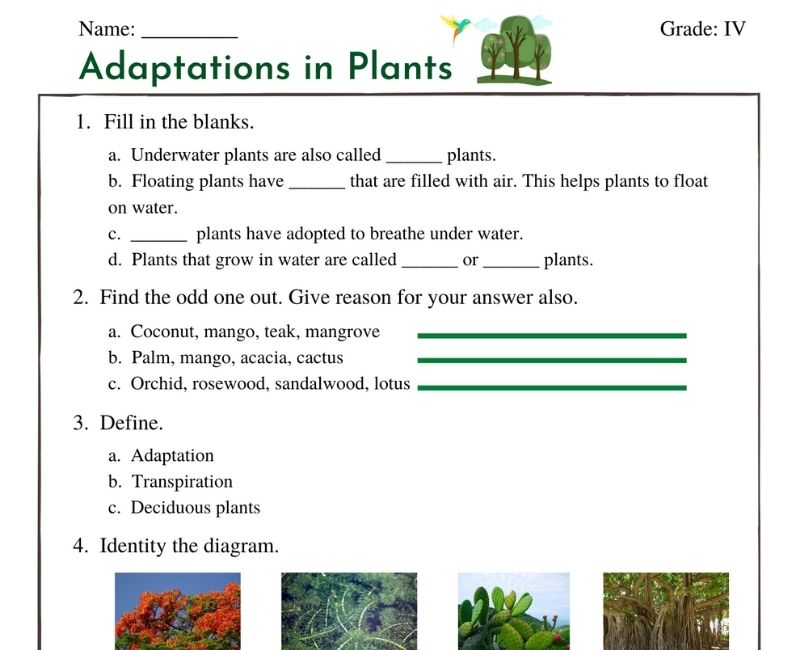
- Adaptation in Plants Worksheet Class 4
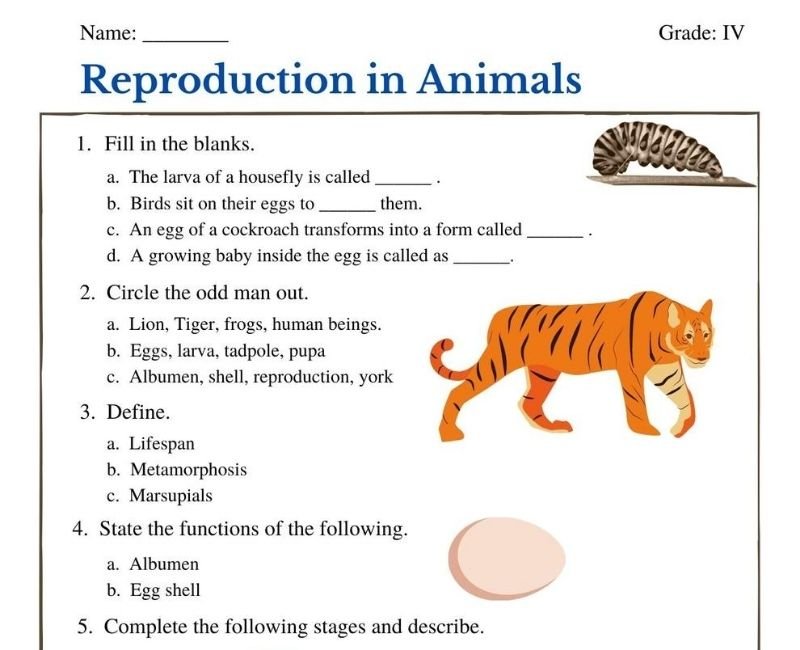
- Reproduction in Animals Worksheet Class 4
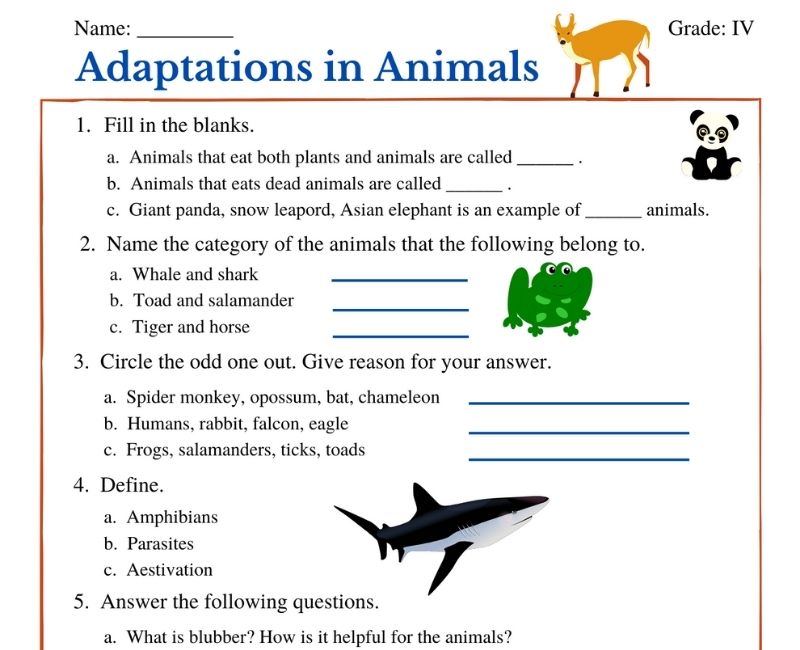
- Adaptation in Animals Worksheet Class 4
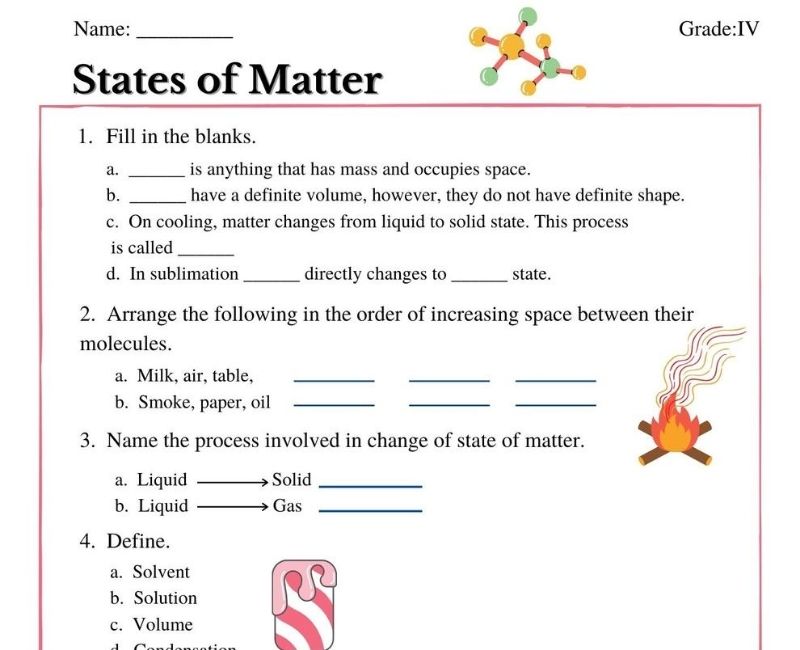
- States of Matter Worksheet Class 4
- Teeth and Microbes Worksheet Class 4
- Food and Nutrition Worksheet Class 4
- Air Water and Weather Worksheet Class 4
- Leaves and the Food Factory of Plants Worksheet Class 4
- Safety and First Aid Worksheet Class 4
- Our Universe Worksheet Class 4
- Clothes We Wear Worksheet Class 4
- Our Environment Worksheet Class 4
Frequently Asked Questions
 Download