Class 4 Science
Air, Water and Weather Class 4 Science Worksheet with Quiz and Activities
What is air made of, how does rain form and why does the weather change? Explore with this Air, Water and Weather worksheet for Class 4: take the Air, Water and Weather Class 4 online quiz, build a water filter in the Virtual Lab and play the Air, Water and Weather Class 4 activities and interactive games online.
Flip the cards and try the Water Cycle Lab, then tap the Games, Labs, Challenges or Virtual Lab island.
Air, Water and Weather Class 4 Online Quiz
20 questions · tap an answer to move on · full review at the end
Flip the cards, try the Water Cycle Lab, then play the games, do the labs and take the challenges. Earn up to 3 stars in every activity.
Fact cards: tap a card to flip it
Water Cycle Lab
Take water round the water cycle. At each step, drag what you think happens onto the picture and watch the result. A wrong choice shows what goes wrong, so you can try again.
Challenge marks: 0 / 15 (0 of 5 challenges done)
Finish all 5 challenges to see your comment.
Virtual Lab: do real experiments step by step
Practice sheet
Air, Water and Weather Class 4 Activities
Follow a raindrop, burst a balloon on a balance, hold water up with air and build a water filter in the Virtual Lab. Earn up to 3 stars in every activity.
Air: the invisible blanket
We cannot see air, smell clean air or hold it in our hands, yet it is all around us. A thick blanket of air called the atmosphere wraps the whole Earth. We know air is there because we feel it when the wind blows, see it fill a balloon and watch it make leaves dance on a tree.
Air is a mixture of gases. About four-fifths of it is nitrogen and about one-fifth is oxygen, the gas we need to breathe. Air also has a little carbon dioxide, which plants use to make food, along with water vapour, dust and smoke.
Properties of air
- Air takes up space. A balloon swells when we blow air into it.
- Air has weight. A football weighs a little more after we pump air into it.
- Air presses on everything. This push is called air pressure.
- Moving air is wind. Gentle wind is a breeze; very strong winds can become storms and cyclones.
Water: the gift of life
About three-quarters of the Earth is covered with water, but most of it is salty sea water. Only a tiny part is fresh water in rivers, lakes, ponds, wells and under the ground. Plants, animals and people all need water to live. We use it for drinking, cooking, bathing, washing, farming, and even for making electricity in dams.
| Source | Type of water |
|---|---|
| Seas and oceans | Salty, not fit to drink |
| Rivers, lakes and ponds | Fresh, but must be cleaned |
| Wells and hand pumps | Fresh water from under the ground |
| Rain | Fresh water that refills all the others |
The water cycle
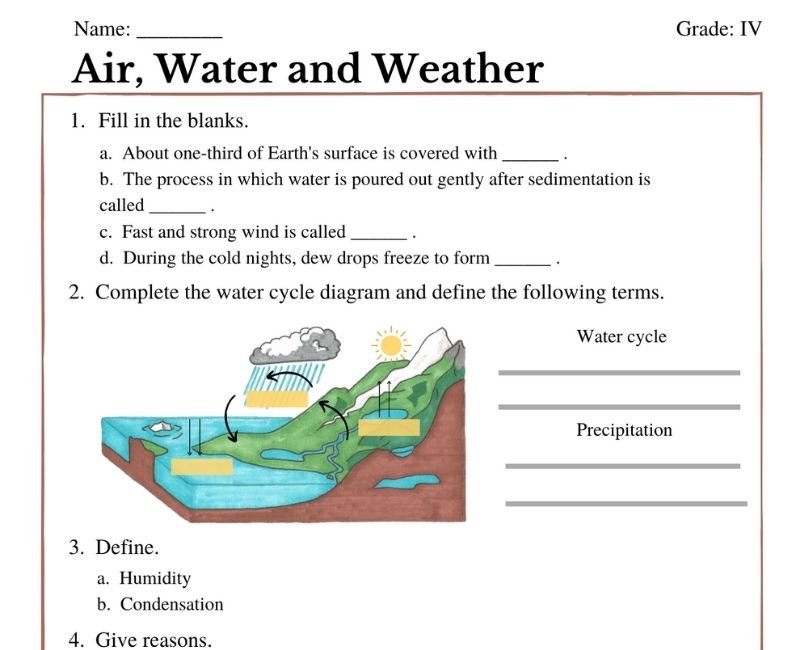
The water we drink today may once have been in a cloud over the sea. The Sun heats water in seas, rivers and lakes, and some of it turns into invisible water vapour that rises into the air. High up, the air is cool, so the vapour turns into tiny droplets that form clouds. When the droplets join and become heavy, they fall as rain, snow or hail. The water flows back into rivers and seas, and the journey starts again. This never-ending journey is called the water cycle.
What is weather?
Weather is what the air is like at a place at a particular time. Is it hot or cold? Sunny or cloudy? Windy or calm? Dry or rainy? Weather can change from morning to evening. Scientists who study the weather use instruments such as thermometers for temperature, rain gauges for rainfall and wind vanes for wind direction. They share weather forecasts so that farmers, fishermen, pilots and families can plan their day. The usual weather of a place over many years is called its climate.
Seasons in India
India has hot summers, rainy monsoons and cool winters, with pleasant spring and autumn in between. We change our clothes, food and activities with the seasons: cotton clothes and cool drinks in summer, umbrellas and raincoats in the monsoon, and woollens and hot soup in winter.
Keeping air and water clean
Smoke from factories, vehicles and burning garbage pollutes the air, while sewage, plastic and chemicals pollute rivers and lakes. We can help by planting trees, walking or cycling for short trips, never throwing waste into water, saving water at home and collecting rainwater.
This Air, Water and Weather worksheet for Class 4 turns these ideas into an island adventure on WitKnowLearn with an online quiz, online activities and interactive games. Flip the cards, follow water round the Water Cycle Lab, play the games, do the science labs, take the challenges and then carry out drying and filtering experiments in the Virtual Lab.
Science Air, Water and Weather Class 4
Air, Water and Weather is an important Class 4 Science topic. It explains what air is made of and its properties, where water comes from and why we must save it, how water moves in the water cycle, what weather is and how it is measured, the seasons, and how to keep air and water clean. This guide explains each idea in simple language for Class 4 students, parents and teachers. It goes with the Air, Water and Weather worksheet for Class 4 on WitKnowLearn, which also gives an online quiz, online activities, interactive games and a Virtual Lab on the same page.
What is there in this topic
- Air: what it is made of and its properties
- Uses of air and wind
- Sources and uses of water
- The water cycle
- Weather, weather instruments and climate
- Seasons
- Air and water pollution, saving water
Learning objectives
- Describe air as a mixture of gases and list its properties.
- Name sources of water and ways to save it.
- Explain the steps of the water cycle.
- Describe weather and name instruments that measure it.
Learning outcomes
After this page a child can:
- Show that air has weight and pushes on things.
- Explain how rain forms.
- Make a simple water filter and explain its limits.
- Suggest ways to keep air and water clean.
Air, Water and Weather Class 4 resources on this page
| Resource | What it does |
|---|---|
| Air, Water and Weather Class 4 online quiz | 20 questions in three levels with a full answer review |
| Flip cards | Six cards on air, what is in air, water, the water cycle, weather and seasons |
| Water Cycle Lab | Move water from the sea to the clouds and back as rain |
| 5 interactive games | Air or water, pollution bubbles, weather tools memory, dress for the weather, save or waste |
| 5 science labs | Balloon balance, candle and jar, upside-down glass, rain gauge and spinning spiral experiments |
| 5 challenges | Marked out of 3 each with a total out of 15 |
| Virtual Lab | Two full experiments on drying clothes and filtering water, with aim, objectives, procedure, observation table, conclusion and outcomes |
| Practice sheet | 16 questions with answer boxes and a live score |
Weather words
| Word | Meaning |
|---|---|
| Temperature | How hot or cold it is |
| Rainfall | How much rain falls |
| Humidity | How much water vapour is in the air |
| Breeze | A gentle wind |
| Drizzle | Very light rain |
| Forecast | A guess about tomorrow's weather made by scientists |
Types of questions
- Properties and uses of air
- Sources and uses of water
- Steps of the water cycle
- Weather instruments
- Seasons and clothes
- Pollution and saving water
- Experiments with air and water
Solved examples
Common mistakes
| Mistake | Correct |
|---|---|
| Thinking air is empty space | Air is matter: it has weight and takes up space. |
| Thinking clouds are smoke or cotton | Clouds are tiny drops of water. |
| Mixing up weather and climate | Weather is today; climate is over many years. |
| Thinking clear water is always safe | Clear water can still have germs. |
Daily life
Air and water shape our day: we check the sky before hanging clothes, carry umbrellas in the monsoon and fly kites on windy days. Saving water, planting trees and not burning garbage keep the air and water clean for everyone.
Tips for parents and teachers
- Keep a weather diary for a week with symbols.
- Make a rain gauge from a clear bottle and a ruler.
- Dry two handkerchiefs in sun and shade and compare.
- Count how many buckets of water the family uses in a day.
- Let the child retry the challenges to earn 3 stars.
Related Class 4 Science Worksheets
- Adaptation in Plants Worksheet Class 4
- Reproduction in Animals Worksheet Class 4
- Adaptation in Animals Worksheet Class 4
- States of Matter Worksheet Class 4
- Teeth and Microbes Worksheet Class 4
- Food and Nutrition Worksheet Class 4
- Force Work and Energy Worksheet Class 4
- Leaves and the Food Factory of Plants Worksheet Class 4
- Safety and First Aid Worksheet Class 4
- Our Universe Worksheet Class 4
- Clothes We Wear Worksheet Class 4
- Our Environment Worksheet Class 4
Frequently Asked Questions
 Download