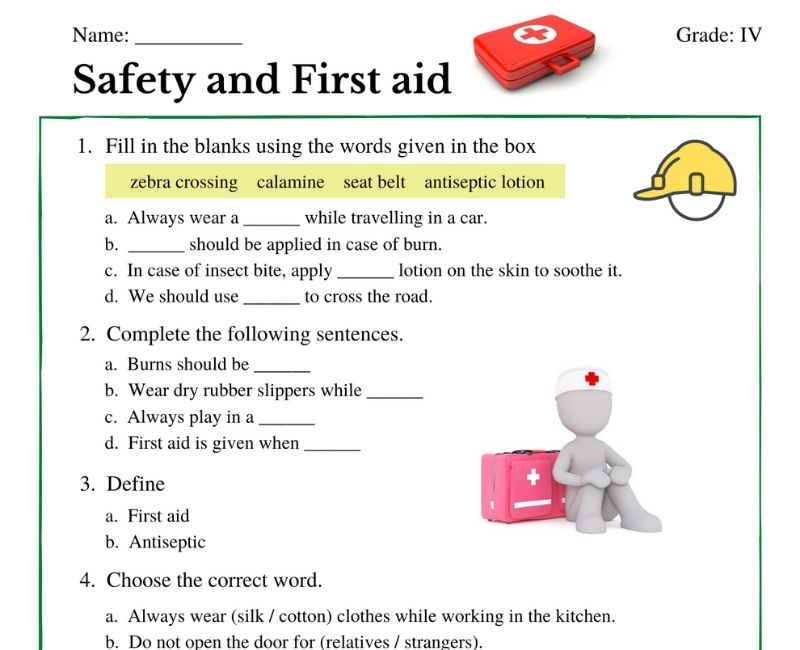
Class 4 Science
Safety and First Aid Class 4 Science Worksheet with Quiz and Activities
How do we stay safe at home and on the road, and what should we do when someone gets hurt? Explore with this Safety and First Aid worksheet for Class 4: take the Safety and First Aid Class 4 online quiz, test bandages in the Virtual Lab and play the Safety and First Aid Class 4 activities and interactive games online.
Flip the cards and try the First Aid Lab, then tap the Games, Labs, Challenges or Virtual Lab island.
Safety and First Aid Class 4 Online Quiz
20 questions · tap an answer to move on · full review at the end
What is first aid?
Flip the cards, try the First Aid Lab, then play the games, do the labs and take the challenges. Earn up to 3 stars in every activity.
Fact cards: tap a card to flip it
First Aid Lab
Help three friends who are hurt. For each one, drag the first aid you think is right onto the picture and watch what happens. A wrong choice shows what goes wrong, so you can try again.
⛑️ Patient 1 of 3 · 🩹 Small cut: Riya cut her finger on a sharp page. It is a small cut. What is the right first aid? Drag a choice onto the picture to test it.
The test result will appear here.
- ⛑️Patient 1: 🩹 Small cut
Choose the right first aid. - ⬜Patient 2: 🔥 Small burn
Waiting… - ⬜Patient 3: 🩸 Nosebleed
Waiting… - ⬜What did we find?
Help all 3 patients to unlock.
Challenge marks: 0 / 15 (0 of 5 challenges done)
Finish all 5 challenges to see your comment.
Virtual Lab: do real experiments step by step
Which Material Makes the Best Bandage?
🎯 Aim
To test three materials and find out which one is best for covering a wound.
📘 Learning objectives
- Understand what a good bandage needs to do.
- Test materials for soaking up liquid and staying strong.
- Choose the best material using evidence.
🧰 Materials needed
⚠️ Safety first
Use clean water only. Never test on a real wound; this is only a model test.
🔬 Procedure: do each step yourself
- Lay the cotton gauze on Tray A.
- Lay the plastic sheet on Tray B.
- Lay the tissue paper on Tray C.
- Put 5 drops of water on the gauze, then gently pull its ends.
- Put 5 drops of water on the plastic, then gently pull its ends.
- Put 5 drops of water on the tissue, then gently pull its ends.
Step 1: Lay the cotton gauze on Tray A.
📋 Observation table: fill in what you saw
| Material | What happened |
|---|---|
| Cotton gauze | |
| Plastic sheet | |
| Tissue paper |
✍️ Conclusion
Which material is best for a bandage, and why?
🏁 Learning outcomes
After this experiment I can:
- ✅ explain what makes a good bandage
- ✅ test materials fairly and compare results
- ✅ choose the right material using evidence
🎉 Lab report complete!
How Can We Be Seen at Night?
🎯 Aim
To find out which clothing is easiest to see in the dark.
📘 Learning objectives
- Learn why walkers and cyclists must be seen at night.
- Compare dark clothes, light clothes and reflective strips.
- Suggest safe clothing for night time.
🧰 Materials needed
⚠️ Safety first
Never shine a torch into anyone’s eyes. Move carefully in the dark room.
🔬 Procedure: do each step yourself
- Hang the dark T-shirt on Hook 1.
- Hang the white T-shirt on Hook 2.
- Hang the reflective strip on Hook 3. Switch off the lights.
- From across the room, shine the torch on Hook 1.
- Shine the torch on Hook 2.
- Shine the torch on Hook 3.
Step 1: Hang the dark T-shirt on Hook 1.
📋 Observation table: fill in what you saw
| Item | How it looked in torchlight |
|---|---|
| Dark T-shirt | |
| White T-shirt | |
| Reflective strip |
✍️ Conclusion
What should you wear when walking or cycling at night?
🏁 Learning outcomes
After this experiment I can:
- ✅ explain why we must be seen on roads at night
- ✅ compare how well different clothes can be seen
- ✅ choose safe clothing for night time
🎉 Lab report complete!
Practice sheet
Type your answers in the boxes. For word answers write in small letters. Press Check when you finish.
AWrite safe or unsafe
BWho will help? Use the word bank
CWrite yes or no
DComplete the sentence with one word
Safety and First Aid Class 4 Activities
Fix kitchen dangers, cross a road safely, help a friend with a twisted ankle and test bandages in the Virtual Lab. Earn up to 3 stars in every activity.
Why do we need to be safe?
Accidents can happen anywhere: in the kitchen, on the stairs, on the road, in the playground or near water. Most accidents happen because someone was in a hurry, careless or did not know the danger. The good news is that almost all of them can be prevented. Being safe means knowing the dangers around us and following simple rules, so that we and others do not get hurt.
Safety at home
Our home feels safe, but it has hidden dangers. Never touch switches or plugs with wet hands, and never poke anything into a socket. Keep away from the gas stove, hot pans and the iron. Sharp knives and scissors should be used only with an adult nearby. Medicines, cleaning liquids and insect sprays must be stored high up, out of reach of small children. Wipe spilt water at once, keep toys off the stairs and hold the handrail.
Safety on the road
| Rule | Why it matters |
|---|---|
| Walk on the footpath, or on the right side facing traffic | You can see vehicles coming towards you |
| Cross at a zebra crossing or a footbridge | Drivers expect people to cross there |
| Look right, left and right again | In India the nearest traffic comes from the right |
| Obey traffic lights | Red means stop, yellow means get ready, green means go |
| Wear a helmet and a seat belt | They protect your head and body in a crash |
Safety at school, at play and near water
Walk, don't run, in corridors and on stairs. Use playground swings and slides one at a time and wait your turn. Never push others. Near water, swim only where a lifeguard or adult is watching, never jump into water whose depth you do not know, and wear a life jacket in a boat. Stay away from open drains, wells and railway tracks.
Staying safe from fire
Never play with matches, lighters or crackers. If you see a fire, move away, warn others and get an adult to call the fire brigade. If your clothes ever catch fire, remember: Stop, Drop and Roll.
What is first aid?
First aid is the first help given to an injured or sick person before a doctor arrives. Good first aid can stop an injury from getting worse, ease pain and sometimes even save a life. Every home, school and vehicle should have a first-aid box with bandages, plasters, cotton wool, antiseptic lotion, small scissors, a thermometer and a list of emergency numbers.
| Problem | Simple first aid |
|---|---|
| Small cut or scrape | Wash with clean water, cover with a clean plaster |
| Small burn | Cool under running water for at least 10 minutes; no butter or toothpaste |
| Nosebleed | Sit, lean forward and pinch the soft part of the nose |
| Twisted ankle | Rest, a wrapped ice pack, a gentle bandage, raise the foot |
| Insect sting | Remove the sting gently, put on a cold cloth, tell an adult |
Emergency numbers
In India, 112 connects you to help for any emergency. You can also call 108 for an ambulance, 101 for the fire brigade, 100 for the police and 1098 for Childline. Learn your parents' phone numbers and your home address by heart.
This Safety and First Aid worksheet for Class 4 turns these ideas into an island adventure on WitKnowLearn with an online quiz, online activities and interactive games. Flip the cards, help three friends in the First Aid Lab, play the games, do the safety labs, take the challenges and then test bandages and night-time clothing in the Virtual Lab.
Science Safety and First Aid Class 4
Safety and First Aid is an important Class 4 Science topic. It explains how to stay safe at home, on the road, at school, at play and near water, how to prevent fires, what first aid is, what goes in a first-aid box, simple first aid for common injuries and which numbers to call in an emergency. This guide explains each idea in simple language for Class 4 students, parents and teachers. It goes with the Safety and First Aid worksheet for Class 4 on WitKnowLearn, which also gives an online quiz, online activities, interactive games and a Virtual Lab on the same page.
What is there in this topic
- Safety at home, at school and at play
- Road safety and traffic signals
- Safety near water and fire safety
- First aid and the first-aid box
- First aid for cuts, burns, nosebleeds, sprains and stings
- Emergency numbers and safe helpers
Learning objectives
- Identify dangers at home, on the road and near water.
- Follow road safety rules and traffic signals.
- Explain what first aid is and what a first-aid box contains.
- Describe simple first aid for common injuries.
Learning outcomes
After this page a child can:
- Spot and fix common dangers in a kitchen.
- Cross a road safely using the right steps.
- Give the right first aid for a small cut, burn or nosebleed, and tell an adult.
- Recall emergency numbers in India.
Safety and First Aid Class 4 resources on this page
| Resource | What it does |
|---|---|
| Safety and First Aid Class 4 online quiz | 20 questions in three levels with a full answer review |
| Flip cards | Six cards on home, road, school, water, first aid and getting help |
| First Aid Lab | Choose the right first aid for a cut, a burn and a nosebleed |
| 5 interactive games | Safe or unsafe, first-aid box bubbles, helpline memory, road signals, call for help |
| 5 safety labs | Safe kitchen, twisted ankle, cross the road, stop drop and roll, and egg seat belt activities |
| 5 challenges | Marked out of 3 each with a total out of 15 |
| Virtual Lab | Two full experiments on bandage materials and being seen at night, with aim, objectives, procedure, observation table, conclusion and outcomes |
| Practice sheet | 16 questions with answer boxes and a live score |
Safe helpers
| Helper | When to go to them |
|---|---|
| Parents and family | Any time you are hurt, scared or unsure |
| Teachers | Accidents or problems at school |
| Police officers | When you are lost or in danger |
| Doctors and nurses | Injuries and illness |
| Firefighters | Fires and rescues |
Types of questions
- Safe or unsafe
- Road rules and signals
- First aid for injuries
- First-aid box items
- Emergency numbers
- Hands-on safety activities
Solved examples
Common mistakes
| Mistake | Correct |
|---|---|
| Putting toothpaste or butter on a burn | Cool it under running water. |
| Tilting the head back for a nosebleed | Lean forward and pinch the nose. |
| Running across the road | Look both ways and walk across. |
| Hiding an injury from adults | Always tell an adult. |
Daily life
Safety habits protect us every day: wearing a seat belt in the car, walking on the footpath, keeping medicines away from little ones and knowing where the first-aid box is kept. Practising these habits at home and school makes them automatic.
Tips for parents and teachers
- Go round the house together and spot dangers.
- Practise "look right, left, right" on a quiet road.
- Check the family first-aid box and replace old items.
- Help the child learn emergency numbers and a parent's phone number.
- Let the child retry the challenges to earn 3 stars.
Related Class 4 Science Worksheets
- Adaptation in Plants Worksheet Class 4
- Reproduction in Animals Worksheet Class 4
- Adaptation in Animals Worksheet Class 4
- States of Matter Worksheet Class 4
- Teeth and Microbes Worksheet Class 4
- Food and Nutrition Worksheet Class 4
- Force Work and Energy Worksheet Class 4
- Air Water and Weather Worksheet Class 4
- Leaves and the Food Factory of Plants Worksheet Class 4
- Our Universe Worksheet Class 4
- Clothes We Wear Worksheet Class 4
- Our Environment Worksheet Class 4
Frequently Asked Questions
What is Safety and First Aid for Class 4?
It is a Science topic about staying safe at home, on the road, at school and near water, preventing fires, and giving simple first aid for common injuries.
What is first aid?
First aid is the first help given to an injured or sick person before a doctor arrives. It stops the injury from getting worse and eases pain.
What should a first-aid box contain?
Bandages, plasters, cotton wool, antiseptic lotion, small scissors, a thermometer and a list of emergency numbers.
What is the first aid for a small burn?
Hold the burn under cool running water for at least 10 minutes. Do not put butter, toothpaste or ice on it. Tell an adult.
What should you do for a nosebleed?
Sit down, lean forward and pinch the soft part of the nose for about 10 minutes. Do not tilt the head back.
What are the emergency numbers in India?
112 for any emergency, 108 for an ambulance, 101 for the fire brigade, 100 for the police and 1098 for Childline.
What is in the Virtual Lab?
Two full experiments: testing which material makes the best bandage, and finding which clothing is easiest to see at night. Each has an aim, objectives, materials, safety notes, procedure, observation table, conclusion and outcomes.
Does this page have Safety and First Aid Class 4 questions and answers?
Yes. The 20-question Safety and First Aid Class 4 online quiz shows the correct answer and a reason for every question at the end, and the practice sheet has a Show answers button for all 16 questions.
Which class is this worksheet for?
It is made for Class 4 Science students learning about safety rules, road safety, fire safety and simple first aid.
What can children do on this page?
On WitKnowLearn they get an online quiz, online activities and interactive games: a first aid lab, five safety labs, a Virtual Lab with two experiments, sorting games and challenges, all on the screen.
Can my child use these activities on a phone?
Yes. All drag activities work with a finger on phones and tablets and with a mouse on computers. Tapping also works, and the practice sheet takes typed answers.
What is included on this page?
A 20-question online quiz with review, flip cards, the First Aid Lab, 5 interactive games, 5 safety labs, 5 marked challenges, a Virtual Lab with 2 experiments, a 16-question practice sheet, a complete guide, 12 related Class 4 Science worksheets and these FAQs.
 Download