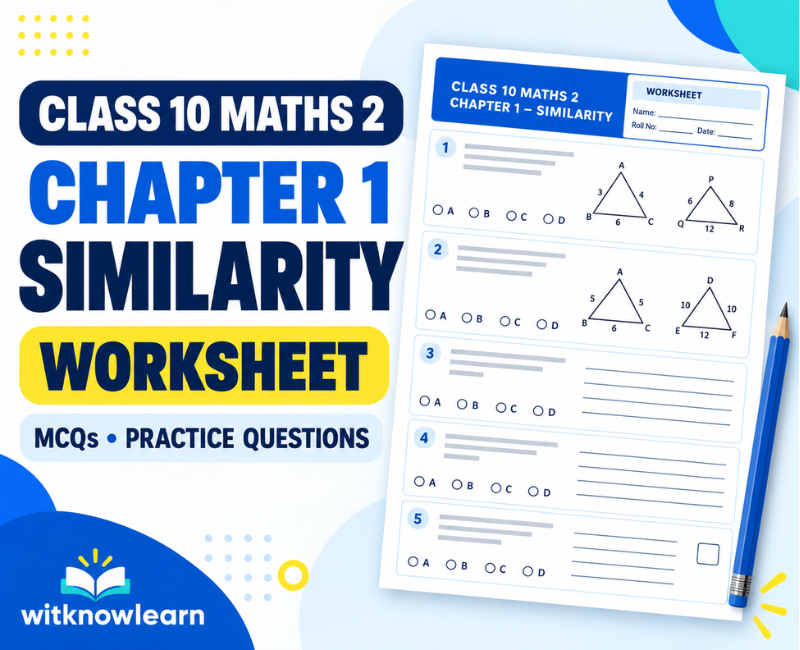
Class 10 Maths 2 Chapter 1 Similarity Worksheet
Strengthen your preparation with the Maharashtra Board Class 10 Maths 2 Chapter 1 Similarity Worksheet. Practise multiple-choice questions, theorem-based questions, numerical problems, proofs and board-exam-style applications with sufficient space for complete working.
Class 10 Maths 2 Chapter 1 Similarity Worksheet
This Class 10 Similarity worksheet is designed for Maharashtra State Board students who want structured practice beyond reading textbook solutions. It includes questions based on similar triangles, the Basic Proportionality Theorem, corresponding sides, proportional segments, areas of similar triangles and applications of similarity.
The worksheet begins with concept-based multiple-choice questions and gradually moves towards calculations, theorem applications and proof-based questions. This progression helps students check their fundamental understanding before attempting longer board-exam problems.
Concepts Covered in the Similarity Worksheet
Similar Triangles
Identify corresponding angles and sides, write similarity statements in the correct order and use proportional sides to calculate unknown lengths.
Proportionality Theorems
Apply the Basic Proportionality Theorem, its converse and the angle-bisector theorem to solve geometrical problems.
Areas of Similar Triangles
Use the relationship between corresponding sides and areas of similar triangles to solve numerical and proof-based questions.
Important Similarity Rules for This Worksheet
Two triangles are similar when their corresponding angles are equal and their corresponding sides are proportional. The triangles have the same shape, but they are not required to have the same size.
- In the AAA similarity test, corresponding angles of the two triangles are equal.
- In the SAS similarity test, one corresponding angle is equal and the including sides are proportional.
- In the SSS similarity test, all three pairs of corresponding sides are proportional.
- The ratio of the areas of two similar triangles equals the square of the ratio of their corresponding sides.
- A line parallel to one side of a triangle divides the other two sides proportionally.
Types of Questions Included
Multiple-Choice Questions
The MCQ section checks important definitions, similarity criteria, corresponding sides, proportional ratios and theorem applications. Students should solve each question before checking the available options.
Find the Unknown Length
These questions require students to identify similar triangles, write the correct proportion and calculate an unknown side or segment. The correspondence between the vertices must be maintained throughout the solution.
Theorem-Based Questions
Students practise the Basic Proportionality Theorem, its converse and related results. Proofs should contain the given information, construction when required, theorem statement, logical steps and final conclusion.
Area and Ratio Questions
These questions connect the ratio of corresponding sides with the ratio of areas. Students must remember that the area ratio involves the square of the corresponding-side ratio.
Board-Exam-Style Problems
The final section includes mixed questions that require students to select the appropriate similarity test or theorem. These questions support Maharashtra SSC examination revision and help students practise complete step-by-step presentation.
How to Solve the Similarity Worksheet
- Read the complete question and mark all the given measurements on the diagram.
- Identify the two triangles that may be similar.
- Write the equal corresponding angles or proportional sides.
- State the correct AAA, SAS or SSS similarity test.
- Write the similarity statement in the correct order.
- Form a proportion using only corresponding sides.
- Solve the resulting equation one mathematical step per line.
- Write the final answer with its correct unit and geometrical reason.
Benefits of Practising This Worksheet
- Revises all important Similarity concepts in one structured practice activity.
- Improves understanding of corresponding sides and angles.
- Develops confidence in theorem-based and proof-based questions.
- Provides practice in writing complete mathematical steps.
- Helps identify common calculation and diagram-reading mistakes.
- Supports school tests, unit tests, prelims and SSC Board examination preparation.
- Encourages students to solve independently before checking the answer key or chapter solutions.
Common Mistakes Students Should Avoid
- Do not write the vertices of similar triangles in the wrong corresponding order.
- Do not compare a side from one triangle with a non-corresponding side from the other triangle.
- Do not use a similarity test without writing the required equal angles or proportional sides.
- Do not forget to square the side ratio when calculating the ratio of areas.
- Use the Basic Proportionality Theorem only when the required line is parallel to one side of the triangle.
- Do not write only the final answer in a theorem-based question.
Practise Before Checking the Solutions
Attempt every question independently and show complete working. After completing the worksheet, compare your method with the Chapter 1 Similarity solutions. Correct every mistake and attempt the difficult questions again without looking at the answer. This process is more effective than simply reading the solution.
Frequently Asked Questions
Select any question to view its answer.
What topics are covered in the Class 10 Similarity worksheet?
What are the three tests of similarity?
What is the Basic Proportionality Theorem?
How do I identify corresponding sides of similar triangles?
Are similar triangles always congruent?
What is the relationship between the areas of similar triangles?
Why is the order of vertices important in similarity?
Does this worksheet contain MCQs and numerical questions?
Is this worksheet useful for Maharashtra SSC Board preparation?
Should I check the solutions while completing the worksheet?
How many times should I practise the Similarity worksheet?
 Download