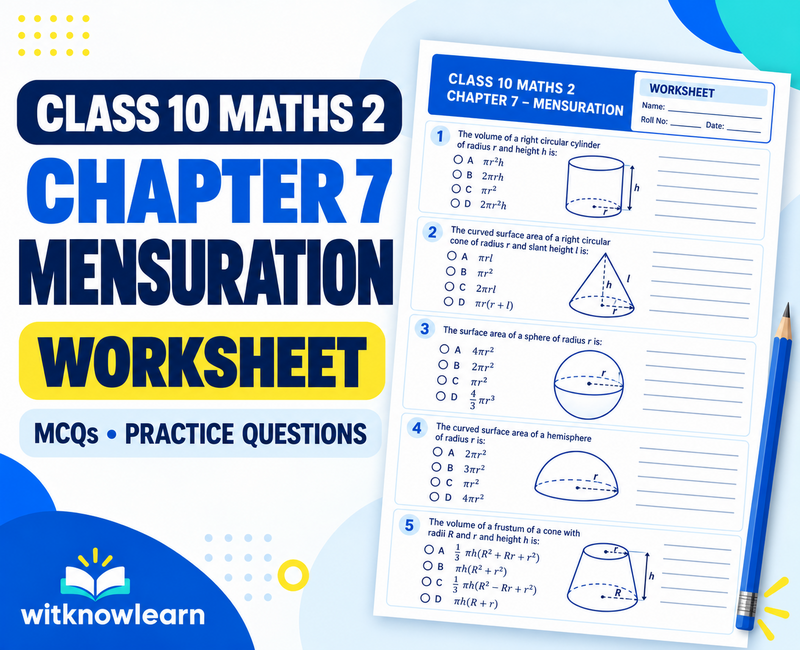
Maharashtra Board Practice Worksheet
Class 10 Maths 2 Chapter 7
Mensuration Worksheet
Practise Maharashtra Board Class 10 Maths 2 Chapter 7 Mensuration with
MCQs, surface-area and volume calculations, combined solids, conversion
of solids, frustums and questions previously asked in Maharashtra Board
examinations.
Worksheet objective: Revise the complete Mensuration
chapter using previous Maharashtra Board examination questions and
additional similar questions covering all important solids and
applications.
What Is Included in This Mensuration Worksheet?
This worksheet contains concept-based MCQs, formula questions,
numerical problems, word problems and examination-focused questions.
Questions previously asked in Maharashtra Board examinations have been
included, with the examination year mentioned beside applicable
questions in the worksheet.
Additional similar questions are included using different measurements
and situations. These questions help students practise the same formula
and method independently instead of memorising only the answer to a
previous examination question.
2
Previous Board Questions
3
Similar Practice Questions
Class 10 Mensuration Worksheet
This Class 10 Mensuration worksheet is designed for Maharashtra State
Board students who want structured practice after studying Chapter 7.
It covers cylinders, cones, spheres, hemispheres, frustums, combined
solids, conversion of solids and practical applications involving
capacity, area and volume.
Students must first identify the solid and determine whether the
question requires curved surface area, total surface area or volume.
All measurements should be converted to the same unit before
substitution, and every calculation should be shown one mathematical
step per line.
πr²
Surface Area
Calculate curved and total surface areas by identifying which
surfaces are exposed.
V
Volume and Capacity
Calculate the space occupied by solids and convert cubic units
into litres or millilitres.
3D
Combined Solids
Divide complex objects into familiar solids and combine their
areas or volumes correctly.
Important Mensuration Formulae
Cylinder: CSA = 2πrh, TSA = 2πr(r + h), Volume = πr²h
Cone: CSA = πrl, TSA = πr(l + r), Volume = ⅓πr²h
Sphere: Surface area = 4πr², Volume = ⁴⁄₃πr³
Hemisphere: CSA = 2πr², TSA = 3πr², Volume = ⅔πr³
Frustum volume = ⅓πh(R² + Rr + r²)
- For a cone, slant height l = √(r² + h²).
- Diameter = 2 × radius.
- 1 litre = 1000 cm³.
- 1 millilitre = 1 cm³.
- Surface area is written in square units.
- Volume and capacity are written in cubic units.
Types of Questions Included
Multiple-Choice Questions
MCQs test formula selection, radius and diameter, curved and total
surface area, volume, capacity and unit conversion.
Previous Maharashtra Board Questions
Selected questions previously asked in Maharashtra Board
examinations are included for focused preparation. The examination
year is mentioned beside applicable questions.
Additional Similar Questions
Similar questions with changed measurements and situations provide
additional practice of important Board examination methods.
Surface-Area Questions
Students calculate curved or total surface area after identifying
which surfaces of the solid are exposed.
Volume and Capacity Questions
These questions involve the volume of solids, containers, tanks
and conversion between cubic centimetres and litres.
Combined Solids
Students separate a complex object into cylinders, cones, spheres
or hemispheres and add or subtract the required measurements.
Conversion and Recasting
When one solid is melted and recast into another, students equate
the original volume with the total volume of the new solids.
Frustum Problems
Students identify the larger radius, smaller radius, height and
slant height before applying the required frustum formula.
How to Solve Mensuration Questions
- Draw or study the solid and mark all given measurements.
- Convert the diameter into radius wherever necessary.
- Convert every measurement into the same unit.
- Identify whether area, volume or capacity is required.
- Separate combined objects into familiar solids.
- Write the correct formula before substituting values.
- Calculate one mathematical step per separate line.
- Write the final answer with the correct square or cubic unit.
Benefits of Practising This Worksheet
-
Provides practice with questions previously asked in Maharashtra
Board examinations.
-
Shows the examination year beside applicable previous questions.
-
Includes additional similar questions for independent practice.
-
Revises all important surface-area and volume formulae.
-
Improves understanding of combined and converted solids.
-
Develops accuracy in units and capacity conversions.
-
Supports school tests, prelims and SSC Board preparation.
Common Mistakes Students Should Avoid
- Do not use the diameter in place of the radius.
- Do not confuse curved surface area with total surface area.
- Do not include a joined internal surface in the external area.
- Do not use surface area when the question asks for volume.
- Do not mix centimetres and metres in one calculation.
- Do not use square units for volume.
- Do not round decimal values before the final calculation.
- For recasting questions, equate volumes rather than areas.
Check Your Work with Chapter 7 Solutions
Attempt the previous Board questions and similar practice questions
independently. After completing the worksheet, compare your formulae,
unit conversions and final answers with the complete Chapter 7
Mensuration solutions.
View Chapter 7 Solutions →
Frequently Asked Questions
Select any question to view its answer.
What is included in the Mensuration worksheet?
It includes MCQs, surface area, volume, capacity, combined
solids, recasting, frustums, previous Board questions and
similar practice questions.
Does it include previous Maharashtra Board questions?
Yes. Selected questions previously asked in Maharashtra Board
examinations are included, with the year mentioned beside
applicable questions.
Are additional similar questions included?
Yes. Similar questions with changed measurements provide
additional practice of the same concepts.
What is the difference between surface area and volume?
Surface area measures the outer covering of a solid, while
volume measures the space occupied by the solid.
What remains unchanged during recasting?
The total volume remains unchanged when no material is lost.
How are litres converted into cubic centimetres?
One litre equals 1000 cubic centimetres, and one millilitre
equals one cubic centimetre.
Does the worksheet contain MCQs?
Yes. It includes formula-based MCQs followed by numerical and
application questions.
Is it useful for Maharashtra SSC preparation?
Yes. Previous Board questions and similar practice questions
provide focused Maharashtra SSC examination preparation.
When should I check the Chapter 7 solutions?
Check the solutions after attempting every question and showing
complete formula substitution and calculation.

 Download