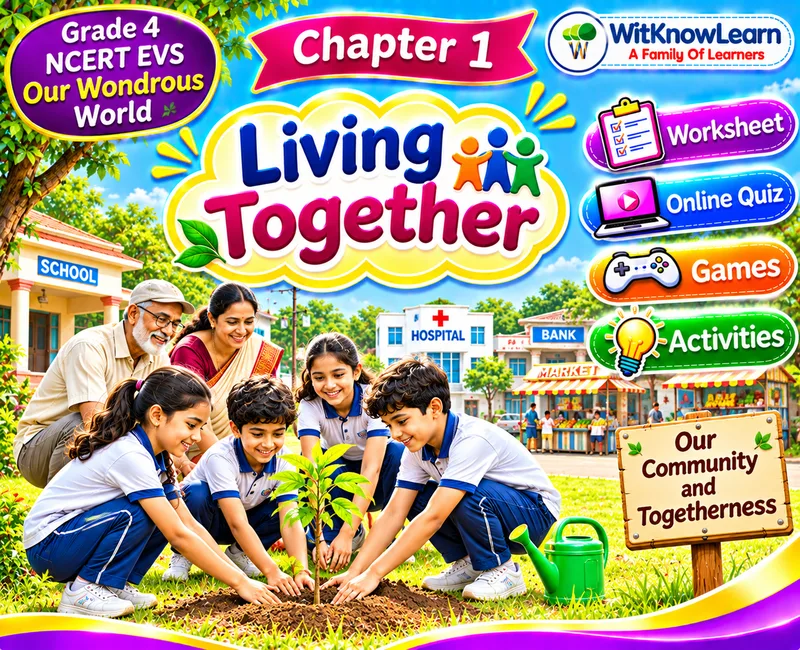
Living Together Class 4 EVS Worksheet with Online Quiz & Games
Read the worksheet. Play the online quiz. Explore chapter ideas through games and observation.
Chandan’s village prepares for Van Mahotsav by improving a shared park. Children, families and skilled workers contribute different kinds of help. The chapter connects community places, cooperation, shared celebrations and continued care for nature.
Explore the learning cards and the discovery lab, then choose a Games, Labs or Challenges island.
Living Together Class 4 Online Quiz
20 questions · full review after submission
Living Together Class 4 Activities
Observe, compare and explain. Earn up to 3 stars in every activity.
Living Together Worksheet for Class 4 EVS
Chandan’s village prepares for Van Mahotsav by improving a shared park. Children, families and skilled workers contribute different kinds of help. The chapter connects community places, cooperation, shared celebrations and continued care for nature.
This worksheet with online quiz and online activities connects the chapter with fresh situations. Children compare clues, use precise vocabulary and explain why a choice fits. The activities include classification, matching, memory, word construction, sequence work and short scenario challenges.
Learning begins with noticing. A clear record separates observation from a prediction or a guess. Children can then connect what they noticed with an idea from the chapter and consider how it applies to their own surroundings.
| Idea | Meaning | Learning check |
|---|---|---|
| Community | people connected through shared places, activities or interests | Give a relevant example and explain the connection. |
| Cooperation | working together towards a common purpose | Give a relevant example and explain the connection. |
| Public Place | a place used by members of the community | Give a relevant example and explain the connection. |
| Sapling | a young tree | Give a relevant example and explain the connection. |
Four steps to a supported answer
- Read the complete question or situation.
- Identify the evidence available.
- Connect the clue with an appropriate chapter idea.
- Check that the answer does not claim more than the evidence supports.
Three worked examples
Before the event
Choose a shared goal, ask who can help and list the tasks.
During the event
Use agreed roles, keep paths clear and listen to people’s needs.
After the event
Clean up, thank contributors and plan continued plant care.
Living Together Class 4 EVS questions and answers on this page support NCERT Our Wondrous World Chapter 1. The online quiz includes an explained review, while the practice sheet provides live marking and answer reveal.
Living Together Class 4 EVS Complete Chapter Guide
Living Together Chapter Guide
NCERT Our Wondrous World · Chapter 1 · Unit: Our Community.
Chapter introduction
Chandan’s village prepares for Van Mahotsav by improving a shared park. Children, families and skilled workers contribute different kinds of help. The chapter connects community places, cooperation, shared celebrations and continued care for nature.
Topic explanations and careful distinctions
Van Mahotsav and ongoing care
The chapter places Van Mahotsav in the first week of July, during India’s rainy season. Planting is followed by suitable care of saplings and the shared park. The work involves planning, cleaning, repairing, planting, watering and sharing a meal.
Community examples
The Kanker bridge account illustrates cooperation when access across a river becomes difficult. The chapter also describes Uruka community feasting in Assam and Khetala-related cooperation in Sikkim. Dates and practices can vary; one example does not describe every family.
Tools and roles
A mason may work with brick and mortar, a carpenter with wooden objects and an electrician with electrical systems. Children can observe or help with suitable tasks, while electrical work and other specialist repairs belong with trained adults.
Learning objectives
- Identify the chapter’s key ideas and vocabulary.
- Use relevant details to support an answer.
- Compare examples using a clear classification rule.
- Explain connections between people, materials or natural processes.
- Keep an honest observation or activity record.
- Apply an idea to a new situation.
Learning outcomes
Children can use precise terms, identify a supported conclusion and explain a practical connection. Personal observation, drawing and reflection tasks can have several suitable responses.
Key Concepts Meanings and Examples
| Term | Meaning |
|---|---|
| Community | people connected through shared places, activities or interests |
| Cooperation | working together towards a common purpose |
| Public Place | a place used by members of the community |
| Sapling | a young tree |
| Nursery | a place where young plants are grown |
| Volunteer | a person who willingly helps with a task |
| Mason | a skilled worker who builds or repairs masonry |
| Carpenter | a skilled worker who makes or repairs wooden objects |
| Electrician | a trained worker who handles electrical installations |
| Compost | decomposed organic material used to improve soil |
| Feast | a special shared meal |
| Harvest | the gathering of a crop |
| Inclusion | making room for people to participate |
| Maintenance | continued work that keeps something in good condition |
| Interdependence | relying on one another in different ways |
| Responsibility | a duty to act with care |
Eight solved vocabulary examples
- Electrician: a trained worker who handles electrical installations.
- Compost: decomposed organic material used to improve soil.
- Feast: a special shared meal.
- Harvest: the gathering of a crop.
- Inclusion: making room for people to participate.
- Maintenance: continued work that keeps something in good condition.
- Interdependence: relying on one another in different ways.
- Responsibility: a duty to act with care.
Resources on this page
| Resource | Includes |
|---|---|
| Quiz | 20 questions with timer and explained review after submission |
| Learn | 6 flip cards and a 3-round discovery lab |
| Activity islands | 5 games, 5 labs and 5 challenges |
| Practice | 16 short answers with live marking and answer reveal |
| Personal work | Observation, design, writing and reflection prompts |
Common mistakes
| Confusion | Better approach |
|---|---|
| A guess is the same as an observation | Record what was actually noticed |
| One example proves an unlimited rule | State the conditions and limits |
| Every learner must give identical personal examples | Accept relevant examples with clear reasons |
| A term’s spelling alone explains its meaning | Use the complete context |
Apply the chapter
Before the event: Choose a shared goal, ask who can help and list the tasks.
During the event: Use agreed roles, keep paths clear and listen to people’s needs.
After the event: Clean up, thank contributors and plan continued plant care.
Inquiry and reflection
Ask what you know, how you know it and what you would need to check next. Listen to different experiences without assuming that one person’s surroundings or choices describe everyone.
Explore Observe and Create
Community Plan Board
Select checkpoints for an imagined shared project. A plan includes preparation, suitable roles and continued care.
Living Together Choice Explorer
Choose a situation and compare the chapter connection.
My community map
Draw four places near you and explain how people use each.
An invitation
Write an invitation to a shared planting event, including place, date and purpose.
A helper interview
Write three respectful questions about a worker’s tools, skills and contribution.
My role
Describe one task you can help with and the adult support it needs.
A follow-up diary
Record observations of one planted tree without damaging it.
More Grade 4 EVS Chapters
Frequently Asked Questions
What is Living Together in Class 4 EVS?
Living Together is Chapter 1 of NCERT Our Wondrous World, also called The World Around Us. Chandan’s village prepares for Van Mahotsav by improving a shared park. Children, families and skilled workers contribute different kinds of help. The chapter connects community places, cooperation, shared celebrations and continued care for nature.
Does this Living Together Class 4 worksheet include an online quiz?
Yes. There are 20 questions with a timer, numbered navigation, a score out of 20 and an explained review after submission.
What is Van Mahotsav?
It is a tree-planting festival. The chapter places it in the first week of July and connects it with community work and continued plant care.
Why are public places important?
Places such as parks, schools and roads support different shared needs. Keeping them usable benefits many people.
What are the key ideas in Living Together?
community, cooperation, public place, sapling, nursery, volunteer, mason, carpenter. The chapter also encourages observation, discussion and applying ideas in everyday settings.
What does community mean?
People connected through shared places, activities or interests.
What does cooperation mean?
Working together towards a common purpose.
How can children answer observation questions?
Describe the visible evidence first, then give a reasoned inference if asked. Distinguish what was observed from what is predicted or guessed.
What is included beyond the worksheet?
Six flip cards, a three-round discovery lab, five games, five focused labs, five challenges, a 16-question practice sheet, a choice explorer and personal observation tasks.
How does cooperation help a community?
People combine different skills, materials and time to address shared needs.
Can activities be used on a phone?
The page adapts to a smaller screen. Tile activities support tap-then-tap as well as dragging; quiz options stack on narrow screens.
Are all personal observations automatically marked?
No. A local map, diary, interview, design or reflection may have many suitable responses. The writing tasks offer prompts, while the fixed-answer practice has live marking and answer reveal.
 Download