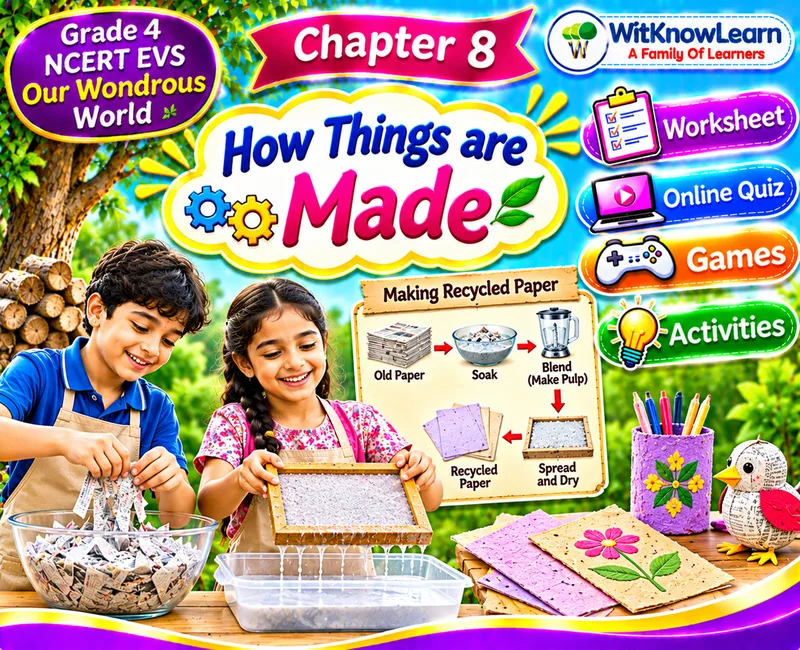
How Things Are Made Class 4 EVS Worksheet with Quiz and Activities
NCERT Our Wondrous World Chapter 8: paper from trees, recycled paper, natural colours, types of paper and the 5Rs of waste management. On WitKnowLearn you get the How Things Are Made Class 4 online quiz, online activities and interactive games, science labs, a virtual lab and a practice sheet, all on one page.
How Things Are Made Class 4 Online Quiz
20 questions: 10 easy, 5 average and 5 thinking. Tap an answer and the next question comes up.
How Things Are Made Class 4 Activities
How Things Are Made: the Chapter Story
A short read for Class 4 before you play. These notes are written for this page and are not copied from the textbook.
🌳 From tree to paper
One Sunday, Pihu is painting while her mother reads the newspaper. A picture says that recycling paper can save trees. Pihu learns that her drawing book, napkins, newspapers and chart papers all come from trees.
🧪 Making recycled paper
Pihu and her mother try making paper at home. They tear old newspapers, soak them overnight with a few fenugreek seeds, mash the mixture into pulp, roll it into thin sheets and let it dry. The seeds help hold the pulp together. The new paper feels rougher than a drawing book, and that is fine!
🎨 Colours from nature
Next they colour pieces of the same size using turmeric, spinach, beetroot and henna. They use the same quantity of each, then note the colour and whether it is dull or bright. Natural dyes come from plant parts and are safe to use.
💌 A special gift
Pihu turns her handmade paper into a greeting card for her mother. A card from recycled paper is a lovely and thoughtful gift.
📜 Paper long ago
Before paper, people wrote on cloth, leaves and wooden boards. In India, palm leaves called talapatra were used. Today materials like banana fibre can also make paper and save trees.
♻ The 5Rs
We can look after the Earth with the 5Rs: Refuse, Reduce, Reuse, Repurpose and Recycle. Each R is a small choice, like saying no to a plastic straw or turning old newspapers into toys.
How Things Are Made Class 4 Activities
Read, play and learn about paper, natural colours and the 5Rs. Earn up to 3 stars in every activity.
Everything around us is made from something. In this chapter children follow the story of paper, from trees to the pages of a book. They also learn that making paper uses many trees, a lot of water and energy, so we should use it wisely.
Children then make recycled paper from old newspapers, colour it with natural ingredients and explore different types of paper. They finish with the 5Rs, five simple choices that reduce waste and protect the environment.
Words and facts to know
| Word | Meaning | Example |
|---|---|---|
| Pulp | A soft wet mixture of paper fibres | Soaked newspaper that has been mashed |
| Binding material | Something that holds things together | Fenugreek seeds in paper pulp |
| Natural dye | Colour made from plant parts | Turmeric gives a yellow colour |
| Recycle | Make something new from used material | Old newspapers to handmade paper |
How to use this page
- Flip the six cards and try the Paper Making Lab in the Learn tab.
- Play the five games and the five science labs to practise each idea.
- Finish the five challenges to collect up to 15 points.
- Take the 20-question online quiz and fill in the practice sheet.
Worked examples
20 − 13 = 7, so 7 sheets are left.
3 × 6 = 18, so 18 cards are made.
This is repurposing, because the newspaper gets a new use.
This How Things Are Made worksheet for Class 4 (NCERT Our Wondrous World Chapter 8) gives you online activities and interactive games that turn the chapter into play. Every activity has a goal, a hint and a short fact, so children learn while they enjoy.
Complete Guide: EVS How Things Are Made Class 4
This guide is for Class 4 students, parents and teachers who are studying NCERT Our Wondrous World, Chapter 8, How Things Are Made. It explains the main ideas in simple words and shows how to use the quiz, labs and games on this page.
Introduction to NCERT Class 4 EVS Chapter 8
Chapter 8 of Our Wondrous World (The World Around Us) is called How Things Are Made. Using paper as the example, it shows where materials come from, how they are made and how we can use them responsibly. This introduction is written for this page and is not copied from the textbook.
What is there in this chapter
- Paper comes from trees, and recycling paper saves trees.
- Making recycled paper with old newspapers, fenugreek seeds and water.
- A natural colour experiment with turmeric, spinach, beetroot and henna.
- Making a greeting card or a mask from recycled paper.
- Making paper from wood pulp, and earlier writing materials such as talapatra.
- Different types of paper and their uses, and the Braille system.
- The 5Rs of waste management and creative ideas with used paper.
Learning objectives (written for this page, not copied from the book)
- Explain that paper is made from trees and that its making uses water and energy.
- List the steps for making recycled paper.
- Do a fair colour test using the same size and quantity.
- Match different types of paper with their uses.
- Name the 5Rs and give an example of each.
Learning outcomes
- The child can make simple recycled paper with adult help.
- The child can compare natural colours and record them in a table.
- The child can pick the right R for a daily situation.
- The child can suggest ways to save paper at home and school.
How Things Are Made Class 4 resources on this page
| Resource | What it gives |
|---|---|
| Online quiz | 20 questions: 10 easy, 5 average and 5 thinking, with a full review |
| Flip cards | 6 picture cards with one-line rules |
| Paper Making Lab | A hands-on lab with 3 rounds |
| Games | 5 interactive games |
| Labs | 5 science activity labs |
| Virtual Lab | 2 experiments with aim, procedure, observation table and conclusion |
| Challenges | 5 challenges, 15 points in all |
| Practice sheet | 16 questions with answer boxes and a live score |
Key facts
| Topic | Key idea |
|---|---|
| Source | Paper is made from trees. |
| Recycled paper | Old paper is soaked, mashed, rolled and dried. |
| Natural dyes | Made from plant parts and safe to use. |
| The Rs | Refuse, reduce, reuse, repurpose and recycle. |
Types of questions you may see
- Multiple choice and true or false questions on facts.
- Fill in the blanks and match the following.
- Short answers in your own words.
- Situation-based tasks such as choosing the right R.
Solved examples
Old newspapers, fenugreek seeds and water.
5 × 4 = 20 sheets.
So that the colours can be compared fairly.
Reuse.
Making boxes and packing things.
Write on both sides of a sheet.
Common mistakes
| Mistake | Correct idea |
|---|---|
| Paper does not need trees. | Most paper comes from trees. |
| Reuse and repurpose mean the same. | Reuse is the same job again; repurpose is a new use. |
| Natural dyes are harmful. | Natural dyes made from plants are safe to use. |
| Recycled paper looks exactly like book paper. | It is rougher because it is handmade. |
How Things Are Made in daily life
At home, children can reuse bags, write on both sides of paper and give old books to others. At school, they can collect used paper and make handmade paper or cards.
Tips for parents and teachers
- Keep a box for used paper and talk about how to use it again.
- Let an adult handle the grinder or blender when making pulp.
- Use paper pieces of the same size and the same quantity of ingredient in the colour test.
- Praise creative ideas for using old paper.
Related NCERT Our Wondrous World Class 4 Worksheets
- 🤝Chapter 1: Living Together Class 4
- 🏘Chapter 2: Exploring Our Neighbourhood Class 4
- 🦋Chapter 3: Nature Trail Class 4
- 🌱Chapter 4: Growing Up with Nature Class 4
- 🥗Chapter 5: Food for Health Class 4
- 😊Chapter 6: Happy and Healthy Living Class 4
- ⚙Chapter 7: How Things Work Class 4
- 🌏Chapter 9: Different Lands, Different Lives Class 4
- 🌤Chapter 10: Our Sky Class 4
How Things Are Made Class 4 FAQs
What is How Things Are Made in Class 4 EVS?
How Things Are Made is Chapter 8 of the NCERT Class 4 book Our Wondrous World. Children learn how paper is made from trees, make recycled paper from old newspapers, colour it with natural ingredients and learn the 5Rs of waste management.
How is paper made?
Paper is made from wood pulp, which comes from trees. Making paper needs many trees, a lot of water and a lot of energy. That is why we should use paper responsibly and only when needed.
How do we make recycled paper at home?
Collect old newspapers, fenugreek seeds and water. Tear the paper, soak it with the seeds overnight, mash it into a wet mixture, roll it into thin sheets and let them dry. An adult should help with any grinder or blender.
Why are fenugreek seeds used?
Fenugreek (methi) seeds act as a binding material. They help hold the paper pulp together so that it forms a sheet.
Which natural ingredients can colour paper?
Turmeric, spinach, beetroot and henna are examples. Natural dyes are made from plant parts such as leaves, flowers, roots and seeds, and they are safe to use. Use the same size of paper and the same quantity of ingredient for a fair test.
What are the 5Rs of waste management?
The 5Rs are Refuse, Reduce, Reuse, Repurpose and Recycle. Refuse means saying no to waste-making things, reduce means using less, reuse means using again, repurpose means giving a new use, and recycle means making something new from old material.
What is the difference between reuse and repurpose?
Reuse means using the same thing again for the same job, such as a gift bag. Repurpose means using it in a new and creative way, such as turning an old bottle into a flower vase.
Does this page have How Things Are Made Class 4 questions and answers?
Yes. The 20-question online quiz ends with a full review that shows the correct answer and a short reason for every question. The practice sheet has 16 questions and a Show answers button.
Which class and book is this worksheet for?
This worksheet is for Class 4 and follows NCERT Our Wondrous World (The World Around Us, EVS) Chapter 8, How Things Are Made. The learning objectives and all questions are written for this page and are not copied from the textbook.
What can children do on this page?
Children can take the online quiz, play interactive games, try online activities and science labs, finish challenges, do the hands-on Paper Making Lab, run two virtual experiments and solve a practice sheet. They can earn up to 3 stars in every activity.
Can my child use these activities on a phone?
Yes. The page works on phones, tablets and laptops. Children can drag a word or card with a finger or mouse, or tap the word first and then tap the box where it belongs.
What is included on this page?
This page has a 20-question online quiz, 6 flip cards, the Paper Making Lab, 5 games, 5 labs, 5 challenges, a virtual lab with 2 experiments, a 16-question practice sheet, a chapter story, a topic description, a complete guide, related NCERT Class 4 worksheets and 12 FAQs.
 Download