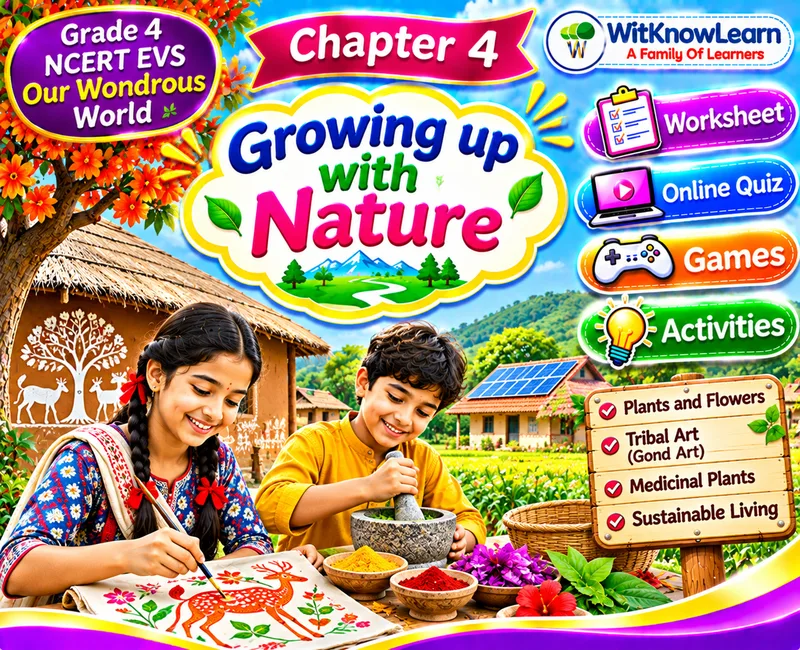
Class 4 EVS · Our Wondrous World · Chapter 4
Growing up with Nature Class 4 EVS Worksheet with Quiz and Activities
Why is Palash called the flame of the forest, and how can a whole village run on sunlight? Find out with this Growing up with Nature worksheet for Class 4 EVS (Our Wondrous World, Chapter 4): take the Growing up with Nature Class 4 online quiz, test natural dyes in the Virtual Lab and play the activities and interactive games online.
Flip the cards and try the Village Life Lab, then tap the Games, Labs, Challenges or Virtual Lab island.
Growing up with Nature Class 4 Online Quiz
20 questions · tap an answer to move on · full review at the end
Flip the cards, try the Village Life Lab, then play the games, do the labs and take the challenges. Earn up to 3 stars in every activity.
Fact cards: tap a card to flip it
Village Life Lab
Help the village with three everyday tasks. In each one, drag the choice you think is nature-friendly onto the picture and watch what happens. A wrong choice shows what goes wrong, so you can try again.
Challenge marks: 0 / 15 (0 of 5 challenges done)
Finish all 5 challenges to see your comment.
Virtual Lab: do real experiments step by step
Practice sheet
Growing up with Nature Class 4 Activities
Help a village live in harmony with nature, light it with solar power, build a mud house and test natural dyes and clay pots in the Virtual Lab. Earn up to 3 stars in every activity.
A journey to a village near the forest
"Growing up with Nature" is Chapter 4 of the Class 4 EVS book Our Wondrous World. It follows Reena and Amit, who travel with their family to their village near a forest. It is time for the harvest festival, and there is extra excitement: on the same day, the village is becoming a fully solar-powered village. Through their trip, the children discover how closely village life is connected with nature, and how people there use natural resources wisely and thank nature for everything it gives.
The flame of the forest
As they enter the village, the children see trees covered with bright orange-red flowers. This is the Palash tree. When it blooms, the whole forest looks reddish-orange from far away, so it is called the flame of the forest. In Gujarat, Palash is known as Kesuda. Just like Palash, many flowers and trees have different local names in different parts of India.
Sunlight that lights up homes
The village has solar panels. These panels take in sunlight and change it into electricity, which runs fans, bulbs and other appliances. Sunlight is a renewable source of energy: it will not run out, and using it does not make smoke. Resources such as coal and petroleum are limited and will not last forever, so clean energy from the Sun helps protect our planet.
Homes made from nature
Amit notices that the village houses look very different from city houses. They are built using clay, hay, cow dung and other natural materials. Such homes stay cool in summer and do not harm the environment. Their walls are decorated with beautiful paintings made by the children’s grandmother, using a dye of rice flour and water. Grandmother also paints on cloth with colours made from flowers, leaves and powdered coloured stones. One famous style of painting with natural colours is Gond art, which shows trees, animals, birds and people.
Making natural dyes
Many plant parts have colouring properties, such as beetroot, hibiscus and marigold. To make a natural dye, we collect these plant parts, boil them in water for 30 minutes to an hour with an adult’s help, and then strain the liquid. A light-coloured handkerchief soaked in the dye overnight comes out beautifully coloured. Natural dyes are gentle on our skin and on rivers.
Clever ways to store food
In the village house, the children see tools for farming and collecting honey, and containers for storing grain. Earthen pots are lined inside with neem leaves, and bamboo baskets are coated outside with cow dung. These traditional methods keep insects and pests away from the stored grain. In Uttarakhand, people use a Tumri, a container made from a dried bottle gourd. Every region has its own clever ways of preserving food.
Respecting nature: honey, herbs and healing
The Jenu Kurubas, a tribe from Karnataka, get their name from Jenu, which means honey. When they collect honey, they sing songs to apologise to the bees, showing deep respect for nature. In the village, Dada ji uses a mixture made with neem oil to keep mosquitoes away. Plants like tulsi (leaves) and ajwain (seeds) are used at home for common problems. A first-aid box is also important, because quick help can prevent a small injury from becoming serious.
Festivals that celebrate nature
In the evening, the whole village glows with colourful lights. Prayers are offered to God and mother nature, the dhol and nagada fill the air, and everyone joins the traditional dance. Many festivals in India are linked with plants and animals: on Vat Purnima people worship the banyan tree, Hari Jiroti is celebrated by planting fruit-bearing trees, and the Kaziranga Elephant Festival spreads awareness about elephants. Sacred groves are small patches of forest protected by local communities, where trees and wildlife are kept safe.
How we can care for nature
We use nature every day for food, clothes and health. If we overuse resources like water, soil, wood or sea products, they can run short. We can help by reducing paper waste, saying no to plastic, saving water and electricity, keeping food and water for birds, planting trees and organising clean-up drives.
This Growing up with Nature worksheet for Class 4 EVS brings the chapter to life on WitKnowLearn with an online quiz, online activities and interactive games. Flip the cards, help the village in the Village Life Lab, play the games, do the nature labs, take the challenges and then test natural dyes and a clay pot in the Virtual Lab.
EVS Growing up with Nature Class 4
Growing up with Nature is Chapter 4 of the Class 4 EVS book Our Wondrous World. It explains how a village near a forest lives closely with nature: the Palash tree, solar energy, homes made of natural materials, natural dyes and Gond art, traditional ways of storing grain, herbal remedies, festivals linked with plants and animals, sacred groves and ways to protect nature. This guide explains each idea in simple language for Class 4 students, parents and teachers. It goes with the Growing up with Nature worksheet for Class 4 on WitKnowLearn, which also gives an online quiz, online activities, interactive games and a Virtual Lab on the same page.
What is there in this chapter
- Palash, the flame of the forest
- A solar-powered village
- Houses made of clay, hay and cow dung
- Natural dyes and Gond art
- Traditional ways to store grain
- The Jenu Kurubas, neem, tulsi and ajwain
- Festivals, sacred groves and caring for nature
Learning objectives
- Describe how village life depends on nature.
- Explain the use of solar energy.
- Identify natural materials and traditional practices.
- Suggest ways to use natural resources carefully.
Learning outcomes
After this page a child can:
- Sort materials into natural and factory-made.
- List the steps to make a natural dye.
- Explain how neem and cow dung protect stored grain.
- Name festivals linked with plants and animals.
Growing up with Nature Class 4 resources on this page
| Resource | What it does |
|---|---|
| Growing up with Nature Class 4 online quiz | 20 questions in three levels with a full answer review |
| Flip cards | Six cards on Palash, the solar village, natural homes, natural colours, storing grain and thanking nature |
| Village Life Lab | Store the harvest, light the village and keep mosquitoes away the nature-friendly way |
| 5 interactive games | Nature or factory, natural colour bubbles, nature’s gifts memory, festivals of nature, helps or harms |
| 5 nature labs | Natural dye steps, solar power, build a mud house, herbal garden and power cut |
| 5 challenges | Marked out of 3 each with a total out of 15 |
| Virtual Lab | Two full experiments on natural dye colours and cooling water in a clay pot, with aim, objectives, procedure, observation table, conclusion and outcomes |
| Practice sheet | 16 questions with answer boxes and a live score |
Important words
| Word | Meaning |
|---|---|
| Solar panel | A panel that turns sunlight into electricity |
| Natural dye | Colour made from plants, flowers or stones |
| Gond art | A painting style showing nature in natural colours |
| Sacred grove | A forest patch protected by a community |
| Tumri | A store made from a dried bottle gourd |
| Renewable | Something that will not run out, like sunlight |
Types of questions
- Facts from the story
- Natural or man-made
- Steps to make a dye
- Ways to store grain
- Festivals and their plants or animals
- Saving resources
- Thinking questions on overuse
Solved examples
Common mistakes
| Mistake | Correct |
|---|---|
| Thinking solar panels need coal | They use only sunlight. |
| Calling all colours natural | Natural dyes come from plants or stones, not plastic. |
| Boiling dye without an adult | Always ask a grown-up to help. |
| Thinking nature never runs out | Overuse causes shortages. |
Daily life
We use nature all day: cotton clothes, wooden furniture, fruits and vegetables, neem and tulsi for health, and sunlight for drying clothes. Saving water and electricity, avoiding plastic and planting trees are simple ways to say thank you to nature.
Tips for parents and teachers
- Make a natural dye with beetroot together, with adult supervision.
- Grow tulsi or mint in a small pot.
- Ask grandparents about traditional ways to store food.
- Find out the local names of trees and flowers in your area.
- Let the child retry the challenges to earn 3 stars.
Related Class 4 Worksheets
- Adaptation in Plants Worksheet Class 4
- Reproduction in Animals Worksheet Class 4
- Adaptation in Animals Worksheet Class 4
- States of Matter Worksheet Class 4
- Teeth and Microbes Worksheet Class 4
- Food and Nutrition Worksheet Class 4
- Force Work and Energy Worksheet Class 4
- Air Water and Weather Worksheet Class 4
- Leaves and the Food Factory of Plants Worksheet Class 4
- Safety and First Aid Worksheet Class 4
- Our Environment Worksheet Class 4
- Our Universe Worksheet Class 4
Frequently Asked Questions
 Download