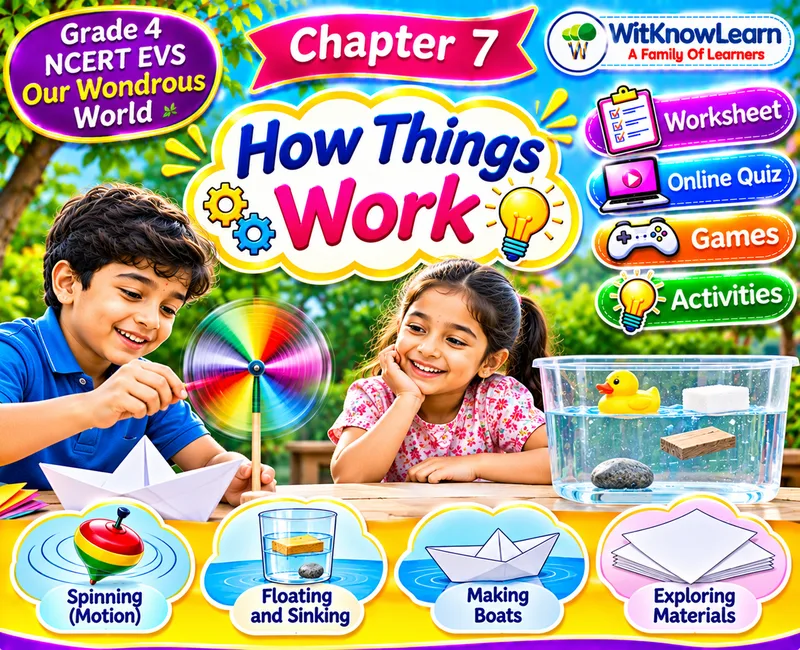
How Things Work Class 4 EVS Worksheet with Quiz and Activities
NCERT Our Wondrous World Chapter 7: spinning objects, spinners, tops and the charkha, floating and sinking, and building boats. On WitKnowLearn you get the How Things Work Class 4 online quiz, online activities and interactive games, science labs, a virtual lab and a practice sheet, all on one page.
How Things Work Class 4 Online Quiz
20 questions: 10 easy, 5 average and 5 thinking. Tap an answer and the next question comes up.
How Things Work Class 4 Activities
How Things Work: the Chapter Story
A short read for Class 4 before you play. These notes are written for this page and are not copied from the textbook.
🪙 Spin it and see
Meera and Dhruv gather a coin, a bangle, a pencil, a stone, a wooden spinner and an eraser. They spin each one and watch closely. The coin spins well, but as it slows it begins to shake. The eraser does not spin properly at all. Spinning is a way to discover how things behave.
🌀 Spinners in the centre
Next they make spinners from cardboard and toothpicks. A spinner with the toothpick at the centre stays upright and turns round and round. When the toothpick is away from the centre, it does not spin properly. A square card looks like a circle when it spins fast!
🧵 Old toys and tools
Spinning is very old. People in India have played with tops for thousands of years, first from clay and later from wood, like the lattu. The charkha uses a spinning wheel to twist cotton fibre into thread, and ceiling fans and potter's wheels spin too.
💧 Float or sink?
Meera and Dhruv float paper boats in a puddle. Some float properly and some flip over. Then they fill a bucket with water and guess first, then drop a leaf, a nail and more objects. They learn that heavy or light alone does not decide the result.
🔍 Shape matters
A piece of foil spread out or shaped like a cup floats. Pressed into a tight ball, it sinks. If the ball is not pressed tightly, it may float. Changing the shape changes what happens.
⛵ Build and test boats
In groups of three or four, children make boats from paper, cardboard, ice-cream sticks, clay or shells. They compare strengths and challenges, balance the weight and try again. A class exhibition lets everyone share what they learned.
How Things Work Class 4 Activities
Read, play and learn about spinning, floating and sinking. Earn up to 3 stars in every activity.
Science begins with a simple question: what will happen if I try this? In this chapter children spin objects, build spinners, drop things in water and make boats. They guess first, observe carefully and then think about the reason. When something does not work, they change one thing and test again.
Spinning and floating are all around us. A potter's wheel, a ceiling fan and a charkha all spin, and boats carry people across water. Children learn that shape and balance matter. The same foil can float or sink, and a boat with its weight on one side can tip over.
Words and facts to know
| Word | Meaning | Example |
|---|---|---|
| Spin | To turn round and round | A coin or a wooden top |
| Float | To stay on top of water | A leaf on a puddle |
| Sink | To go down in water | An iron nail |
| Balance | When weight is spread evenly | A boat that does not tip over |
How to use this page
- Flip the six cards and try the Float and Sink Lab in the Learn tab.
- Play the five games and the five science labs to practise each idea.
- Finish the five challenges to collect up to 15 points.
- Take the 20-question online quiz and fill in the practice sheet.
Worked examples
10 − 6 = 4, so 4 objects float.
8 × 3 = 24, so 24 sticks are needed.
The shape is different, and shape affects floating and sinking.
This How Things Work worksheet for Class 4 (NCERT Our Wondrous World Chapter 7) gives you online activities and interactive games that turn the chapter into play. Every activity has a goal, a hint and a short fact, so children learn while they enjoy.
Complete Guide: EVS How Things Work Class 4
This guide is for Class 4 students, parents and teachers who are studying NCERT Our Wondrous World, Chapter 7, How Things Work. It explains the main ideas in simple words and shows how to use the quiz, labs and games on this page.
Introduction to NCERT Class 4 EVS Chapter 7
Chapter 7 of Our Wondrous World (The World Around Us) is called How Things Work. Children explore spinning objects, spinners, floating and sinking, and boat building through hands-on activities. This introduction is written for this page and is not copied from the textbook.
What is there in this chapter
- Spinning a coin, a bangle, a pencil, a stone, a wooden spinner and an eraser.
- Making spinners with cardboard, toothpicks and a pen tube.
- The charkha, tops, ceiling fans and potter's wheels.
- Testing what floats and what sinks, and how shape changes the result.
- Building and balancing boats in groups, and a class exhibition.
- A table with the columns I observe, I wonder and I think.
Learning objectives (written for this page, not copied from the book)
- Observe which objects spin and describe how they spin.
- Guess and then test whether objects float or sink.
- Explain that shape and balance affect floating and sinking.
- Record observations in a table.
- Plan, build and improve a boat with a group.
Learning outcomes
- The child can make a spinner and say what makes it spin better.
- The child can sort objects into floats and sinks after testing them.
- The child can use a table to note what they see, wonder and think.
- The child knows that trying again after a failure is part of science.
How Things Work Class 4 resources on this page
| Resource | What it gives |
|---|---|
| Online quiz | 20 questions: 10 easy, 5 average and 5 thinking, with a full review |
| Flip cards | 6 picture cards with one-line rules |
| Float and Sink Lab | A hands-on lab with 3 rounds |
| Games | 5 interactive games |
| Labs | 5 science activity labs |
| Virtual Lab | 2 experiments with aim, procedure, observation table and conclusion |
| Challenges | 5 challenges, 15 points in all |
| Practice sheet | 16 questions with answer boxes and a live score |
Key facts
| Topic | Key idea |
|---|---|
| Spinning | A spinner with the toothpick at the centre spins properly. |
| Floating | Spread-out or cup-shaped foil floats. |
| Sinking | A tight foil ball sinks. |
| Boats | Spread the weight evenly and test again. |
Types of questions you may see
- Multiple choice and true or false questions on facts.
- Fill in the blanks and match the following.
- Short answers in your own words.
- Table-based tasks such as I observe, I wonder and I think.
Solved examples
A coin spins well. An eraser does not spin properly.
5 × 4 = 20 sticks.
No. Shape and other things matter too.
Change the boat, balance it and test again.
A ceiling fan and a potter's wheel.
To show boats, compare ideas and learn from others.
Common mistakes
| Mistake | Correct idea |
|---|---|
| All heavy things sink. | Shape also decides, so some heavy things can float. |
| Every object spins well. | Erasers do not spin properly. |
| A failed test means we should stop. | We change something and test again. |
| Skip the guess and just test. | Guessing first helps us learn from the result. |
How Things Work in daily life
At home, children can spin a bangle, float a leaf in a bucket or sail a paper boat. At school, they can work in groups, share their findings and improve their designs.
Tips for parents and teachers
- Let children guess before every test and then talk about the result.
- Keep a bucket of water and a tray handy for safe water play.
- Praise trying again, not only getting it right.
- Ask open questions such as, What do you wonder?
Related NCERT Our Wondrous World Class 4 Worksheets
- 🤝Chapter 1: Living Together Class 4
- 🏘Chapter 2: Exploring Our Neighbourhood Class 4
- 🦋Chapter 3: Nature Trail Class 4
- 🌱Chapter 4: Growing Up with Nature Class 4
- 🥗Chapter 5: Food for Health Class 4
- 😊Chapter 6: Happy and Healthy Living Class 4
- 🏭Chapter 8: How Things Are Made Class 4
- 🌏Chapter 9: Different Lands, Different Lives Class 4
- 🌤Chapter 10: Our Sky Class 4
How Things Work Class 4 FAQs
What is How Things Work in Class 4 EVS?
How Things Work is Chapter 7 of the NCERT Class 4 book Our Wondrous World. Children spin objects, make spinners, test what floats and what sinks, and build boats. They learn by guessing, observing and trying again.
Which objects spin well?
Coins, bangles and wooden tops spin well. An eraser does not spin properly. A coin starts to shake as it slows down. A spinner with the toothpick at the centre stays upright.
What is a charkha?
A charkha is a spinning wheel used to twist cotton fibre into thread. Its large wheel turns round and round. Ceiling fans and potter's wheels are other things that spin.
What is a lattu?
A lattu is a popular Indian top, commonly made of wood. Spinning tops have been used in India for thousands of years, and clay was used to make them in earlier times.
Why does an object float or sink?
It is not decided only by whether the object is heavy or light. Shape matters too. Aluminium foil floats when spread out or shaped like a cup, but sinks when pressed into a tight ball.
What should I write in the observation table?
The table has three columns: I observe, I wonder and I think. We write what we see, a question we have, and our own idea about the reason. We also guess before the test and then note what really happened.
How do we build a good boat?
Work in groups of three or four and use materials such as paper, cardboard, ice-cream sticks, clay, coconut shells or walnut shells. Spread the weight evenly, test the boat, change it and try again. Then share your boat at a class exhibition.
Does this page have How Things Work Class 4 questions and answers?
Yes. The 20-question online quiz ends with a full review that shows the correct answer and a short reason for every question. The practice sheet has 16 questions and a Show answers button.
Which class and book is this worksheet for?
This worksheet is for Class 4 and follows NCERT Our Wondrous World (The World Around Us, EVS) Chapter 7, How Things Work. The learning objectives and all questions are written for this page and are not copied from the textbook.
What can children do on this page?
Children can take the online quiz, play interactive games, try online activities and science labs, finish challenges, do the hands-on Float and Sink Lab, run two virtual experiments and solve a practice sheet. They can earn up to 3 stars in every activity.
Can my child use these activities on a phone?
Yes. The page works on phones, tablets and laptops. Children can drag a word or card with a finger or mouse, or tap the word first and then tap the box where it belongs.
What is included on this page?
This page has a 20-question online quiz, 6 flip cards, the Float and Sink Lab, 5 games, 5 labs, 5 challenges, a virtual lab with 2 experiments, a 16-question practice sheet, a chapter story, a topic description, a complete guide, related NCERT Class 4 worksheets and 12 FAQs.
 Download