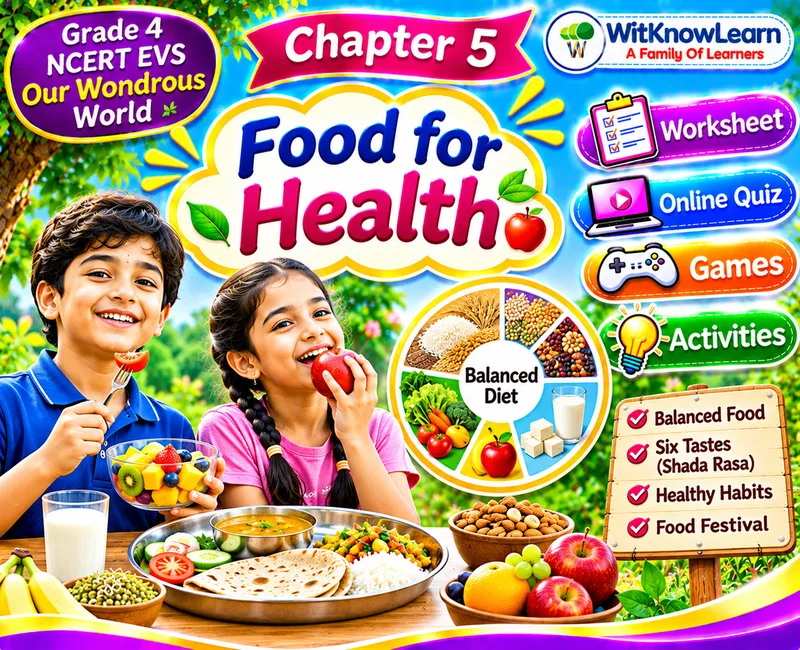
Class 4 EVS · Our Wondrous World · Chapter 5
Food for Health Class 4 EVS Worksheet with Quiz and Activities
What are the six tastes, and what makes a plate balanced? Find out with this Food for Health worksheet for Class 4 EVS (Our Wondrous World, Chapter 5): take the Food for Health Class 4 online quiz, test foods for oil in the Virtual Lab and play the activities and interactive games online.
Flip the cards and try the Healthy Choices Lab, then tap the Games, Labs, Challenges or Virtual Lab island.
Food for Health Class 4 Online Quiz
20 questions · tap an answer to move on · full review at the end
Flip the cards, try the Healthy Choices Lab, then play the games, do the labs and take the challenges. Earn up to 3 stars in every activity.
Fact cards: tap a card to flip it
Healthy Choices Lab
Three friends at the food festival need to make a choice. In each one, drag the option you think is healthy onto the picture and watch what happens. A wrong choice shows what goes wrong, so you can try again.
Challenge marks: 0 / 15 (0 of 5 challenges done)
Finish all 5 challenges to see your comment.
Virtual Lab: do real experiments step by step
Practice sheet
Food for Health Class 4 Activities
Help friends make healthy choices, mix Ugadi Pachadi, fill a balanced plate and test foods for oil and water in the Virtual Lab. Earn up to 3 stars in every activity.
A festival of food
"Food for Health" is Chapter 5 of the Class 4 EVS book Our Wondrous World and the first chapter of the unit on Health and Well-being. The chapter takes us to a lively school food festival with the banner "Eat Right, Stay Healthy". Students and parents bring dishes from all over India: dhokla, litti-chokha, dal-baati-churma, bajre-ki-khichdi, chhena-poda, kadhi-pakoda, ker-sangri, siddu, roasted corn, hot dosa, crispy vada, jowar upma and ragi laddu. This variety shows how rich and diverse Indian food is.
Mystery Masala and the six tastes
At the "Mystery Masala" stall, Mukesh and his friends taste a dish that is sweet, a little salty and a bit bitter all at once. It is Ugadi Pachadi, a traditional food of Andhra Pradesh, Karnataka and Telangana. It blends six tastes: sweet (meetha), sour (khatta), salty (namkeen), pungent (teekha), bitter (karva) and astringent (kasaila). In Ayurveda these six tastes are called shad rasa, and eating balanced food that contains them is considered good for health. Jaggery is sweet, tamarind is sour, salt is salty, green chilli is pungent, neem is bitter and raw mango is astringent.
Millets: the super food
Surbhi and her friends visit a stall of millet foods. Surbhi remembers that her grandmother ate jowar and bajra roti in winter and jau (barley) roti in summer. Millets such as jowar, bajra and ragi are rich sources of nutrients, which is why the stall is called "Super Food".
Three food groups
Our body needs a variety of foods to stay healthy, energetic and strong, because no single food has all the nutrients we need. Food does three main jobs:
- Energy-giving foods like rice, wheat, potato, maize, banana, sweet potato, honey and millets give us energy. Butter, ghee and oil also give energy.
- Body-building foods like pulses, soybeans, chickpeas, peanuts, tofu, milk, cheese, beans, almonds, eggs, meat and fish help us grow and build strong muscles.
- Protective foods like carrot, orange, lemon, papaya, spinach, cabbage, guava, amla and tomato protect us from diseases.
A balanced plate has food from all three groups in the right amounts: protective foods the most, then body-building foods and some energy-giving foods. Every region of India has its own special thali with many tastes and health benefits.
Say "No" to junk food
Foods with a lot of oil, salt and sugar, such as soft drinks, chips, bread pakoda, burgers, pizza and over-processed packaged food, are called junk food. They are not healthy if eaten regularly or in large amounts. Fresh, home-cooked food is always a better choice. Keeping a food diary helps us notice what we eat and which food groups are missing.
Water for health
Water is an important part of our diet. It helps digest food, keeps our skin and body healthy and removes waste through urine, sweat and faeces. Water-rich fruits like watermelon and cucumber also help keep water in our body.
Ways of cooking
Food can be cooked in many ways: boiling, steaming, frying, roasting, grilling and baking. Idiyappam is steamed, for example. Some foods, like fruit chaat and vegetable salads, can be eaten without cooking. A chef is a professional cook; the French word means director or head of the kitchen. We can even cook in a solar cooker using sunlight, which makes no smoke or ash.
Check the label
Packaged foods have labels showing the net weight, the date of packing and the "best before" or expiry date. Reading labels helps us choose fresh, safe food.
This Food for Health worksheet for Class 4 EVS turns the chapter into fun learning on WitKnowLearn with an online quiz, online activities and interactive games. Flip the cards, make healthy choices in the Healthy Choices Lab, play the games, do the food labs, take the challenges and then test foods for oil and water in the Virtual Lab.
EVS Food for Health Class 4
Food for Health is Chapter 5 of the Class 4 EVS book Our Wondrous World. Through a school food festival, it explains the variety of Indian food, the six tastes (shad rasa), millets, the three food groups, the balanced plate, junk food, water for health, methods of cooking and reading food labels. This guide explains each idea in simple language for Class 4 students, parents and teachers. It goes with the Food for Health worksheet for Class 4 on WitKnowLearn, which also gives an online quiz, online activities, interactive games and a Virtual Lab on the same page.
What is there in this chapter
- The school food festival and regional dishes
- Ugadi Pachadi and the six tastes
- Millets as super food
- Energy-giving, body-building and protective foods
- The balanced plate and regional thalis
- Junk food, water and food diaries
- Methods of cooking and food labels
Learning objectives
- Name the three food groups with examples.
- Identify the six tastes in food.
- Explain why a balanced plate and water are important.
- Describe different methods of cooking.
Learning outcomes
After this page a child can:
- Plan a balanced plate.
- Choose healthy snacks and drinks over junk food.
- Read the important parts of a food label.
- Test foods for oil and compare water content.
Food for Health Class 4 resources on this page
| Resource | What it does |
|---|---|
| Food for Health Class 4 online quiz | 20 questions in three levels with a full answer review |
| Flip cards | Six cards on the food festival, six tastes, super food, food groups, water and cooking |
| Healthy Choices Lab | Balance a lunch plate, choose a drink after playing and pick an evening snack |
| 5 interactive games | Energy or body-building, protective food bubbles, food map memory, how is it cooked, healthy habit or not |
| 5 food labs | Ugadi Pachadi, water tracker, balanced plate, read the label and cooking method finder |
| 5 challenges | Marked out of 3 each with a total out of 15 |
| Virtual Lab | Two full experiments on the paper test for oil and the water in cucumber and potato, with aim, objectives, procedure, observation table, conclusion and outcomes |
| Practice sheet | 16 questions with answer boxes and a live score |
Food groups at a glance
| Group | Job | Examples |
|---|---|---|
| Energy-giving | Give energy | Wheat, maize, banana, millets |
| Body-building | Help us grow | Chickpeas, milk, beans |
| Protective | Fight diseases | Papaya, cabbage, tomato |
Types of questions
- Food groups
- Six tastes and their examples
- Junk food or healthy food
- Cooking methods
- Water and its uses
- Reading labels
- Planning a balanced meal
Solved examples
Common mistakes
| Mistake | Correct |
|---|---|
| Thinking one food is enough | We need food from all three groups. |
| Drinking soft drinks instead of water | Water is the best drink. |
| Ignoring the expiry date | Always check the label. |
| Filling the plate mostly with rice | Fruits and vegetables should take the most space. |
Daily life
Every meal is a chance to eat well: a fruit at breakfast, dal and vegetables at lunch, a glass of milk and plenty of water. Helping to cook at home and keeping a food diary make children curious and careful about what they eat.
Tips for parents and teachers
- Keep a food diary for a week together.
- Make a food collage of the three food groups.
- Read labels on packets at home and find the best before date.
- Cook a millet dish with the child.
- Let the child retry the challenges to earn 3 stars.
Related Class 4 Worksheets
- Adaptation in Plants Worksheet Class 4
- Reproduction in Animals Worksheet Class 4
- Adaptation in Animals Worksheet Class 4
- States of Matter Worksheet Class 4
- Teeth and Microbes Worksheet Class 4
- Food and Nutrition Worksheet Class 4
- Force Work and Energy Worksheet Class 4
- Air Water and Weather Worksheet Class 4
- Leaves and the Food Factory of Plants Worksheet Class 4
- Safety and First Aid Worksheet Class 4
- Our Environment Worksheet Class 4
- Our Universe Worksheet Class 4
Frequently Asked Questions
 Download