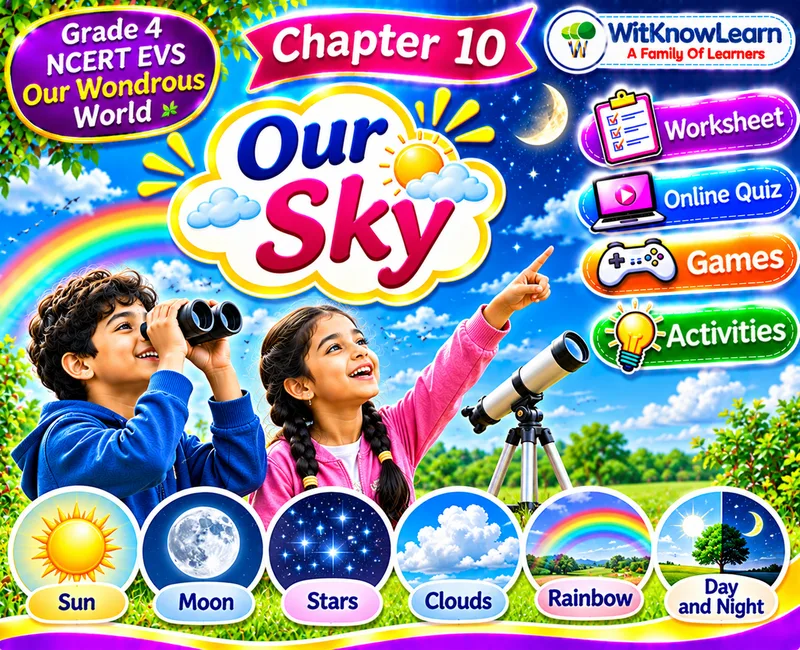
Our Sky Class 4 EVS Worksheet with Quiz and Activities
NCERT Our Wondrous World Chapter 10: the changing sky, the Sun and its journey, shadows, the sundial, star patterns, the Moon and Moon festivals. On WitKnowLearn you get the Our Sky Class 4 online quiz, online activities and interactive games, science labs, a virtual lab and a worksheet-style practice sheet, all on one page.
Our Sky Class 4 Online Quiz
20 questions: 10 easy, 5 average and 5 thinking. Tap an answer and the next question comes up.
Our Sky Class 4 Activities
👆 Tap a tab to switch: Learn, Games, Labs, Challenges, Virtual Lab and Practice sheet
Our Sky: the Chapter Story
A short read for Class 4 before you play. These notes are written for this page and are not copied from the textbook.
🌅 A sky that keeps changing
Look up in the morning, in the afternoon and at night, and the sky looks different each time. The Sun may look orange at sunrise, strong at noon and gone at night, when the Moon and stars appear. Birds, animals, plants and people also change what they do as the day goes by.
☀ The brightest object
The Sun is the brightest object in the sky. It is so bright that we cannot see other stars while it shines. It gives us light and heat. Each day it seems to rise in the East, climb overhead and set in the West.
👤 Shadows on the move
Your shadow runs when you run and changes shape when you pose. Morning shadows are long, noon shadows are short and evening shadows are long again, but on the opposite side. This happens because the Sun moves across the sky.
🔦 Torch and stick
In a dark room, a torch and a stick can copy the Sun and a tree. A stick close to the torch makes a bigger shadow, and moving the torch to another side moves the shadow too.
🕰 Sundials and shadow puppets
Long ago people noticed that shadows help to tell the time and built the sundial. Raja Jai Singh built Jantar Mantar, whose Samrat Yantra works like a giant sundial. Shadow puppetry has also been enjoyed in India for a long time.
🌙 Moon and stars
After sunset thousands of stars twinkle, and the Moon looks like the biggest object in the night sky. Its shape changes from a full circle to a C and sometimes it cannot be seen. Many festivals, such as Diwali and Eid, follow these changes. In 2023, India’s Vikram Lander reached the Moon.
Our Sky Class 4 Activities
Read, play and learn about the Sun, shadows, the Moon and the stars. Earn up to 3 stars in every activity.
The sky is a free science lesson that is always open. In this chapter children watch how the sky changes from morning to night, follow the Sun from East to West and see how the length and direction of a shadow change during the day.
They also explore shadows with a torch, learn about the sundial, watch the Moon change shape and connect the Moon to festivals and calendars. Explore more Class 4 EVS worksheets on WitKnowLearn after this chapter.
Words and facts to know
| Word | Meaning | Example |
|---|---|---|
| Shadow | A dark shape formed when light is blocked | Your shadow on a sunny road |
| Sundial | A device that tells time by a shadow | Samrat Yantra in Jaipur |
| Poornima | The full Moon night | Guru Poornima |
| Amavasya | The new Moon night | Diwali night |
How to use this page
- Flip the six cards and try the Shadow and Sky Lab in the Learn tab.
- Play the five games and the five science labs to practise each idea.
- Finish the five challenges to collect up to 15 points.
- Take the 20-question online quiz and fill in the practice sheet.
Worked examples
20 − 8 = 12, so it is 12 cm long.
5 × 4 = 20, so she draws 20 stars.
At noon the Sun is high overhead, so the shadow is short.
This Our Sky worksheet for Class 4 (NCERT Our Wondrous World Chapter 10) gives you online activities and interactive games that turn the chapter into play. Every activity has a goal, a hint and a short fact, so children learn while they enjoy.
Complete Guide: EVS Our Sky Class 4
This guide is for Class 4 students, parents and teachers who are studying NCERT Our Wondrous World, Chapter 10, Our Sky. It explains the main ideas in simple words and shows how to use the quiz, labs and games on this page.
Introduction to NCERT Class 4 EVS Chapter 10
Chapter 10 of Our Wondrous World (The World Around Us) is called Our Sky. It is the second chapter of the unit Our Environment and invites children to observe the Sun, shadows, the Moon and the stars. This introduction is written for this page and is not copied from the textbook.
What is there in this chapter
- Drawing and describing the morning, afternoon and night sky.
- The Sun: brightness, light, heat and its journey from East to West.
- Shadows: changes through the day, the torch and stick activity and the sundial.
- Jantar Mantar, Samrat Yantra and shadow puppetry.
- The night sky: star patterns and the Moon’s changing shapes.
- Poornima, Amavasya, Moon festivals and the Chandrayaan mission.
Learning objectives (written for this page, not copied from the book)
- Describe how the sky looks at different times of the day.
- Explain the Sun’s apparent movement from East to West.
- Explain how shadows change in length and direction.
- Describe the Moon’s changing shapes and some Moon-based festivals.
- Observe, record and share findings like a scientist.
Learning outcomes
- The child can draw and compare the sky at three times of the day.
- The child can predict how a shadow will change.
- The child can tell Poornima from Amavasya.
- The child enjoys watching the sky and asking questions.
Our Sky Class 4 resources on this page
| Resource | What it gives |
|---|---|
| Online quiz | 20 questions: 10 easy, 5 average and 5 thinking, with a full review |
| Flip cards | 6 picture cards with one-line rules |
| Shadow and Sky Lab | A hands-on lab with 3 rounds |
| Games | 5 interactive games |
| Labs | 5 science activity labs |
| Virtual Lab | 2 experiments with aim, procedure, observation table and conclusion |
| Challenges | 5 challenges, 15 points in all |
| Practice sheet | A worksheet-style sheet with 16 questions, name and date lines and a live score |
Key facts
| Topic | Key idea |
|---|---|
| Sun | Brightest object in the sky; appears to move East to West. |
| Shadow | Long in the morning and evening, short at noon. |
| Moon | Changes shape; full Moon is Poornima, new Moon is Amavasya. |
| Sundial | Uses a shadow to tell time. |
Types of questions you may see
- Multiple choice and true or false questions on facts.
- Fill in the blanks and match the following.
- Short answers and drawing the sky or the Moon.
- Activity questions on shadows and light.
Solved examples
In the West.
At noon, when the Sun is overhead.
Amavasya.
Guru Poornima, Buddha Poornima or Rakshabandhan.
The shadow becomes bigger.
6 × 3 = 18 shapes.
Common mistakes
| Mistake | Correct idea |
|---|---|
| Shadows are shortest in the evening. | Shadows are shortest at noon. |
| The Sun rises in the West. | It appears to rise in the East. |
| Amavasya is the full Moon. | Amavasya is the new Moon; Poornima is the full Moon. |
| Stars are not there in the day. | The Sun is so bright that we cannot see other stars. |
Our Sky in daily life
At home, children can watch the sunset, trace their shadow on the ground and note the Moon’s shape for a few nights. At school, they can try shadow puppetry and share their drawings.
Tips for parents and teachers
- Remind children never to look straight at the Sun.
- Mark a stick’s shadow with chalk every hour on a sunny day.
- Sketch the Moon together for a few nights.
- Visit a planetarium or try a stargazing evening if you can.
Related NCERT Our Wondrous World Class 4 Worksheets
- 🤝Chapter 1: Living Together Class 4
- 🏘Chapter 2: Exploring Our Neighbourhood Class 4
- 🦋Chapter 3: Nature Trail Class 4
- 🌱Chapter 4: Growing Up with Nature Class 4
- 🥗Chapter 5: Food for Health Class 4
- 😊Chapter 6: Happy and Healthy Living Class 4
- ⚙Chapter 7: How Things Work Class 4
- 🏭Chapter 8: How Things Are Made Class 4
- 🌏Chapter 9: Different Lands, Different Lives Class 4
Our Sky Class 4 FAQs
What is Our Sky in Class 4 EVS?
Our Sky is Chapter 10 of the NCERT Class 4 book Our Wondrous World. Children observe how the sky changes through the day, explore shadows with a torch and a stick, watch the Moon and stars and learn about festivals linked to the Moon.
Why does the colour of the sky change?
The sky looks different in the morning, afternoon and at night, and the Sun's colour also seems to change. Children draw the sky at each time and note their observations in a table.
What is the Sun's journey across the sky?
The Sun appears to rise in the East, move up until it is overhead at noon and then move down towards the West. The Sun is the brightest object in the sky and gives us light and heat.
Why do shadows change during the day?
Shadows are long in the morning, short at noon and long again in the evening. The evening shadow falls in the opposite direction to the morning shadow, because the Sun moves across the sky.
How does the torch and stick activity work?
In a dark room, shine a torch on a stick and move the stick or the torch. A stick close to the light gives a bigger shadow, and changing the torch's direction changes the direction of the shadow.
What is a sundial?
A sundial is an old device that tells time using the shadow of the Sun. Raja Jai Singh built Jantar Mantar in Jaipur, Ujjain, Delhi, Varanasi and Mathura, and its Samrat Yantra is a sundial that tells time accurately.
What are Poornima and Amavasya?
Poornima is the full Moon, when the Moon looks like a complete circle. Amavasya is the new Moon, when the Moon cannot be seen. People used the Moon's changing shape to count days, which led to the earliest calendars.
Does this page have Our Sky Class 4 questions and answers?
Yes. The 20-question online quiz ends with a full review that shows the correct answer and a short reason for every question. The practice sheet has 16 questions and a Show answers button.
Which class and book is this worksheet for?
This worksheet is for Class 4 and follows NCERT Our Wondrous World (The World Around Us, EVS) Chapter 10, Our Sky. The learning objectives and all questions are written for this page and are not copied from the textbook.
What can children do on this page?
Children can take the online quiz, play interactive games, try online activities and science labs, finish challenges, do the hands-on Shadow and Sky Lab, run two virtual experiments and solve a practice sheet. They can earn up to 3 stars in every activity.
Can my child use these activities on a phone?
Yes. The page works on phones, tablets and laptops. Children can drag a word or card with a finger or mouse, or tap the word first and then tap the box where it belongs.
What is included on this page?
This page has a 20-question online quiz, 6 flip cards, the Shadow and Sky Lab, 5 games, 5 labs, 5 challenges, a virtual lab with 2 experiments, a worksheet-style 16-question practice sheet, a chapter story, a topic description, a complete guide, related NCERT Class 4 worksheets and 12 FAQs.
 Download