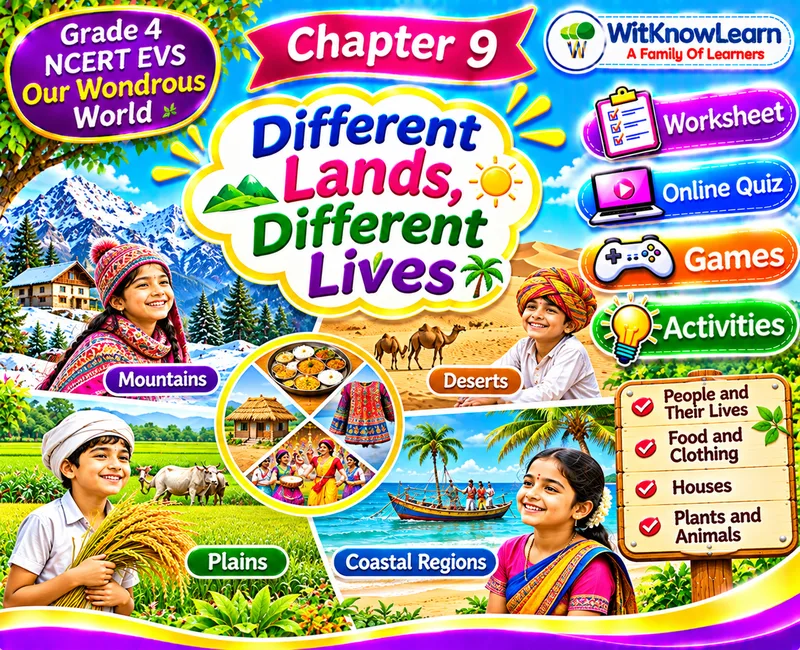
Different Lands, Different Lives Class 4 EVS Worksheet with Quiz and Activities
NCERT Our Wondrous World Chapter 9: plains, deserts, coasts and mountains, with their food, clothes, houses, festivals, plants and animals. On WitKnowLearn you get the Different Lands, Different Lives Class 4 online quiz, online activities and interactive games, science labs, a virtual lab and a practice sheet, all on one page.
Different Lands, Different Lives Class 4 Online Quiz
20 questions: 10 easy, 5 average and 5 thinking. Tap an answer and the next question comes up.
Different Lands, Different Lives Class 4 Activities
Different Lands, Different Lives: the Chapter Story
A short read for Class 4 before you play. These notes are written for this page and are not copied from the textbook.
🎒 Back from the holidays
The classroom buzzes as children return from their holidays with pictures and small things from the places they visited. Chandni went to a beach in Odisha, Ritika to the desert of Rajasthan, Gurpreet to his grandparents in Amritsar and Nayan to the mountains of Sikkim.
🌾 Plains with Gurpreet
Gurpreet tells of wide fields and rich soil where many people farm. His grandmother welcomed him warmly, and the family enjoyed makki di roti, sarson da saag and a big glass of lassi. He also visited the Golden Temple, where the langar serves free meals to everyone.
🏜 Desert with Ritika
Ritika describes a dry land with very little rain, where cactus, khejri and babool grow and camels walk across the sand. She brought bright bangles and a bandhini dupatta. Houses are made of mud, and tankas store precious water.
🏖 Coast with Chandni
Chandni’s scrap book is full of fishermen, shells, boat rides, sand art and a Sambalpuri saree. Many people there depend on fishing. She also explains that strong winds and cyclones are a challenge, and that early warnings help to protect people.
⛰ Mountains with Nayan
Nayan writes in his diary about cool clean air and Mount Kangchenjunga turning golden at sunrise. He tasted thukpa and sel roti, wore warm traditional dress and rode a yak. He also learned about the New Year festival Loosong and Namsoong.
🌍 One country, many lives
The land around us shapes our food, clothes, houses and festivals. By comparing plains, deserts, coasts and mountains, we learn to respect every way of life.
Different Lands, Different Lives Class 4 Activities
Read, play and learn about plains, deserts, coasts and mountains. Earn up to 3 stars in every activity.
India has many kinds of land, and each shapes the way people live. In this chapter four children share their holiday trips and we learn about farming in the plains, water-saving in the desert, fishing on the coast and warm clothes in the mountains.
Children also meet local foods, dresses, festivals, plants and animals of each region. They learn that people face challenges too, such as cyclones on the coast and landslides in the mountains, and that communities can prepare and help each other.
Words and facts to know
| Word | Meaning | Example |
|---|---|---|
| Plains | Wide flat land, often with fertile soil | The fields near Amritsar |
| Desert | A dry place with very little rainfall | The land around Jaisalmer |
| Coast | Land next to the sea | The beaches of Puri |
| Cyclone | A strong storm with powerful winds | Cyclones that hit Odisha |
How to use this page
- Flip the six cards and try the Landform Explorer Lab in the Learn tab.
- Play the five games and the five science labs to practise each idea.
- Finish the five challenges to collect up to 15 points.
- Take the 20-question online quiz and fill in the practice sheet.
Worked examples
50 − 28 = 22, so 22 bangles are left.
4 × 5 = 20, so there are 20 seats.
Water is scarce in the desert, so tankas store water.
This Different Lands, Different Lives worksheet for Class 4 (NCERT Our Wondrous World Chapter 9) gives you online activities and interactive games that turn the chapter into play. Every activity has a goal, a hint and a short fact, so children learn while they enjoy.
Complete Guide: EVS Different Lands, Different Lives Class 4
This guide is for Class 4 students, parents and teachers who are studying NCERT Our Wondrous World, Chapter 9, Different Lands, Different Lives. It explains the main ideas in simple words and shows how to use the quiz, labs and games on this page.
Introduction to NCERT Class 4 EVS Chapter 9
Chapter 9 of Our Wondrous World (The World Around Us) is called Different Lands, Different Lives. It is part of the unit Our Environment and explores plains, deserts, coastal regions and mountains through the holiday stories of four children. This introduction is written for this page and is not copied from the textbook.
What is there in this chapter
- Sharing holiday places and noting the type of region.
- Plains: Amritsar, farming, makki di roti, sarson da saag, lassi and the Golden Temple.
- Desert: Rajasthan, cactus, camels, bandhini cloth, tankas and Jaisalmer Fort.
- Coast: Puri, shells, sand art, fishing, Sambalpuri saree, Rath Yatra and cyclones.
- Mountains: Sikkim, Gangtok, yaks, warm dress, thukpa and Loosong and Namsoong.
- Life in my landform and a comparison table of the four regions.
Learning objectives (written for this page, not copied from the book)
- Name the four types of regions and describe each one.
- Link food, clothes, houses and festivals with the local land and weather.
- Name some plants and animals of each region.
- Describe challenges such as cyclones and landslides and how communities can help.
- Compare life in two or more landforms.
Learning outcomes
- The child can describe the plains, desert, coast and mountains.
- The child can match foods, dresses and animals to regions.
- The child can explain why places are different.
- The child respects the culture of every region.
Different Lands, Different Lives Class 4 resources on this page
| Resource | What it gives |
|---|---|
| Online quiz | 20 questions: 10 easy, 5 average and 5 thinking, with a full review |
| Flip cards | 6 picture cards with one-line rules |
| Landform Explorer Lab | A hands-on lab with 3 rounds |
| Games | 5 interactive games |
| Labs | 5 science activity labs |
| Virtual Lab | 2 experiments with aim, procedure, observation table and conclusion |
| Challenges | 5 challenges, 15 points in all |
| Practice sheet | 16 questions with answer boxes and a live score |
Key facts
| Region | Key idea |
|---|---|
| Plains | Fertile land where farming is common. |
| Desert | Dry land, water is precious. |
| Coast | Fishing is common, cyclones are a challenge. |
| Mountains | Cold and rocky, with warm clothes and sloping roofs. |
Types of questions you may see
- Multiple choice and true or false questions on facts.
- Fill in the blanks and match the following.
- Short answers in your own words.
- Comparison tables and drawing tasks.
Solved examples
Makki di roti or sarson da saag.
The camel.
It protects sea creatures and keeps people healthy.
Mountains.
Share food, shelter and care.
7 × 3 = 21 shells.
Common mistakes
| Mistake | Correct idea |
|---|---|
| Deserts have lots of rain. | Deserts get very little rain. |
| People everywhere eat the same food. | Food changes with the region. |
| Yaks live on the coast. | Yaks live in cold mountains. |
| Cyclones are common in mountains. | Cyclones hit coastal regions. |
Different Lands, Different Lives in daily life
At home, children can ask elders about the food, dress and festivals of their region. At school, they can share holiday stories and draw the landform around them.
Tips for parents and teachers
- Talk about places you have visited and compare them.
- Let children try regional foods and listen to folk songs together.
- Include children who stayed home by asking about their own neighbourhood.
- Show pictures of cyclones and landslides and talk about safety.
Related NCERT Our Wondrous World Class 4 Worksheets
- 🤝Chapter 1: Living Together Class 4
- 🏘Chapter 2: Exploring Our Neighbourhood Class 4
- 🦋Chapter 3: Nature Trail Class 4
- 🌱Chapter 4: Growing Up with Nature Class 4
- 🥗Chapter 5: Food for Health Class 4
- 😊Chapter 6: Happy and Healthy Living Class 4
- ⚙Chapter 7: How Things Work Class 4
- 🏭Chapter 8: How Things Are Made Class 4
- 🌤Chapter 10: Our Sky Class 4
Different Lands, Different Lives Class 4 FAQs
What is Different Lands, Different Lives in Class 4 EVS?
Different Lands, Different Lives is Chapter 9 of the NCERT Class 4 book Our Wondrous World. Four children share holiday trips to the plains of Punjab, the desert of Rajasthan, the coast of Odisha and the mountains of Sikkim, and we see how land shapes food, clothes, houses and festivals.
What are the four types of regions in this chapter?
The chapter looks at plains, deserts, coastal regions and mountains. Each has its own plants, animals, work, food, clothing and festivals.
What is special about the plains of Punjab?
The plains around Amritsar have large fields with rich fertile soil, and many people farm. Popular foods are makki di roti, sarson da saag and lassi. The Golden Temple also serves free meals in its langar.
How do plants and animals live in the desert?
A desert is dry with very little rainfall. Plants like the cactus, khejri and babool survive on little water, and the cactus stores water in its stem. Camels, lizards, wild cats, pythons and eagles live there, and the camel is called the ship of the desert.
What is life like on the coast?
In coastal regions like Puri in Odisha, many people depend on fishing. There are beaches, sea shells such as the shankh, sand art and sea creatures. People also face strong winds and cyclones, so early warnings help to keep them safe.
What is life like in the mountains?
Mountains are rocky and usually cold, and the Himalayan mountains have snow. In Sikkim people wear warm traditional dress, use yaks for travel and build wooden houses with slanting roofs. Trees like oak, pine, walnut and chestnut grow there.
Why do food and clothes differ between regions?
The land and weather decide what grows, what we can make and what keeps us comfortable. So food, clothes, houses and festivals are different in plains, deserts, coasts and mountains.
Does this page have Different Lands, Different Lives Class 4 questions and answers?
Yes. The 20-question online quiz ends with a full review that shows the correct answer and a short reason for every question. The practice sheet has 16 questions and a Show answers button.
Which class and book is this worksheet for?
This worksheet is for Class 4 and follows NCERT Our Wondrous World (The World Around Us, EVS) Chapter 9, Different Lands, Different Lives. The learning objectives and all questions are written for this page and are not copied from the textbook.
What can children do on this page?
Children can take the online quiz, play interactive games, try online activities and science labs, finish challenges, do the hands-on Landform Explorer Lab, run two virtual experiments and solve a practice sheet. They can earn up to 3 stars in every activity.
Can my child use these activities on a phone?
Yes. The page works on phones, tablets and laptops. Children can drag a word or card with a finger or mouse, or tap the word first and then tap the box where it belongs.
What is included on this page?
This page has a 20-question online quiz, 6 flip cards, the Landform Explorer Lab, 5 games, 5 labs, 5 challenges, a virtual lab with 2 experiments, a 16-question practice sheet, a chapter story, a topic description, a complete guide, related NCERT Class 4 worksheets and 12 FAQs.
 Download