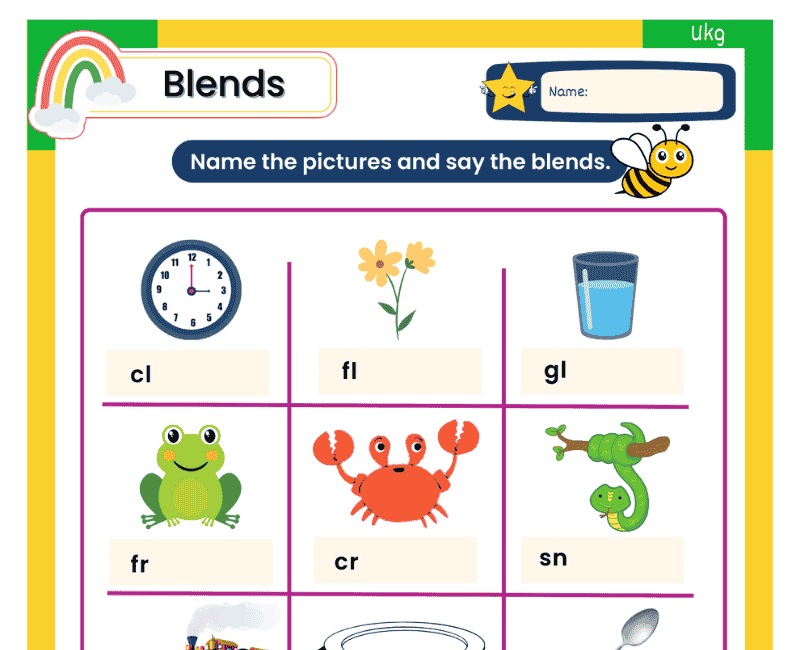
Blend the Sounds and Build a Word! 🔤🐸🌈
20 quiz questions and 10 interactive blends activities. Deliver word mail, build spellings, sort beginnings and repair missing sounds!
📝 Beginning Blends Quiz for UKG
⏱ Time Left: 20:00
Question 1 of 20 • Answered: 0/20
Which blend begins flag?
Question navigation — green means answered.
🎮 Blends Games for UKG
1. 🔎 Explore Blend Words
Choose a beginning. Read each whole word with an adult. The two consonants retain their sounds.
cl → clap • clip
Ready to play!
2. 📮 Deliver Blend Mail
Choose a word envelope, then its beginning-blend mailbox.
Ready to play!
3. 🃏 Word and Blend Memory
Match a word with its first two consonants.
Find four pairs.
4. 🔠 Build Three Blend Words
Tap the letter tiles in order. Each tile can be used once. Use Undo to change your spelling.
Build frog.
—
Ready to play!
5. 🧺 Sort Beginning Blends
Choose each word, then its cl, fl or sl basket.
Ready to play!
🧠 Blends Word Activities for SR KG
6. 🔧 Repair Missing Consonants
An adult reads the target word. Give each spelling its missing letter.
Ready to play!
7. 🔊 Map the Sounds in Clap
Say clap with an adult. Put c, l, a and p into four sound boxes in order. Each letter represents one sound here.
□ | □ | □ | □
Ready to play!
8. 🪜 Climb the Word Ladder
Tap one letter position, then a replacement letter. Make each requested new word by changing just one letter.
Change flap into clap.
Ready to play!
9. 🔍 Find Every Beginning Blend
Select every word that STARTS with two consonants. Leave words whose consonant blend is only at the end.
Ready to play!
10. 📖 Build a Frog Sentence
Build this sentence: The frog can hop. Read frog carefully and then read the whole sentence with an adult.
Ready to play!
📄 Blends Worksheet for UKG and SR KG
Use the existing download option on this page for the six-page printable blends worksheet. These online activities offer additional beginning-blend practice.
📖 Read the beginning consonant blends learning guide
A blends worksheet for UKG helps children read and spell words with neighbouring consonant sounds. UKG is also called Senior KG or SR KG. These beginning blends activities use familiar short-vowel words such as clap, flag, frog, drum, stop and spin, with adult support for instructions and vocabulary.
Blending is the action of joining sounds to read a word. A consonant blend is a group of adjacent consonants in which the individual consonant sounds are retained. In flag, f and l occur together at the beginning, followed by the vowel sound and the final g. Encourage children to follow the letters in order rather than guessing from a picture.
Begin when children can recognise the relevant letter-sound correspondences and blend simpler words with support. Show a short word, model its sounds and blend them into the whole word. Choose examples that fit the phonics sequence used in class. There is no need to introduce every blend in one lesson.
Beginning blends worksheets for kindergarten often group words by their first two consonants. For example, clap and clip start with cl, flag and flip start with fl, and stop and stem start with st. Read each word aloud before sorting it. Both consonants matter, so a word beginning with c alone does not automatically belong in the cl group.
Keep blends and digraphs distinct. In a blend such as fl, the two consonants retain their sounds. In a digraph such as sh in shop, the two letters represent one sound. In ordinary speech, tr and dr may sound less separated than the letters suggest. Model natural pronunciation and connect it with the written spelling rather than forcing an artificial extra vowel.
Movable letter tiles help children notice every sound. To build frog, use f, r, o and g in order. If a child writes fog instead, compare the spoken words and return to the missing r. Sound boxes can support this process: clap has four phonemes, so c, l, a and p each have a place in the model.
Use short word changes to encourage careful reading. Flap can become clap by changing its first letter. Clap becomes clip when a changes to i. Ask children to read the whole new word after every change and discuss its meaning. Pictures can support vocabulary, but the letters provide the information needed to decode the word.
The online consonant blends quiz and ten interactive phonics games complement the printable blends worksheet for SR KG. Children match words with beginnings, build spellings, sort cards and repair labels. An adult can read unfamiliar words and check spoken blending. Keep practice brief, revisit secure examples and move towards independent reading when children can attend to both consonants without leaving one out.
💬 UKG Blends Worksheet FAQs
😊 What are consonant blends?
They are neighbouring consonants that retain their individual consonant sounds, such as f and l at the beginning of flag.
😊 What is the difference between a blend and blending?
A blend is a consonant group in a word. Blending is the action of joining sounds together to read a word.
😊 How do I teach beginning blends to a UKG child?
Review the letter sounds, model a short word and blend its sounds in order. Use a few familiar words and movable letter tiles.
😊 What is the difference between a blend and a digraph?
A blend retains the consonant sounds, as in fl in flag. A digraph uses two letters for one sound, as in sh in shop.
😊 Which blend words can we practise in SR KG?
Try clap, clip, flag, flip, frog, drum, stop and spin. Choose words that match the phonics patterns already taught in class.
😊 Why does my child miss a consonant when reading a blend?
The child may need help attending to each sound in a longer sequence. Compare words such as fog and frog, and build them with separate letter tiles.
😊 Should I teach blends before simple CVC words?
Follow the classroom phonics sequence. Being secure with relevant letter sounds and simpler blending can help children manage adjacent consonants.
😊 How many sounds are in clap?
Clap has four phonemes: /k/, /l/, /a/ and /p/. The beginning cl is a blend with two consonant sounds.
😊 Can blends occur at the end of words?
Yes. For example, st occurs at the end of nest. These online activities mainly practise beginning blends.
😊 How do I download the blends worksheet for UKG?
Use the existing download option on this page for the printable worksheet. The online quiz and games provide additional practice.
 Download