Circles Class 9 Maths Worksheet with Quiz and Activities
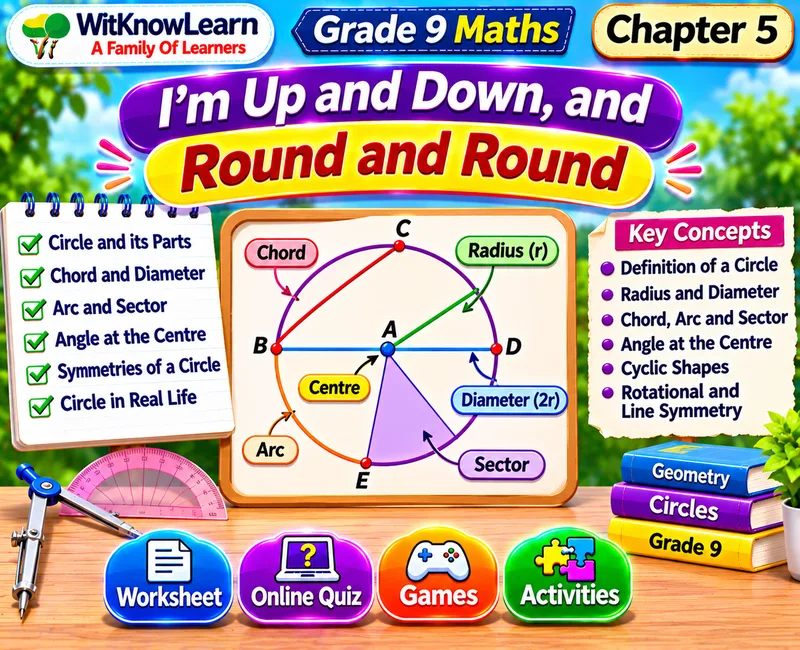
Find chord lengths, chase angles on arcs and prove cyclic quadrilateral facts, with a chord triangle you build in 2D and 3D. On WitKnowLearn you get the Circles Class 9 online quiz, online activities and interactive games, a circle lab, a virtual lab and a worksheet-style practice sheet for NCERT Ganita Manjari Chapter 5.
Circles Class 9 Online Quiz
20 questions: 10 easy, 5 average and 5 thinking. Tap an answer and the next question comes up.
Circles Class 9 Activities
👆 Tap a tab to switch: Learn, Games, Labs, Challenges, Virtual Lab and Practice sheet
Circles: the Story of Round Things
A short read for Class 9 before you play. These notes follow Chapter 5 of NCERT Ganita Manjari, Part I.
🌙 Circles in nature
Raindrops on water, the sun and the moon, and the cross-section of a stem all look like circles. A circle is the set of points at a fixed distance from a centre.
📍 How many circles?
Through two points there are infinitely many circles. Through three points not in a line there is exactly one, and its centre is where the perpendicular bisectors meet.
📏 Chords
The perpendicular from the centre bisects a chord. Equal chords are equally far from the centre, and a chord nearer to the centre is longer.
🎯 Angles on arcs
An arc subtends an angle at the centre that is double the angle at the circle. So the angle in a semicircle is 90°.
🔷 Cyclic quadrilaterals
Four points on a circle are concyclic. In the quadrilateral they form, opposite angles add up to 180°, and the converse also holds.
⬡ Hexagon in a circle
Each side of a regular hexagon subtends 60° at the centre, so each side equals the radius.
Circles Class 9 Activities
Measure chords, chase angles and build circles on the Number Train. Earn up to 3 stars in every activity.
This page follows NCERT Class 9 Maths Ganita Manjari, Part I, Chapter 5. Students work with chords, distances from the centre, angles on arcs, the angle in a semicircle and cyclic quadrilaterals.
The activities are pitched at Class 9 level. Students sort theorems, pop true facts, match terms, test which shapes can be inscribed, and solve case studies on parks, wheels and coins. The virtual lab builds a chord triangle in a flat 2D view and as a 3D coin. Explore more Class 9 maths worksheets on WitKnowLearn after this chapter.
Formulas and facts to know
| Theorem | Statement | Example |
|---|---|---|
| Chord bisector | Perpendicular from the centre bisects the chord | 24 cm chord: half is 12 |
| Equal chords | Equal chords are equally far from the centre | Both at 5 cm |
| Angle at centre | Double the angle at the circle | 70° gives 35° |
| Semicircle | Angle is 90° | 35° + 55° + 90° |
| Cyclic quadrilateral | Opposite angles add to 180° | 75° + 105° |
How to use this page
- Flip the six cards and try the Circle Lab in the Learn tab.
- Play the five games and the five labs to practise each theorem.
- Finish the five challenges to collect up to 15 points.
- Build the chord triangle in the Virtual Lab and look at it in 2D and 3D.
- Take the 20-question online quiz, with assertion and reason and case study questions, and fill in the practice sheet.
Worked examples
r = √(8² + 6²) = 10 cm.
5x − 10 = 180, so x = 38, ∠P = 86° and ∠R = 94°.
Their distances are 4 cm and 3 cm, so they are 7 cm apart on opposite sides and 1 cm apart on the same side.
This Circles worksheet for Class 9 maths gives you online activities and interactive games that make circle theorems clear. Every activity has a goal, a hint and a short fact, so students learn while they enjoy.
Complete Guide: NCERT Class 9 Maths Circles Chapter 5
This guide is for Class 9 students, parents and teachers. It covers Chapter 5 of NCERT Ganita Manjari, Part I, and shows how to use the quiz, labs and games on this page.
Introduction to Circles
The chapter studies the symmetries of a circle and proves theorems about chords, arcs, angles and cyclic quadrilaterals.
What is there in this chapter
- Definitions and symmetries of a circle.
- How many circles pass through given points.
- Chords and the angles they subtend.
- Midpoints and perpendicular bisectors of chords.
- Distance of chords from the centre.
- Angles subtended by an arc.
- Concyclicity of points and cyclic quadrilaterals.
Learning objectives
- Find the length of a chord or its distance from the centre.
- Use the angle at the centre theorem.
- Apply the angle in a semicircle and angles in the same segment.
- Prove properties of cyclic quadrilaterals.
- Reason with assertions and case studies.
Learning outcomes
- The student can find that a 24 cm chord in a circle of radius 13 cm is 5 cm from the centre.
- The student can state that an arc of 70° at the centre gives 35° on the circle.
- The student can solve for x using opposite angles of a cyclic quadrilateral.
- The student can solve a case study on a circular park.
Circles Class 9 resources on this page
| Resource | What it gives |
|---|---|
| Online quiz | 20 questions: 10 easy, 5 average and 5 thinking, with assertion and reason and case study questions and a full review |
| Flip cards | 6 picture cards with one-line rules |
| Circle Lab | A hands-on lab with 3 rounds |
| Games | 5 interactive games |
| Labs | 5 activity labs |
| Virtual Lab | 2 experiments and a 2D and 3D chord triangle builder with aim, procedure, observations and conclusion |
| Challenges | 5 challenges, 15 points in all |
| Practice sheet | A worksheet-style sheet with 16 questions, name and date lines and a live score |
Key facts
| Idea | Rule |
|---|---|
| Circles through 2 points | Infinitely many |
| Circle through 3 points | One, if they are not in a line |
| Chord and centre | Perpendicular from the centre bisects the chord |
| Nearer chord | Longer chord |
| Angle at the centre | Double the angle at the circle |
| Cyclic quadrilateral | Opposite angles add to 180° |
Types of questions you may see
- Find a chord length or distance with the Baudhayana-Pythagoras theorem.
- Find angles at the centre and on the circle.
- Find the unknown in a cyclic quadrilateral.
- Prove a chord or cyclic theorem.
- Assertion and reason questions.
- Case studies on parks, coins and triangles in circles.
Solved examples
Distance = √(169 − 144) = 5 cm.
144 + d² = 25 + (d + 7)², so d = 5 and r = 13 cm.
∠ACB = 50° and ∠ADB = 130°.
OD = 5, AD = 18 cm and AB = 6√13 cm.
Side 6 cm, distance from O is 3√3 cm and ∠ADB = 30°.
Distance from the fountain = √(625 − 576) = 7 m.
Common mistakes
| Mistake | Correct idea |
|---|---|
| Using the whole chord in the right triangle. | Use half the chord. |
| Saying the farther chord is longer. | The nearer chord is longer. |
| Doubling instead of halving the angle on the circle. | The angle at the centre is double the angle on the circle. |
| Thinking opposite angles of a cyclic quadrilateral are equal. | They add up to 180°. |
| Forgetting two cases for parallel chords. | Same side: subtract distances. Opposite sides: add them. |
Circles in daily life
Wheels, clocks, coins, parks and round tables all use circles. Engineers use chords and angles when they design arches and gears.
Tips for parents and teachers
- Fold a paper circle to show the symmetry of a diameter.
- Use a compass to draw circles through three marked points.
- Ask students to measure angles at the centre and at the circle.
- Practise one assertion and one case study each week.
Related Class 9 Maths Worksheets
- 🔢Number Systems Class 9 Worksheet
- 🧮Polynomials Class 9 Worksheet
- 📍Coordinate Geometry Class 9 Worksheet
- 📈Linear Equations in Two Variables Class 9
- 📐Introduction to Euclids Geometry Class 9
- 📏Lines and Angles Class 9 Worksheet
- 🔺Triangles Class 9 Worksheet with MCQs
- 🔷Quadrilaterals Class 9 Worksheet
- ⭕Circles Class 9 Worksheet with MCQs
- 🧩Herons Formula Class 9 Worksheet
- 📦Surface Area and Volumes Class 9 Worksheet
- 📊Statistics Class 9 Worksheet
Circles Class 9 FAQs
What is Chapter 5 of NCERT Class 9 Maths Ganita Manjari?
Chapter 5 is I am Up and Down, and Round and Round, which is about circles. It covers symmetries of a circle, how many circles pass through given points, chords and the angles they subtend, distance of chords from the centre, angles subtended by an arc and concyclic points.
What are a chord, a diameter and an arc?
A chord is a line segment joining two points on a circle. A diameter is a chord that passes through the centre and is the longest chord. An arc is a part of the circle between two points.
How many circles pass through two points or three points?
Infinitely many circles pass through two points. Exactly one circle passes through three points that are not in a line. No circle passes through three collinear points.
How do you find the centre of the circle through three points?
Draw the perpendicular bisectors of two of the segments joining the points. They meet at the centre, which is called the circumcentre. The radius is the distance from the centre to any of the points.
What does the perpendicular from the centre do to a chord?
The perpendicular from the centre of a circle to a chord bisects the chord. The proof joins the centre to both ends and uses congruent right triangles by the RHS rule.
How do you find the length of a chord from its distance from the centre?
Use the right triangle with the radius as hypotenuse. Half the chord = square root of (r^2 - d^2). For r = 13 and d = 5, half the chord is 12, so the chord is 24.
Which chord is longer, the nearer one or the farther one?
The chord nearer to the centre is longer. Equal chords are at equal distances from the centre, and the diameter, at distance 0, is the longest chord.
What is the angle at the centre theorem?
The angle subtended by an arc at the centre is double the angle it subtends at any point on the remaining part of the circle. So a 100 degree central angle gives a 50 degree angle on the circle.
Why is the angle in a semicircle 90 degrees?
A diameter subtends 180 degrees at the centre, so it subtends half of that, 90 degrees, at any point on the circle.
What is a cyclic quadrilateral and what is its key property?
A cyclic quadrilateral has all four vertices on a circle. Its opposite angles add up to 180 degrees, and its exterior angle equals the interior opposite angle.
Which parallelograms can be inscribed in a circle?
Only a rectangle. In a parallelogram opposite angles are equal, and in a cyclic quadrilateral they add to 180 degrees, so each angle is 90 degrees.
What can students do on this page?
Students can take a 20-question online quiz with assertion and reason and case study questions, play five games, try five online activities, finish five challenges, run the Circle Lab, do two virtual experiments, build a chord triangle in 2D and 3D, and fill in a 16-question practice sheet with a Show answers button.
 Download