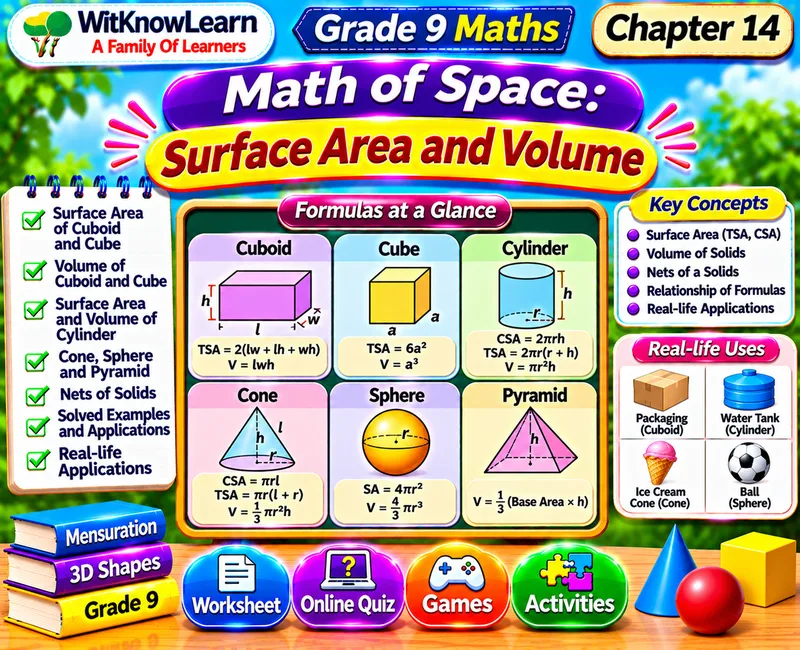
Math of Space: Surface Area and Volume Class 9 Maths Worksheet with Quiz and Activities
Work with surface areas and volumes of solids, and spin a triangle into a cone in 2D and 3D. On WitKnowLearn you get the Math of Space: Surface Area and Volume Class 9 online quiz, online activities and interactive games, a solid lab, a virtual lab and a worksheet-style practice sheet for NCERT Ganita Manjari Chapter 14.
Math of Space: Surface Area and Volume Class 9 Online Quiz
20 questions: 10 easy, 5 average and 5 thinking. Tap an answer and the next question comes up.
Math of Space: Surface Area and Volume Class 9 Activities
👆 Tap a tab to switch: Learn, Games, Labs, Challenges, Virtual Lab and Practice sheet
Math of Space: Surface Area and Volume: the Story of Solids
A short read for Class 9 before you play. These notes follow Chapter 14 of NCERT Ganita Manjari, Part I.
🧊 Cubes and cuboids
Volume is length times breadth times height.
🥛 Cylinders
Volume is pi r squared h.
🍦 Cones
A cone is one third of a cylinder.
⚽ Spheres
Surface 4 pi r squared and volume 4/3 pi r cubed.
🔺 Pyramids
One third of base area times height.
📦 Packing
Divide each side and multiply the counts.
Math of Space: Surface Area and Volume Class 9 Activities
Follow every step on the Number Train. Earn up to 3 stars in every activity.
This page follows NCERT Class 9 Maths Ganita Manjari, Part I, Chapter 14. Students work with surface areas and volumes of cubes, cones, spheres and pyramids.
The activities are pitched at Class 9 level. Students sort surface area from volume, pop true facts, use the formulas for cones and spheres, and solve case studies on melting metal, a crow and marbles, and milk glasses. The virtual lab spins a triangle into a cone in 2D and 3D. Explore more Class 9 maths worksheets on WitKnowLearn after this chapter.
Formulas and facts to know
| Solid | Volume | Surface area |
|---|---|---|
| Cube | a cubed | 6 a squared |
| Cylinder | pi r2 h | 2 pi r (r + h) |
| Cone | 1/3 pi r2 h | pi r (r + l) |
| Sphere | 4/3 pi r3 | 4 pi r2 |
How to use this page
- Flip the six cards and try the Solid Lab in the Learn tab.
- Play the five games and the five labs to practise each idea.
- Finish the five challenges to collect up to 15 points.
- Spin a triangle into a cone in the Virtual Lab and look at it in 2D and 3D.
- Take the 20-question online quiz, with assertion and reason and case study questions, and fill in the practice sheet.
Worked examples
Side 4, so 6 x 16 = 96 cm2.
2/3 x 22/7 x 9261 = 19404 cm3.
64 pi divided by 4/3 pi = 48.
This Math of Space: Surface Area and Volume worksheet for Class 9 maths gives you online activities and interactive games that make the chapter clear. Every activity has a goal, a hint and a short fact, so students learn while they enjoy.
Complete Guide: NCERT Class 9 Maths Math of Space: Surface Area and Volume Chapter 14
This guide is for Class 9 students, parents and teachers. It covers Chapter 14 of NCERT Ganita Manjari, Part I, and shows how to use the quiz, labs and games on this page.
Introduction to Math of Space: Surface Area and Volume
The chapter finds surface areas and volumes of common solids and uses them to solve problems about packing, melting and filling.
What is there in this chapter
- Cubes and cuboids.
- Cylinders.
- Cones.
- Spheres and hemispheres.
- Pyramids.
- Cutting and recasting solids.
- Packing and filling.
Learning objectives
- Find surface areas of solids.
- Find volumes of solids.
- Compare cones, cylinders and spheres.
- Solve packing and melting problems.
- Reason with assertions and case studies.
Learning outcomes
- The student can find that a cube of volume 64 cm3 has surface area 96 cm2.
- The student can find that a cone with radius 7 cm and slant height 10 cm has surface area 374 cm2.
- The student can find that a pyramid with base 10 m and height 6 m has volume 200 cubic m.
- The student can find that 1600 milk glasses need 739.2 litres.
Math of Space: Surface Area and Volume Class 9 resources on this page
| Resource | What it gives |
|---|---|
| Online quiz | 20 questions: 10 easy, 5 average and 5 thinking, with assertion and reason and case study questions and a full review |
| Flip cards | 6 picture cards with one-line rules |
| Solid Lab | A hands-on lab with 3 rounds |
| Games | 5 interactive games |
| Labs | 5 activity labs |
| Virtual Lab | 2 experiments and a 2D and 3D cone builder with aim, procedure, observations and conclusion |
| Challenges | 5 challenges, 15 points in all |
| Practice sheet | A worksheet-style sheet with 16 questions, name and date lines and a live score |
Key facts
| Idea | Rule |
|---|---|
| Cube | a3 and 6a2 |
| Cylinder | pi r2 h |
| Cone | 1/3 pi r2 h |
| Sphere | 4/3 pi r3 |
| Pyramid | 1/3 base x height |
| Cutting | Volume same, area up |
Types of questions you may see
- Find surface areas.
- Find volumes.
- Compare solids.
- Packing and melting problems.
- Assertion and reason questions.
- Case studies on milk glasses and marbles.
Solved examples
96 cm2.
220 cm2.
19404 cm3.
4000.
11.
48.
Common mistakes
| Mistake | Correct idea |
|---|---|
| Using the height instead of the slant height in the CSA of a cone. | CSA uses l. |
| Forgetting the 1/3 in cone and pyramid volumes. | Volume is one third of base times height. |
| Thinking cutting a cube keeps the surface area. | New faces increase it. |
| Mixing square and cubic units. | Area is in square units, volume in cubic units. |
| Using the diameter as the radius. | Halve the diameter first. |
Math of Space: Surface Area and Volume in daily life
Water tanks, ice cream cones, balls and packing boxes all need surface area and volume, and builders use these formulas every day.
Tips for parents and teachers
- Write the formula before putting in numbers.
- Halve the diameter to get the radius.
- Check units are square or cubic.
- Practise one assertion and one case study each week.
Related Class 9 Maths Worksheets
- 🔢Number Systems Class 9 Worksheet
- 🧮Polynomials Class 9 Worksheet
- 📍Coordinate Geometry Class 9 Worksheet
- 📈Linear Equations in Two Variables Class 9
- 📐Introduction to Euclids Geometry Class 9
- 📏Lines and Angles Class 9 Worksheet
- 🔺Triangles Class 9 Worksheet with MCQs
- 🔷Quadrilaterals Class 9 Worksheet
- ⭕Circles Class 9 Worksheet with MCQs
- 🧩Herons Formula Class 9 Worksheet
- 📦Surface Area and Volumes Class 9 Worksheet
- 📊Statistics Class 9 Worksheet
Math of Space: Surface Area and Volume Class 9 FAQs
What is Chapter 14 of NCERT Class 9 Maths Ganita Manjari?
Chapter 14 is Math of Space: Surface Area and Volume. It covers cubes, cuboids, cylinders, cones, spheres, hemispheres and pyramids.
What is the difference between surface area and volume?
Surface area is the total area of the outside of a solid, measured in square units. Volume is the space inside it, measured in cubic units.
What are the formulas for a cube?
For a cube of side a, the volume is a cubed and the total surface area is 6a squared. A cube of volume 64 cm3 has side 4 cm and surface area 96 cm2.
What happens when a cube is cut into smaller cubes?
The total volume stays the same, but the total surface area increases because new faces appear. Cutting a 4 cm cube into 1 cm cubes makes the surface area 4 times as large.
What are the formulas for a cylinder?
Volume = pi r squared h and curved surface area = 2 pi r h. Total surface area = 2 pi r (r + h).
What are the formulas for a cone?
Volume = 1/3 pi r squared h, curved surface area = pi r l and total surface area = pi r (r + l), where l is the slant height.
How is a cone related to a cylinder?
A cone has exactly one third of the volume of a cylinder with the same base and the same height.
What are the formulas for a sphere?
Surface area = 4 pi r squared and volume = 4/3 pi r cubed. A hemisphere has volume 2/3 pi r cubed.
How is a sphere related to its enclosing cylinder?
A sphere fills two thirds of the smallest cylinder that encloses it. The cylinder has radius r and height 2r.
What is the volume of a pyramid?
Volume = 1/3 x base area x height. A square base of side 10 m and height 6 m gives 200 cubic m.
How do we find how many boxes fit in a godown?
Divide each side of the godown by the matching side of the box and multiply the three numbers. A 40 m by 25 m by 10 m godown holds 4000 boxes of 2 m by 1.25 m by 1 m.
What can students do on this page?
Students can take a 20-question online quiz with assertion and reason and case study questions, play five games, try five online activities, finish five challenges, run the Solid Lab, do two virtual experiments, spin a triangle into a cone in 2D and 3D, and fill in a 16-question practice sheet with a Show answers button.
 Download