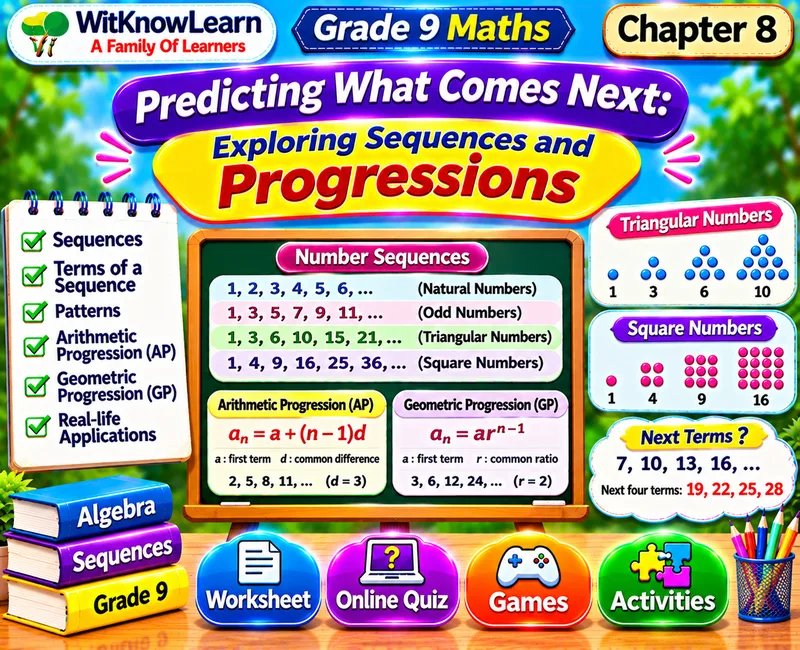
Sequences and Progressions Class 9 Maths Worksheet with Quiz and Activities
Spot patterns, use explicit and recursive rules, and tell AP from GP, with an AP you plot in 2D and 3D. On WitKnowLearn you get the Sequences and Progressions Class 9 online quiz, online activities and interactive games, a sequence lab, a virtual lab and a worksheet-style practice sheet for NCERT Ganita Manjari Chapter 8.
Sequences and Progressions Class 9 Online Quiz
20 questions: 10 easy, 5 average and 5 thinking. Tap an answer and the next question comes up.
Sequences and Progressions Class 9 Activities
👆 Tap a tab to switch: Learn, Games, Labs, Challenges, Virtual Lab and Practice sheet
Sequences and Progressions: the Story of Patterns
A short read for Class 9 before you play. These notes follow Chapter 8 of NCERT Ganita Manjari, Part I.
🔢 Sequences
A sequence is an ordered list of numbers, where each number is a term.
📝 Explicit and recursive
An explicit rule uses n. A recursive rule uses earlier terms.
➕ Arithmetic progressions
An AP adds the same difference each time: tn = a + (n - 1)d.
✖ Geometric progressions
A GP multiplies by the same ratio each time.
🔺 Triangular numbers
The sum 1 + 2 + ... + n is n(n + 1)/2.
🌿 Patterns everywhere
Fibonacci numbers, bounces and fractals all follow rules.
Sequences and Progressions Class 9 Activities
Spot the pattern on the Number Train. Earn up to 3 stars in every activity.
This page follows NCERT Class 9 Maths Ganita Manjari, Part I, Chapter 8. Students find terms, rules and sums of sequences, and tell AP from GP.
The activities are pitched at Class 9 level. Students sort sequences, pop true facts, use explicit and recursive rules, and solve case studies on salaries, bouncing balls and the Sierpinski carpet. The virtual lab plots an arithmetic progression as points on a 2D graph and as 3D towers. Explore more Class 9 maths worksheets on WitKnowLearn after this chapter.
Formulas and facts to know
| Sequence | Type | Rule |
|---|---|---|
| 3, 8, 13, 18 | AP | d = 5 |
| 2, 6, 18, 54 | GP | r = 3 |
| 1, 3, 6, 10 | Triangular | n(n + 1)/2 |
| 1, 2, 3, 5, 8 | Fibonacci | add two terms |
How to use this page
- Flip the six cards and try the Sequence Lab in the Learn tab.
- Play the five games and the five labs to practise each idea.
- Finish the five challenges to collect up to 15 points.
- Plot the AP 1, 5, 9, 13, 17 in the Virtual Lab and look at it in 2D and 3D.
- Take the 20-question online quiz, with assertion and reason and case study questions, and fill in the practice sheet.
Worked examples
a = 3 and d = 5, so t10 = 3 + 9 x 5 = 48.
tn = 24 - 3n, so n = 35.
2485 - 465 = 2020.
This Sequences and Progressions worksheet for Class 9 maths gives you online activities and interactive games that make the chapter clear. Every activity has a goal, a hint and a short fact, so students learn while they enjoy.
Complete Guide: NCERT Class 9 Maths Sequences and Progressions Chapter 8
This guide is for Class 9 students, parents and teachers. It covers Chapter 8 of NCERT Ganita Manjari, Part I, and shows how to use the quiz, labs and games on this page.
Introduction to Sequences and Progressions
The chapter studies number patterns called sequences, with rules for the nth term, and two key types, the AP and the GP.
What is there in this chapter
- Introduction to sequences.
- Explicit rule for a sequence.
- Recursive rule for a sequence.
- Arithmetic progressions.
- Visualising an AP.
- Sums of natural numbers.
- Geometric progressions.
Learning objectives
- Write and use explicit and recursive rules.
- Find the nth term of an AP and a GP.
- Add natural numbers with n(n + 1)/2.
- See an AP as points on a line.
- Reason with assertions and case studies.
Learning outcomes
- The student can find that the 10th term of 3, 8, 13, ... is 48.
- The student can find that 1 + 2 + ... + 100 is 5050.
- The student can find the 5th bounce of a ball as 6.2208 m.
- The student can solve a case study on a salary with yearly increments.
Sequences and Progressions Class 9 resources on this page
| Resource | What it gives |
|---|---|
| Online quiz | 20 questions: 10 easy, 5 average and 5 thinking, with assertion and reason and case study questions and a full review |
| Flip cards | 6 picture cards with one-line rules |
| Sequence Lab | A hands-on lab with 3 rounds |
| Games | 5 interactive games |
| Labs | 5 activity labs |
| Virtual Lab | 2 experiments and a 2D and 3D arithmetic progression plotter with aim, procedure, observations and conclusion |
| Challenges | 5 challenges, 15 points in all |
| Practice sheet | A worksheet-style sheet with 16 questions, name and date lines and a live score |
Key facts
| Idea | Rule |
|---|---|
| AP | Constant difference d |
| GP | Constant ratio r |
| nth term of AP | a + (n - 1)d |
| Sum of 1 to n | n(n + 1)/2 |
| Recursive rule | Uses earlier terms |
| AP graph | Points on a line |
Types of questions you may see
- Find a term from a rule.
- Find which term has a given value.
- Sums of natural numbers.
- AP and GP word problems.
- Assertion and reason questions.
- Case studies on salaries, bounces and fractals.
Solved examples
11.
48.
210.
30.
178.
45.
Common mistakes
| Mistake | Correct idea |
|---|---|
| Calling 1, 4, 9, 16 an AP. | Check that the differences are equal. |
| Using n instead of n - 1 in a + (n - 1)d. | The first term has n = 1. |
| Accepting a decimal n as a term number. | n must be a natural number. |
| Mixing difference and ratio. | Subtract for an AP, divide for a GP. |
| Counting terms with last minus first only. | Add 1: (last - first)/d + 1. |
Sequences and Progressions in daily life
Salaries with yearly increments, savings plans, bouncing balls and population growth all follow progressions.
Tips for parents and teachers
- Write the first four differences or ratios.
- Check your answer by finding the next term.
- Draw the pattern for small n.
- Practise one assertion and one case study each week.
Related Class 9 Maths Worksheets
- 🔢Number Systems Class 9 Worksheet
- 🧮Polynomials Class 9 Worksheet
- 📍Coordinate Geometry Class 9 Worksheet
- 📈Linear Equations in Two Variables Class 9
- 📐Introduction to Euclids Geometry Class 9
- 📏Lines and Angles Class 9 Worksheet
- 🔺Triangles Class 9 Worksheet with MCQs
- 🔷Quadrilaterals Class 9 Worksheet
- ⭕Circles Class 9 Worksheet with MCQs
- 🧩Herons Formula Class 9 Worksheet
- 📦Surface Area and Volumes Class 9 Worksheet
- 📊Statistics Class 9 Worksheet
Sequences and Progressions Class 9 FAQs
What is Chapter 8 of NCERT Class 9 Maths Ganita Manjari?
Chapter 8 is Predicting What Comes Next: Exploring Sequences and Progressions. It covers sequences, explicit and recursive rules, arithmetic progressions, geometric progressions and sums of natural numbers.
What is a sequence?
A sequence is an ordered list of numbers. Each number is a term. The odd numbers 1, 3, 5, 7, ... form an infinite sequence, while 6, 12, 24, 48, 96 is a finite one.
What is an explicit rule?
An explicit rule gives the nth term directly from n. For tn = 3n - 4 the 5th term is 3 x 5 - 4 = 11.
What is a recursive rule?
A recursive rule gives each term from earlier terms. For t1 = 1 and tn = tn-1 + 3 the terms are 1, 4, 7, 10, ...
What is an arithmetic progression?
An AP is a sequence where the difference between consecutive terms is constant. Its nth term is tn = a + (n - 1)d, where a is the first term and d the common difference.
What is a geometric progression?
A GP is a sequence where each term is the previous term times a constant ratio r. Its nth term is a x r to the power (n - 1). For 2, 6, 18, 54 the ratio is 3.
How do we add the first n natural numbers?
Use n(n + 1)/2. For n = 100 the sum is 100 x 101/2 = 5050. These sums are the triangular numbers 1, 3, 6, 10, ...
Why do the points of an AP lie on a straight line?
Equal steps in n give equal steps in tn, because the difference is constant. For tn = 4n - 3 the points (1, 1), (2, 5), (3, 9) lie on one line.
What is the Virahanka-Fibonacci sequence?
It is 1, 2, 3, 5, 8, 13, 21, ... where each term is the sum of the previous two. It was studied in India by Virahanka and later by Hemachandra and Fibonacci.
How can we check whether a number is a term of a sequence?
Put it equal to the rule and solve for n. If n is a natural number, it is a term. For tn = 5n - 3, 172 gives n = 35, so it is a term, but 98 gives n = 20.2, so it is not.
Can a sequence be both an AP and a GP?
A constant sequence like 4, 4, 4, ... is both. The sequence 1, -1, 1, -1, ... is a GP with r = -1 but not an AP.
What can students do on this page?
Students can take a 20-question online quiz with assertion and reason and case study questions, play five games, try five online activities, finish five challenges, run the Sequence Lab, do two virtual experiments, plot an AP in 2D and 3D, and fill in a 16-question practice sheet with a Show answers button.
 Download