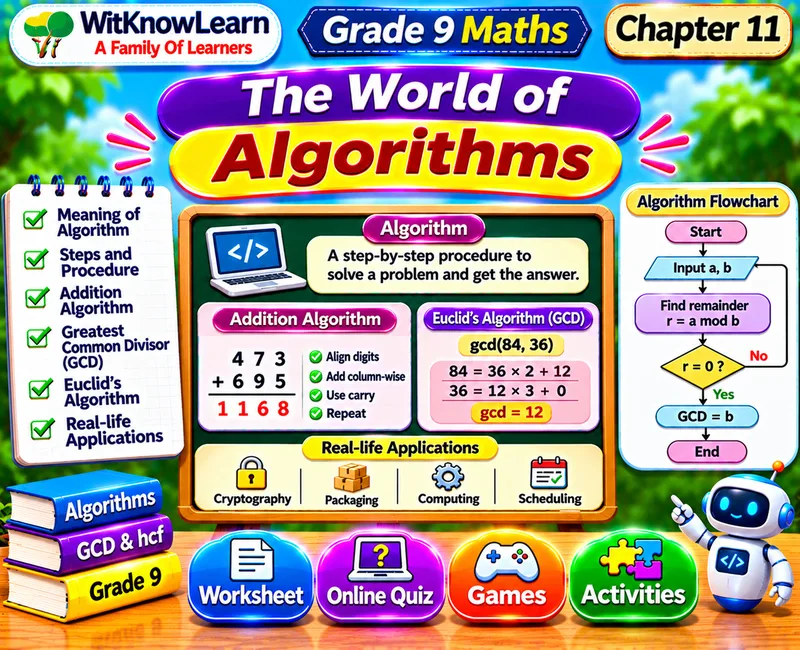
Algorithms Class 9 Maths Worksheet with Quiz and Activities
Run algorithms for divisors and the gcd, and see why Euclid is fast, with a floor you tile in 2D and 3D. On WitKnowLearn you get the Algorithms Class 9 online quiz, online activities and interactive games, a algorithm lab, a virtual lab and a worksheet-style practice sheet for NCERT Ganita Manjari Chapter 11.
Algorithms Class 9 Online Quiz
20 questions: 10 easy, 5 average and 5 thinking. Tap an answer and the next question comes up.
Algorithms Class 9 Activities
👆 Tap a tab to switch: Learn, Games, Labs, Challenges, Virtual Lab and Practice sheet
Algorithms: the Story of Algorithms
A short read for Class 9 before you play. These notes follow Chapter 11 of NCERT Ganita Manjari, Part I.
📜 Step by step
An algorithm is a precise list of steps that always works.
➕ Column addition
Add digit by digit with a carry of at most 1.
🔍 Divisors
List the divisors in order, or only up to the square root.
🧱 The gcd
The largest number that divides both numbers.
🔁 Euclid's idea
Replace (m, n) by (n, m mod n) until n is 0.
⏱ Speed
Good algorithms grow with the number of digits.
Algorithms Class 9 Activities
Follow every step on the Number Train. Earn up to 3 stars in every activity.
This page follows NCERT Class 9 Maths Ganita Manjari, Part I, Chapter 11. Students run algorithms for addition, divisors, remainders and the gcd.
The activities are pitched at Class 9 level. Students sort algorithms from guesses, pop true facts, take Euclid reduction steps, and solve case studies on tiling a floor and on how long counting takes. The virtual lab tiles a floor with Euclid's algorithm in 2D and 3D. Explore more Class 9 maths worksheets on WitKnowLearn after this chapter.
Formulas and facts to know
| Pair | Steps | gcd |
|---|---|---|
| 60, 16 | 3 | 4 |
| 48, 18 | 3 | 6 |
| 1071, 462 | 3 | 21 |
| 825, 375 | 2 | 75 |
How to use this page
- Flip the six cards and try the Algorithm Lab in the Learn tab.
- Play the five games and the five labs to practise each idea.
- Finish the five challenges to collect up to 15 points.
- Tile a floor with Euclid's algorithm in the Virtual Lab and look at it in 2D and 3D.
- Take the 20-question online quiz, with assertion and reason and case study questions, and fill in the practice sheet.
Worked examples
gcd(18, 12), gcd(12, 6), gcd(6, 0) = 6.
Multiples of 18: 18, 36. 36 is divisible by 12, so lcm = 36.
11 x 5 = 55.
This Algorithms worksheet for Class 9 maths gives you online activities and interactive games that make the chapter clear. Every activity has a goal, a hint and a short fact, so students learn while they enjoy.
Complete Guide: NCERT Class 9 Maths Algorithms Chapter 11
This guide is for Class 9 students, parents and teachers. It covers Chapter 11 of NCERT Ganita Manjari, Part I, and shows how to use the quiz, labs and games on this page.
Introduction to Algorithms
The chapter shows how to write down precise procedures, called algorithms, and compares how fast different algorithms are.
What is there in this chapter
- What is an algorithm.
- Addition as an algorithm.
- Divisors and gcd.
- Euclid's subtraction step.
- Euclid's algorithm with remainders.
- Why Euclid works.
- How fast algorithms are.
Learning objectives
- Write and run an algorithm.
- Find divisors and the gcd.
- Use Euclid's algorithm.
- Compare how fast algorithms are.
- Reason with assertions and case studies.
Learning outcomes
- The student can find that gcd(825, 375) is 75.
- The student can find that gcd(1071, 462) is 21.
- The student can find that 55 tiles cover a floor of 825 by 375.
- The student can compare counting dots with column addition.
Algorithms Class 9 resources on this page
| Resource | What it gives |
|---|---|
| Online quiz | 20 questions: 10 easy, 5 average and 5 thinking, with assertion and reason and case study questions and a full review |
| Flip cards | 6 picture cards with one-line rules |
| Algorithm Lab | A hands-on lab with 3 rounds |
| Games | 5 interactive games |
| Labs | 5 activity labs |
| Virtual Lab | 2 experiments and a 2D and 3D floor tiling builder with aim, procedure, observations and conclusion |
| Challenges | 5 challenges, 15 points in all |
| Practice sheet | A worksheet-style sheet with 16 questions, name and date lines and a live score |
Key facts
| Idea | Rule |
|---|---|
| Algorithm | Precise steps |
| m mod n | Remainder |
| gcd | Greatest common divisor |
| Euclid | (m, n) to (n, m mod n) |
| Carry | At most 1 |
| Fast algorithm | Grows with digits |
Types of questions you may see
- Run an algorithm.
- Find remainders and divisors.
- Find a gcd by Euclid.
- Compare speeds.
- Assertion and reason questions.
- Case studies on floors and counting time.
Solved examples
75.
4.
3000.
55.
6076.
49.
Common mistakes
| Mistake | Correct idea |
|---|---|
| Thinking the carry can be 2. | The largest sum is 19, so it is at most 1. |
| Stopping Euclid too early. | Continue until the remainder is 0. |
| Reading gcd as the smaller number. | Check the divisors. |
| Mixing up m mod n with the quotient. | It is the remainder. |
| Counting every number up to min(m, n). | Use the mod rule instead. |
Algorithms in daily life
Computers, calculators and phones all run algorithms, and Euclid's algorithm helps in coding and secure messages.
Tips for parents and teachers
- Write each step of an algorithm clearly.
- Check each remainder is less than the divisor.
- Test an algorithm on a small case first.
- Practise one assertion and one case study each week.
Related Class 9 Maths Worksheets
- 🔢Number Systems Class 9 Worksheet
- 🧮Polynomials Class 9 Worksheet
- 📍Coordinate Geometry Class 9 Worksheet
- 📈Linear Equations in Two Variables Class 9
- 📐Introduction to Euclids Geometry Class 9
- 📏Lines and Angles Class 9 Worksheet
- 🔺Triangles Class 9 Worksheet with MCQs
- 🔷Quadrilaterals Class 9 Worksheet
- ⭕Circles Class 9 Worksheet with MCQs
- 🧩Herons Formula Class 9 Worksheet
- 📦Surface Area and Volumes Class 9 Worksheet
- 📊Statistics Class 9 Worksheet
Algorithms Class 9 FAQs
What is Chapter 11 of NCERT Class 9 Maths Ganita Manjari?
Chapter 11 is The World of Algorithms. It covers algorithms, column addition, the divisors algorithm, gcd, Euclid's algorithm and how fast algorithms are.
What is an algorithm?
An algorithm is a precise step-by-step procedure, built from basic steps we already know, that solves a whole class of problems.
Where does the word algorithm come from?
It comes from the name of the scholar Al-Khwarizmi, who wrote about Indian methods of arithmetic. His name in Latin, Algoritmi, gave us algorism and then algorithm.
What is the carry in column addition?
The carry is the digit passed to the next column. Because the biggest column sum is 9 + 9 + 1 = 19, the carry is never more than 1.
What is m mod n?
It is the remainder when m is divided by n. For example 47 mod 5 = 2, because 47 = 9 x 5 + 2.
How does the divisors algorithm work?
Check each number from 1 to n in order and keep those that divide n. For 18 it gives [1, 2, 3, 6, 9, 18]. Divisors come in pairs, so checking up to the square root is enough.
What is Euclid's algorithm?
To find gcd(m, n), repeatedly replace (m, n) by (n, m mod n) until the second number is 0. The first number is then the gcd. For example gcd(60, 16) goes to gcd(16, 12), gcd(12, 4), gcd(4, 0), so the gcd is 4.
Why does gcd(m, n) = gcd(n, m - n) work?
Every common divisor of m and n also divides m - n, and every common divisor of n and m - n also divides m. So both pairs have the same common divisors.
How is the gcd used to tile a floor?
The side of a square tile must divide both sides of the floor. The largest tile has side gcd(825, 375) = 75 cm, and (825/75) x (375/75) = 55 tiles are needed.
Why is Euclid's algorithm so fast?
Its work grows with the number of digits, not with the size of the numbers. Checking every number up to min(m, n) would take over 1.5 lakh checks for 2587392 and 157656, but Euclid takes 7 steps.
How do we find the lcm of two numbers?
Take multiples of the bigger number in turn until one is divisible by the smaller. For 12 and 18 the first such multiple is 36.
What can students do on this page?
Students can take a 20-question online quiz with assertion and reason and case study questions, play five games, try five online activities, finish five challenges, run the Algorithm Lab, do two virtual experiments, tile a floor with Euclid's algorithm in 2D and 3D, and fill in a 16-question practice sheet with a Show answers button.
 Download