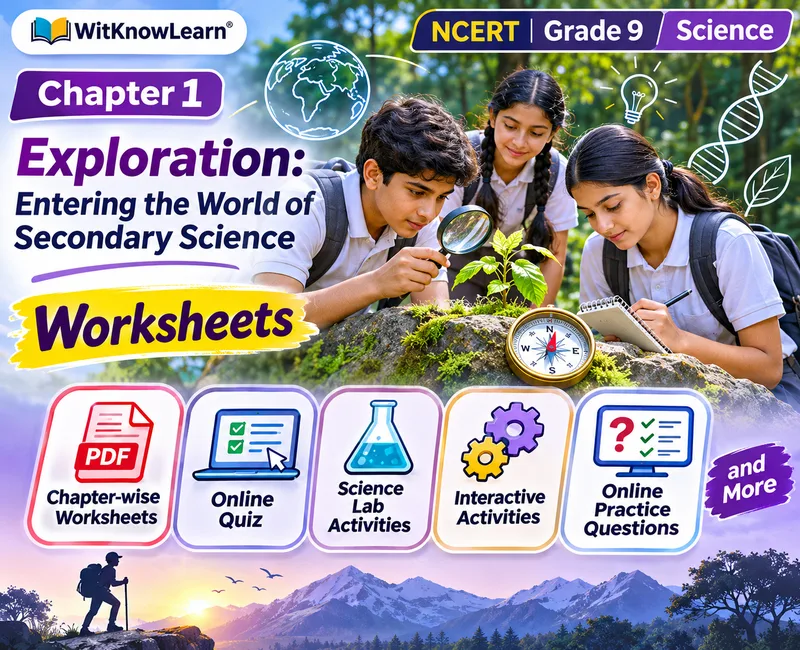
Exploration Class 9 Science Worksheet with Quiz and Activities
Think like a scientist: build models, tell laws from theories, convert units, make estimates and drop a ball from a tower. On WitKnowLearn you get the Exploration Class 9 online quiz, online activities and interactive games, a science lab, a virtual lab and a worksheet-style practice sheet for NCERT Class 9 Science Chapter 1.
Exploration Class 9 Online Quiz
20 questions: 10 easy, 5 average and 5 thinking. Tap an answer and the next question comes up.
Exploration Class 9 Activities
👆 Tap a tab to switch: Learn, Games, Labs, Challenges, Virtual Lab and Practice sheet
🧪 Science Lab
Do the experiment on screen: 3 rounds, then see what we found.
Lab progress
- 🧪 Round 1 of 3
- ⬜ Round 2 of 3
- ⬜ Round 3 of 3
- ⬜ What did we find?
🎯 Law or Theory?
⭐⭐⭐Goal: Sort 8 statements: does a law describe it, or does a theory explain it?
How to play: Drag each card into its bin, or tap a card and then tap a bin.
A law says what happens. A theory says why it happens.
Law
describes a patternTheory
explains whyFACTS: Laws describe patterns. Theories explain why the patterns occur.
🫧 Science Facts Bubbles
⭐⭐⭐Goal: Pop the 5 true facts. Leave the 4 false ones.
How to play: Tap a bubble to pop it. False bubbles wobble and stay.
Think about models, laws, theories and units.
FACTS: Science changes its ideas only on evidence.
🧠 Units and Terms Memory
⭐⭐⭐Goal: Match each quantity or term with its unit or meaning.
How to play: Flip two cards. If they match, they stay open. Find all 6 pairs.
Think of SI units and definitions.
FACTS: SI units are shared by scientists everywhere.
📝 Science Word Gaps
⭐⭐⭐Goal: Fill each gap with the right word from the tray. One word is extra.
How to play: Drag a word into a gap, or tap a word and then tap a gap.
Read the whole sentence before you choose a word.
A scientist uses a as a simplified way of looking at a real system.
Newton's laws of motion are examples of a that describes a pattern.
The atomic theory is an example of a that explains why matter behaves as it does.
When a prediction fails, scientists re-examine the and measurements.
The SI unit of mass is the .
FACTS: A model keeps what matters and ignores the rest.
⚖ Which Is Greater?
⭐⭐⭐Goal: In each pair, tap the greater value.
How to play: Tap one card in every pair.
Convert to the same unit first.
FACTS: Always compare quantities in the same unit.
🔗 Unit Conversion Lab
⭐⭐⭐Goal: Convert units correctly.
How to play: Drag a number into each gap, or tap a number and then a gap.
To change km/h to m/s, multiply by 5 and divide by 18.
36 km/h is m/s.
54 km/h is m/s.
20 m/s is km/h.
2.2 lb is about kg.
FACTS: Same quantity, different unit, different number.
➗ Fuel Mix-up Lab
⭐⭐⭐Goal: Find what went wrong with the fuel.
How to play: Drag the right number into each gap.
Volume is mass divided by density.
22300 kg at 0.8 kg per litre needs litres.
Dividing by 1.76 instead gives about litres.
Compared with the need, the aircraft was about litres short.
Its share of the fuel it needed was about percent.
FACTS: Volume = mass ÷ density.
🪞 Estimation Lab
⭐⭐⭐Goal: Make estimates by multiplying simple numbers.
How to play: Drag the right number into each gap.
Multiply step by step and keep the units.
Breaths in a day at 15 per minute: .
Air in a day at 0.5 L per breath: about litres.
Heartbeats in a day at 72 per minute: .
Rice for 4 people at 2000 kcal a day, in kg per day (350 kcal per 100 g): about kg.
FACTS: A good estimate checks the order of magnitude.
📐 Falling Model Lab
⭐⭐⭐Goal: Use the falling model: distance = 5 t squared (g = 10 m/s2).
How to play: Drag the right number into each gap.
Distance fallen is 5 t squared.
A stone dropped from 20 m takes s.
In 3 s it falls m.
Its speed after 3 s is m/s.
The distance in 4 s is m.
FACTS: Without air resistance the distance grows as the square of the time.
🔬 Keep or Ignore?
⭐⭐⭐Goal: Sort 6 details of a model for the time a bicycle takes to ride from school to home.
How to play: Drag each card into a bin, or tap a card and then tap a bin.
Keep what changes the time. Ignore the rest.
Keep in the model
changes the timeIgnore
no real effectFACTS: Ignoring unimportant details keeps a model simple but useful.
❓ Science Method Quiz
⭐⭐⭐Goal: Answer 3 questions. Each correct answer earns 1 point.
How to play: Tap the best option.
Think about evidence.
1. A model that fails for a feather but works for a stone shows that
2. A theory differs from a law because it
3. Scientists use SI units mainly to
FACTS: Evidence decides in science.
💦 True or False Splash
⭐⭐⭐Goal: Decide if each statement is true or false.
How to play: Tap True or False.
Test with a small case.
1. Food becomes harmful during an eclipse because of the shadow.
2. A failed prediction can lead to a better model.
3. Weather forecasts become less certain further ahead.
FACTS: Check every claim with evidence.
➗ Estimation Sums
⭐⭐⭐Goal: Solve 3 calculations. Type the number.
How to play: Type your answer and press Check.
Multiply step by step.
1. Speed in m/s of a train at 90 km/h?
2. Distance in metres fallen in 2 s by a stone (g = 10 m/s2)?
3. Mass in kg of 2 lb of flour (1 kg = 2.2 lb), to 2 decimal places?
FACTS: Estimates need simple numbers.
🔗 Match the Ideas
⭐⭐⭐Goal: Match each idea with its meaning.
How to play: Drag each card onto its partner, or tap a card and then tap a partner.
Think of what each word does.
FACTS: Words in science have exact meanings.
📖 Story Problems
⭐⭐⭐Goal: Read 3 short stories and choose the best answer.
How to play: Tap an answer.
Use the formula.
1. ✈️ An aircraft needs 22300 kg of fuel at 0.8 kg per litre. How many litres?
2. 🫁 A person breathes 15 times a minute, 0.5 L each. About how much air in one day?
3. 🌾 A family of four needs 2000 kcal each a day. Rice gives 350 kcal per 100 g. About how much rice per day?
FACTS: Science is full of estimates.
📐 Unit Conversion Experiment
⭐⭐⭐Aim
To convert speeds from km/h to m/s and find the pattern.
Objectives
- Multiply the speed in km/h by 5 and divide by 18.
- See that 18 km/h is the same as 5 m/s.
Procedure
- Take the speed in km/h.
- Work out the speed in m/s.
- Type the number.
- Choose the conclusion.
Divide by 18, then multiply by 5. For 36 it is 2 × 5 = 10.
Observation table
| Speed (km/h) | Speed (m/s) |
|---|---|
| 18 | |
| 36 | |
| 72 | |
| 108 |
Conclusion
Outcomes
- I can convert km/h to m/s.
- I know that units change the number but not the speed.
➗ Estimation Experiment
⭐⭐⭐Aim
To estimate the air breathed in one hour at different breathing rates.
Objectives
- Multiply breaths per minute by 0.5 L and by 60 minutes.
- See that the air breathed grows in proportion to the rate.
Procedure
- Take the breaths per minute.
- Work out the litres of air in one hour.
- Type the number.
- Choose the conclusion.
Multiply the rate by 30. For 15 it is 450.
Observation table
| Breaths per minute | Air in one hour (L) |
|---|---|
| 10 | |
| 15 | |
| 20 | |
| 30 |
Conclusion
Outcomes
- I can make a simple estimate.
- I know that equal steps in the rate give equal steps in the air.
🏗 Drop a Ball from a Tower
⭐⭐⭐Aim
To use the falling model for a ball dropped from a 45 m tower, and compare it with a light ball that feels air resistance.
Objectives
- Find the fall time and the landing speed.
- Find the distances fallen after 1, 2 and 3 seconds.
- Compare the model view with the real view.
Procedure
- Type each answer and the figure is built.
- Use the Model view and Real view buttons to compare.
- Read the finished figure.
- Answer the questions and choose the conclusion.
Use g = 10 m/s2. Distance fallen is 5 t squared and speed is g t.
Read your figure
Outcomes
- I can use the falling model.
- I know the distance grows as the square of the time.
- I can tell when the model needs improving.
Read the chapter first. Write each answer on the line. The page checks your answer as you type.
A. Units and conversions
B. Models and laws
C. Estimation
D. Case studies
Exploration: the Story of Doing Science
A short read for Class 9 before you play. These notes follow Chapter 1 of the NCERT Class 9 Science textbook.
🏏 Models
A model keeps what matters and ignores the rest, so a complex system becomes simple enough to study.
⚖️ Laws and theories
A law describes a pattern. A theory explains why it happens and rests on evidence.
🔮 Predictions
Models let us predict. When a prediction fails, scientists re-examine assumptions, models and measurements.
⚖ Units
SI units let everyone share and compare results. Always write the unit with the number.
🫁 Estimation
Break a problem into simple steps and check that the answer is reasonable.
🧪 Many sciences
Everyday things such as a face mask need physics, chemistry, biology and mathematics together.
Exploration Class 9 Science Activities
Follow every step on the Science Train. Earn up to 3 stars in every activity.
This page follows NCERT Class 9 Science, Chapter 1, Exploration: Entering the World of Secondary Science. Students work with models, laws, theories, principles, predictions, SI units and estimation.
The activities are pitched at Class 9 level. Students sort laws from theories, pop true facts, convert units, redo the fuel mix-up and the heart and breathing estimates, and use a falling model. The virtual lab drops a ball from a tower in model view and real view. Explore more Class 9 science worksheets on WitKnowLearn after this chapter.
Key ideas and facts to know
| Term | Meaning | Example |
|---|---|---|
| Model | Simplified view of a system | Ball as a point |
| Law | Describes a pattern | Newton's laws |
| Theory | Explains why, with evidence | Atomic theory |
| Principle | Broad idea for many situations | Conservation of energy |
How to use this page
- Flip the six cards and try the Science Lab in the Learn tab.
- Play the five games and the five labs to practise each idea.
- Finish the five challenges to collect up to 15 points.
- Drop a ball from a tower in the Virtual Lab and compare the model view with the real view.
- Take the 20-question online quiz, with assertion and reason and case study questions, and fill in the practice sheet.
Worked examples
2 lb is 0.91 kg, so he is 1.09 kg short, about 55 percent.
22300 / 0.8 = 27875 L.
103680 x 0.07 = about 7258 L.
This Exploration worksheet for Class 9 science gives you online activities and interactive games that make the chapter clear. Every activity has a goal, a hint and a short fact, so students learn while they enjoy.
Complete Guide: NCERT Class 9 Science Chapter 1 Exploration
This guide is for Class 9 students, parents and teachers. It covers Chapter 1 of NCERT Class 9 Science, Exploration: Entering the World of Secondary Science, and shows how to use the quiz, labs and games on this page.
Introduction to Exploration
The chapter shows how scientists look at the world: they build models, find laws, form theories, make predictions, test them and correct their ideas using evidence.
What is there in this chapter
- Models and assumptions.
- Laws, theories and principles.
- Prediction and testing.
- SI units and symbols.
- Estimation.
- Many branches of science working together.
Learning objectives
- Explain what a model is and why assumptions are made.
- Distinguish a law from a theory.
- Describe how science corrects itself.
- Convert units and use SI units.
- Make reasonable estimates.
- Reason with assertions and case studies.
Learning outcomes
- The student can find that 2 lb is about 0.91 kg and so a unit mix-up leaves a shopkeeper 55 percent short.
- The student can find that 22300 kg of fuel at 0.8 kg per litre is 27875 L.
- The student can estimate that a person breathes about 10800 L of air in a day.
- The student can use the falling model to find that a stone dropped from 45 m takes 3 s.
Exploration Class 9 resources on this page
| Resource | What it gives |
|---|---|
| Online quiz | 20 questions: 10 easy, 5 average and 5 thinking, with assertion and reason and case study questions and a full review |
| Flip cards | 6 picture cards with one-line rules |
| Science Lab | A hands-on lab with 3 rounds |
| Games | 5 interactive games |
| Labs | 5 activity labs |
| Virtual Lab | 2 experiments and a tower drop in model view and real view with aim, procedure, observations and conclusion |
| Challenges | 5 challenges, 15 points in all |
| Practice sheet | A worksheet-style sheet with 16 questions, name and date lines and a live score |
Key facts
| Idea | Rule |
|---|---|
| Model | Keep what matters |
| Law | Describes a pattern |
| Theory | Explains why |
| Speed | km/h x 5 / 18 = m/s |
| Volume | mass / density |
Types of questions you may see
- Definitions of model, law, theory and principle.
- Unit conversions.
- Estimation questions.
- Assertion and reason questions.
- Case studies on the fuel mix-up and the heart.
- Testable questions for everyday claims.
Solved examples
10 m/s.
About 55 percent short.
27875 L.
21600.
About 70 kg a month.
3 s.
Common mistakes
| Mistake | Correct idea |
|---|---|
| Multiplying by 2.2 to change pounds to kilograms. | Divide pounds by 2.2. |
| Saying a theory is a guess. | A theory is an evidence based explanation. |
| Forgetting to write the unit. | Write the unit with every number. |
Exploration in daily life
Weather forecasts, face masks, cooking quantities and fuel for vehicles all use models, units and estimates, and mistakes in units can be costly.
Tips for parents and teachers
- Ask students to write the unit with every answer.
- Ask for a quick estimate before a calculation.
- Discuss one everyday claim each week and ask how to test it.
- Practise one assertion and one case study each week.
Related Class 9 Science Worksheets
- 🧫The Cell Class 9 Science Worksheet
- 🧬Tissues in Action Class 9 Science Worksheet
- 🏃Describing Motion Around Us Class 9 Worksheet
- 🧪Mixtures and their Separation Class 9 Worksheet
- 💪How Forces Affect Motion Class 9 Worksheet
- ⚙️Work Energy and Simple Machines Class 9 Worksheet
- ⚛️Journey Inside the Atom Class 9 Worksheet
- 🧱Atomic Foundations of Matter Class 9 Worksheet
- 🔊Sound Waves Class 9 Science Worksheet
- 🌱Reproduction Class 9 Science Worksheet
- 🐛Diversity and Classification Class 9 Worksheet
- 🌍Earth as a System Class 9 Science Worksheet
Exploration Class 9 FAQs
What is Chapter 1 of NCERT Class 9 Science?
Chapter 1 is Exploration: Entering the World of Secondary Science. It shows how science works through models, laws, theories, principles, predictions, units and estimation.
What is a scientific model?
A model is a simplified way of looking at a real system. It keeps only what matters for a given question and ignores the rest, for example the speed and direction of a cricket ball but not the brand of the bat.
What is the difference between a law and a theory?
A law describes a regular pattern in nature, often as a mathematical relationship, such as Newton's laws of motion. A theory explains why the pattern occurs and is based on evidence, such as the atomic theory.
Is a scientific theory just a guess?
No. In science a theory is a well tested explanation built on a large amount of evidence. It can still be improved when new evidence appears.
Why do scientists neglect air resistance in some problems?
It is a deliberate simplification. For a heavy stone air resistance is small, so the model gives a good result. For a feather or a parachute it is large, so ignoring it gives a wrong answer.
Why do scientists use SI units?
SI units let scientists everywhere communicate clearly and compare results without conversion errors. The kilogram, metre and second are the SI units of mass, length and time.
What is the speed of light and why is it written c?
The speed of light is defined as exactly 299 792 458 m/s, about 3 x 10 to the power 8 m/s. The symbol c comes from the Latin word celeritas, which means speed.
What do scientists do when a prediction fails?
They re-examine the assumptions, the model and the measurements. Ideas are changed only on evidence, never on opinion, which makes science more reliable over time.
Why are weather forecasts less certain several days ahead?
Weather depends on many changing factors, and tiny differences in the starting conditions grow over time and change the outcome.
How do I estimate the air a person breathes in a day?
At rest a person takes about 15 breaths a minute of about 0.5 L. That is 15 x 60 x 24 = 21 600 breaths and about 10 800 L, so roughly 10 000 L in a day.
How do I convert km/h into m/s?
Multiply by 5 and divide by 18. So 36 km/h is 10 m/s and 90 km/h is 25 m/s.
What can students do on this page?
Students can take a 20-question online quiz with assertion and reason and case study questions, play five games, try five online activities, finish five challenges, run the Science Lab, do two virtual experiments, drop a ball from a tower in model and real view, and fill in a 16-question practice sheet with a Show answers button.
 Download