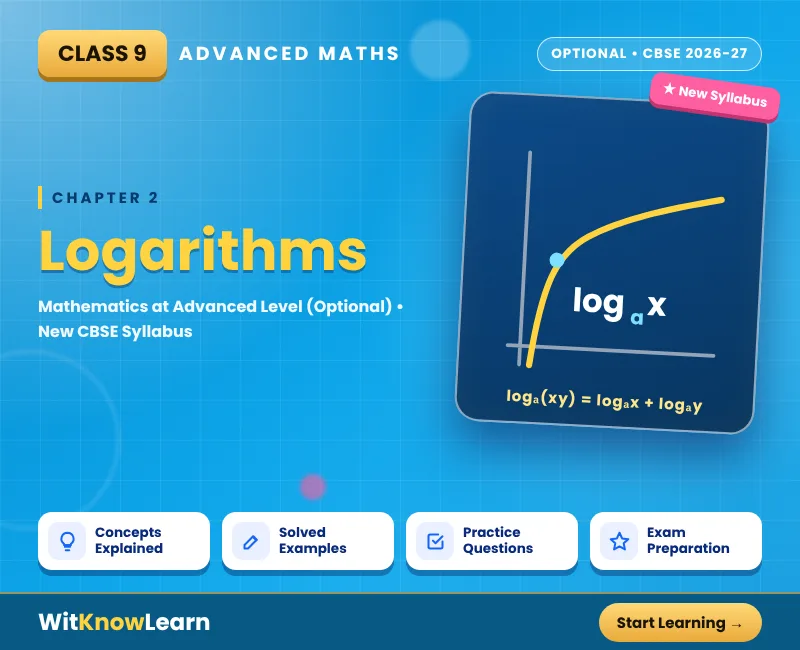
Logarithms Class 9 Advanced Maths Solutions Chapter 2

Logarithms Class 9 Advanced Maths Solutions Chapter 2
Class 9 Maths · Mathematics at Advanced Level · Chapter 2

Logarithms Class 9 Advanced Maths Solutions Chapter 2

Step by step solutions to every question of Exercise 2.1, 2.2, 2.3 and 2.4 of Chapter 2 Logarithms from the CBSE Mathematics at Advanced Level book for Class 9, with laws of logarithms, real-life applications and checked roots.

Exercise 2.1 to 2.4Laws of logarithmsLog equations with checksFAQs

Logarithms Class 9 Advanced Maths at a Glance

Chapter 2 of the Class 9 Mathematics at Advanced Level book explains logarithms as the inverse of exponents. It covers converting between exponential and logarithmic form, common and natural logarithms, the product, quotient, power and change of base rules, applications in science, and solving logarithmic equations.

In every log equation below the roots are put back into the original equation, and any root that makes a logarithm undefined is rejected, exactly as the book's Golden Rule asks.

  • bx = a ⇔ logb a = x (a > 0, b > 0, b ≠ 1); logb 1 = 0, logb b = 1
  • Product rule: loga(MN) = loga M + loga N; Quotient rule: logaMN = loga M – loga N
  • Power rule: loga Mk = k loga M; Change of base: logb a = log alog b; logb a = 1loga b
  • Golden rule: after solving, reject any value that makes the argument of a log ≤ 0 or the base ≤ 0 or 1.

Key Terms in Logarithms Class 9

Logarithmlogb a = x means bx = a.
BaseThe number b in logb a; b > 0 and b ≠ 1.
ArgumentThe number a whose log is taken; a > 0.
Common logarithmLog to base 10, written log a.
Natural logarithmLog to base e, written ln a.
Product rulelogb MN = logb M + logb N.
Power rulelogb Mk = k logb M.
Extraneous rootA value that solves the simplified equation but makes a log undefined.

Logarithms Class 9 Advanced Maths Solutions

Every exercise question of Chapter 2 is solved below in the order of the book. Each solution starts with what is given and the formula used, then shows every step on its own line, a check where possible, and the final answer.

🔷 Exercise 2.1
1Write an equivalent logarithmic statement.
Rule: bx = a ⇔ logb a = x (the base stays the base; the power becomes the answer).
(a) 53 = 125
Base b = 5, power x = 3, value a = 125
log5 125 = 3
(b) 25 = 32
Base = 2, power = 5, value = 32
log2 32 = 5
(c) 7–1 = 17
Base = 7, power = –1, value = 17
log7 17 = –1
(d) 3–1/2 = 1√3
Base = 3, power = –12, value = 1√3
log3 1√3 = –12
✅ Answer: (a) log5 125 = 3 (b) log2 32 = 5 (c) log7 17 = –1 (d) log3 1√3 = –12
2Write an equivalent exponential statement.
Rule: logb a = x ⇔ bx = a
(a) log2 16 = 4
b = 2, x = 4, a = 16 ⇒ 24 = 16
(b) log9 81 = 2
b = 9, x = 2, a = 81 ⇒ 92 = 81
(c) log5 √5 = 12
b = 5, x = 12, a = √5 ⇒ 51/2 = √5
(d) log2 12 = –1
b = 2, x = –1, a = 12 ⇒ 2–1 = 12
✅ Answer: (a) 24 = 16 (b) 92 = 81 (c) 51/2 = √5 (d) 2–1 = 12
3Find the value of (a) log10 1000 (b) log6 36 (c) log2 64.
Method: let the log equal x, change to exponential form and compare powers.
(a) log10 1000
Let log10 1000 = x ⇒ 10x = 1000
1000 = 103 ⇒ 10x = 103
x = 3
(b) log6 36
Let log6 36 = x ⇒ 6x = 36 = 62
x = 2
(c) log2 64
Let log2 64 = x ⇒ 2x = 64 = 26
x = 6
✅ Answer: (a) 3 (b) 2 (c) 6
🟢 Exercise 2.2
1Express as a single logarithm.
Laws used: log M + log N = log MN; log M – log N = log MN; k log M = log Mk; loga a = 1.
(a) log 2 + 2 log 7
2 log 7 = log 72 = log 49 (power law)
log 2 + log 49 = log (2 × 49) (product law)
= log 98
(b) log3 8 + log3 5 – log3 4
log3 8 + log3 5 = log3 (8 × 5) = log3 40
log3 40 – log3 4 = log3 404
= log3 10
(c) log 5 + 2 log 3 – log 15
2 log 3 = log 9
log 5 + log 9 = log 45
log 45 – log 15 = log 4515 = log 3
(d) 2 + 2 log5 3
2 = 2 × 1 = 2 log5 5 = log5 25
2 log5 3 = log5 9
log5 25 + log5 9 = log5 225
(e) 3 – 12 log3 9
3 = 3 log3 3 = log3 27
12 log3 9 = log3 91/2 = log3 3
log3 27 – log3 3 = log3 273 = log3 9
(f) 1 + 2 log4 3 – 3 log4 4
1 = log4 4; 2 log4 3 = log4 9; 3 log4 4 = log4 43 = log4 64
log4 4 + log4 9 – log4 64 = log4 4 × 964
= log4 3664 = log4 916
✅ Answer: (a) log 98 (b) log3 10 (c) log 3 (d) log5 225 (e) log3 9 (f) log4 916
2Find the exact value.
Write the number as a power of the base, then use logb bk = k.
(a) log11 121
121 = 112
log11 112 = 2 log11 11 = 2 × 1 = 2
(b) log7 1
70 = 1 ⇒ log7 1 = 0
(c) log5 625
625 = 5 × 5 × 5 × 5 = 54
log5 54 = 4
(d) log8 8
logb b = 1 ⇒ log8 8 = 1
(e) log 1000
Common log has base 10; 1000 = 103
log 103 = 3
✅ Answer: (a) 2 (b) 0 (c) 4 (d) 1 (e) 3
3If log2 3 = p and log2 5 = q, write in terms of p and q.
Break each number into factors of 2, 3 and 5.
(a) log2 15
15 = 3 × 5
log2 15 = log2 3 + log2 5 = p + q
(b) log2 45
45 = 9 × 5 = 32 × 5
log2 45 = 2 log2 3 + log2 5 = 2p + q
(c) log2 53
log2 53 = log2 5 – log2 3 = q – p
(d) log2 10
10 = 2 × 5
log2 10 = log2 2 + log2 5 = 1 + q
✅ Answer: (a) p + q (b) 2p + q (c) q – p (d) 1 + q
4Which of the following are true?
(a) If 2x+1 = 3x+2 then x + 1 = x + 2
Powers can be equated only when the bases are equal; here 2 ≠ 3.
Also x + 1 = x + 2 gives 1 = 2, which is impossible. ⇒ False
(b) log (x + 1) = log x
If log (x + 1) = log x then x + 1 = x ⇒ 1 = 0, impossible. ⇒ False
(c) logb b3 = 3
Power law: logb b3 = 3 logb b = 3 × 1 = 3 ⇒ True
(d) Logarithm to base 1 is not defined
1y = 1 for every y, so 1y can never equal any other number, and log1 1 has no unique value. ⇒ True
✅ Answer: (c) and (d) are true
5If log2026 x – log2026 y = a, log2026 y – log2026 z = b and log2026 z – log2026 x = c, find (xy)b–c × (yz)c–a × (zx)a–b.
Step 1: Use the quotient law on each given equation.
log2026 xy = a, log2026 yz = b, log2026 zx = c
Step 2: Let P = (xy)b–c × (yz)c–a × (zx)a–b
Take log2026 of both sides and use the product and power laws:
log2026 P = (b – c) log xy + (c – a) log yz + (a – b) log zx
= (b – c)a + (c – a)b + (a – b)c
Step 3: Expand
= ab – ac + bc – ab + ac – bc
= 0
Step 4: log2026 P = 0 ⇒ P = 20260 = 1
✅ Answer: 1
🟣 Exercise 2.3
1Express the following in logarithmic form.
Rule: bx = a ⇔ logb a = x
(a) 54 = 625 ⇒ log5 625 = 4
(b) 10–2 = 0.01 ⇒ log10 0.01 = –2
(c) 70 = 1 ⇒ log7 1 = 0
(d) 81 = 8 ⇒ log8 8 = 1
✅ Answer: (a) log5 625 = 4 (b) log10 0.01 = –2 (c) log7 1 = 0 (d) log8 8 = 1
2Using the properties of logs, simplify log2 16 + log2 4.
Product law: log2 16 + log2 4 = log2 (16 × 4)
= log2 64
64 = 26 ⇒ log2 26 = 6 log2 2 = 6
Check: log2 16 = 4 and log2 4 = 2; 4 + 2 = 6 ✓
✅ Answer: 6
3Evaluate.
(a) log2 256
256 = 28 ⇒ log2 28 = 8
(b) log4 16
16 = 42 ⇒ log4 42 = 2
(c) log5 125
125 = 53 ⇒ log5 53 = 3
(d) log10 0.001
0.001 = 11000 = 10–3 ⇒ log10 10–3 = –3
✅ Answer: (a) 8 (b) 2 (c) 3 (d) –3
4If log2 7 = p and log2 3 = q, write in terms of p and q.
(a) log2 21
21 = 7 × 3 ⇒ log2 7 + log2 3 = p + q
(b) log2 49
49 = 72 ⇒ 2 log2 7 = 2p
(c) log2 73
= log2 7 – log2 3 = p – q
(d) log2 63
63 = 7 × 9 = 7 × 32 ⇒ log2 7 + 2 log2 3 = p + 2q
✅ Answer: (a) p + q (b) 2p (c) p – q (d) p + 2q
5Real-world applications.
(a) Star brightness
Magnitude difference = 2.5 × log10(brightness ratio)
Brightness ratio = 100
= 2.5 × log10 100 = 2.5 × log10 102 = 2.5 × 2 = 5
(b) pH 3 and pH 6
pH = –log10[H⁺] ⇒ [H⁺] = 10–pH
pH 3 ⇒ [H⁺] = 10–3; pH 6 ⇒ [H⁺] = 10–6
Ratio = 10–310–6 = 10–3 + 6 = 103 = 1000
(c) Magnitudes 9 and 4
Each 1-unit rise on the Richter scale is 10 times stronger.
Difference = 9 – 4 = 5 ⇒ 105 = 1,00,000 times
✅ Answer: (a) 5 (b) 1000 times more acidic (c) 1,00,000 times stronger
6True or False (explain your reasoning).
(a) 13 logb x = 3√x
By the power law, 13 logb x = logb x1/3 = logb 3√x.
This is a logarithm, not the number 3√x itself. ⇒ False
(b) log8 e = 1ln 8
Change of base: log8 e = loge eloge 8 = 1ln 8 (since loge e = 1). ⇒ True
(c) Logarithm of a negative number is defined
For b > 0, bx > 0 for every real x, so bx can never be negative. ⇒ False
(d) logb(M + N) = logb M + logb N
logb M + logb N = logb (MN), not logb (M + N). E.g. log 1 + log 1 = 0 but log 2 ≠ 0. ⇒ False
(e) The base can be any real number
The base must be positive and not equal to 1. ⇒ False
✅ Answer: (b) is true; (a), (c), (d), (e) are false
7Find the greatest integer less than log4 9 + log9 28 without a calculator.
Step 1: Change to simpler bases.
log4 9 = log 32log 22 = 2 log 32 log 2 = log2 3
log9 28 = log 28log 32 = 12 log3 28
Step 2: Bound log2 3.
21.5 = 2√2 ≈ 2.83 < 3 and 21.6 ≈ 3.03 > 3
⇒ 1.5 < log2 3 < 1.6
Step 3: Bound log3 28.
33 = 27 < 28 and 33.1 ≈ 30.1 > 28
⇒ 3 < log3 28 < 3.1 ⇒ 1.5 < log9 28 < 1.55
Step 4: Add.
1.5 + 1.5 < sum < 1.6 + 1.55 ⇒ 3 < sum < 3.15
The greatest integer less than the sum is 3.
✅ Answer: 3
8Evaluate x + 5y, where x = log1.43̅ (4340) and y = (12)log2 5.
Note on the question: the base 1.43̅ equals 43/30, but the number inside the log is printed as 43/40. This is a misprint for 43/30 (the same digits as the base), which makes x a whole number. The solution below uses 43/30; the value with the printed 43/40 is shown at the end.
Step 1: Convert the base to a fraction
Let b = 1.43̅ = 1.4333…
10b = 14.333…
100b = 143.333…
100b – 10b = 143.333… – 14.333… = 129
90b = 129 ⇒ b = 12990 = 4330
Step 2: Find x
x = log43/30 (4330)
The base and the number are equal, and loga a = 1
x = 1
Step 3: Find y
y = (12)log2 5 = (2–1)log2 5
= 2–log2 5 = 2log2 (1/5)
= 5–1 (since aloga N = N)
y = 15
Step 4: Find x + 5y
x + 5y = 1 + 5 × 15
= 1 + 1 = 2
If the printed value 43/40 is used, x = log43/30(43/40) = ln 1.075 ÷ ln 1.4333 ≈ 0.0723 ÷ 0.3600 ≈ 0.20, so x + 5y ≈ 1.20, which is not a neat value. This confirms that 43/40 is a misprint.
✅ Answer: x + 5y = 2
🟠 Exercise 2.4
1Solve for x.
Method: combine into one log, change to exponential form, solve, then check the argument is positive.
(a) log3 (2x – 5) = 2
2x – 5 = 32 = 9
2x = 14 ⇒ x = 7
Check: 2(7) – 5 = 9 > 0 ✓
(b) log7 (3x) + log7 2 = log7 24
log7 (3x × 2) = log7 24 ⇒ log7 (6x) = log7 24
6x = 24 ⇒ x = 4
Check: 3x = 12 > 0 ✓
(c) log5 (x + 3) – log5 (x – 1) = 1
log5 x + 3x – 1 = 1 ⇒ x + 3x – 1 = 5
x + 3 = 5x – 5 ⇒ 8 = 4x ⇒ x = 2
Check: x + 3 = 5 > 0, x – 1 = 1 > 0 ✓
(d) log2 (x2 – 7) = 3
x2 – 7 = 23 = 8
x2 = 15 ⇒ x = ±√15
Check: x2 – 7 = 8 > 0 for both values ✓
✅ Answer: (a) 7 (b) 4 (c) 2 (d) ±√15
2Solve for x.
(a) log2 (x – 3) + log2 (x + 1) = 5
log2 [(x – 3)(x + 1)] = 5 ⇒ (x – 3)(x + 1) = 25 = 32
x2 – 2x – 3 = 32 ⇒ x2 – 2x – 35 = 0
(x – 7)(x + 5) = 0 ⇒ x = 7 or x = –5
x = –5 gives x – 3 = –8 < 0 (reject). x = 7 gives 4 and 8 > 0 ✓
x = 7
(b) 2 log4 x = log4 (5x – 4)
log4 x2 = log4 (5x – 4) ⇒ x2 = 5x – 4
x2 – 5x + 4 = 0 ⇒ (x – 1)(x – 4) = 0 ⇒ x = 1 or 4
Check x = 1: x > 0, 5x – 4 = 1 > 0 ✓; x = 4: 5x – 4 = 16 > 0 ✓
x = 1 or 4
(c) log5 (x + 2) + log5 (x – 2) = 1
log5 [(x + 2)(x – 2)] = 1 ⇒ x2 – 4 = 5
x2 = 9 ⇒ x = ±3
x = –3 gives x + 2 = –1 < 0 (reject) ⇒ x = 3
(d) log10 (x – 2) + log10 (x + 1) = 1
(x – 2)(x + 1) = 101 = 10
x2 – x – 2 = 10 ⇒ x2 – x – 12 = 0
(x – 4)(x + 3) = 0 ⇒ x = 4 or –3
x = –3 gives x – 2 < 0 (reject) ⇒ x = 4
✅ Answer: (a) 7 (b) 1, 4 (c) 3 (d) 4
3Solve for x.
(a) logx (3x + 10) = 2, x > 0, x ≠ 1
x2 = 3x + 10 ⇒ x2 – 3x – 10 = 0
(x – 5)(x + 2) = 0 ⇒ x = 5 or –2
The base must be positive ⇒ x = 5
(b) (log3 x)2 – 4 log3 x + 3 = 0
Let y = log3 x ⇒ y2 – 4y + 3 = 0
(y – 1)(y – 3) = 0 ⇒ y = 1 or 3
log3 x = 1 ⇒ x = 3; log3 x = 3 ⇒ x = 27
(c) (log2 x)2 + log2 x3 = 10
log2 x3 = 3 log2 x; let y = log2 x
y2 + 3y – 10 = 0 ⇒ (y + 5)(y – 2) = 0 ⇒ y = 2 or –5
x = 22 = 4 or x = 2–5 = 132
(d) xlog₁₀ x = 1000x2
Take log10 on both sides: log10 x × log10 x = log10 1000 + 2 log10 x
Let y = log10 x: y2 = 3 + 2y ⇒ y2 – 2y – 3 = 0
(y – 3)(y + 1) = 0 ⇒ y = 3 or –1
x = 103 = 1000 or x = 10–1 = 110
✅ Answer: (a) 5 (b) 3, 27 (c) 4, 132 (d) 1000, 110
4Solve for x.
(a) log3 (x2 – 1) = log3 (2x – 1)
x2 – 1 = 2x – 1 ⇒ x2 – 2x = 0 ⇒ x(x – 2) = 0
x = 0 or x = 2
x = 0 gives x2 – 1 = –1 < 0 (reject); x = 2 gives 3 > 0 ✓ ⇒ x = 2
(b) logx 5 – logx 2 = logx √x
logx 52 = logx x1/2 = 12
x1/2 = 52 ⇒ x = (52)2 = 254
(c) log2 x + 1logx 2 = 4
1logx 2 = log2 x (reciprocal rule)
log2 x + log2 x = 4 ⇒ 2 log2 x = 4 ⇒ log2 x = 2
x = 22 = 4
(d) log3 (3 + x) + log3 (8 – x) – log3 (9x – 8) = 2 – log3 9
RHS: log3 9 = 2 ⇒ 2 – 2 = 0
LHS: log3 (3 + x)(8 – x)9x – 8 = 0 ⇒ (3 + x)(8 – x)9x – 8 = 30 = 1
(3 + x)(8 – x) = 9x – 8 ⇒ 24 + 5x – x2 = 9x – 8
x2 + 4x – 32 = 0 ⇒ (x + 8)(x – 4) = 0 ⇒ x = 4 or –8
x = –8 gives 3 + x = –5 < 0 (reject); x = 4 gives 7, 4, 28 > 0 ✓ ⇒ x = 4
(e) log10[log2 (log3 9)] = 5x
log3 9 = 2
log2 2 = 1
log10 1 = 0 ⇒ 5x = 0 ⇒ x = 0
✅ Answer: (a) 2 (b) 254 (c) 4 (d) 4 (e) 0
5If x = log 12 + log 23 + log 34 + … + log 99100 (base 10), evaluate (x + 1)(x + 2)(x + 3) … (x + 99).
Step 1: Product law: x = log (12 × 23 × 34 × … × 99100)
Step 2: Each numerator cancels the previous denominator ⇒ product = 1100
x = log 1100 = log 10–2 = –2
Step 3: The factor (x + 2) = –2 + 2 = 0
Step 4: Any product with a zero factor is zero.
✅ Answer: 0

Logarithms Class 9 Quick Revision Notes

logb a = x is the same statement as bx = a. The base b must be positive and not 1, and the argument a must be positive.

Special values: logb 1 = 0, logb b = 1 and blogb a = a.

Laws: logb MN = logb M + logb N, logb MN = logb M – logb N, logb Mk = k logb M.

Change of base: logb a = log alog b, so logb a × loga b = 1.

To solve a log equation, combine logs into one, change to exponential form, solve, then check every root in the original equation.

Logarithmic scales are used for pH (pH = –log [H⁺]), the Richter scale (each unit is 10 times stronger) and star magnitudes.

Logarithms Class 9 Mind Map

Definition• b^x = a ⇔ log_b a = x• a > 0, b > 0, b ≠ 1• Inverse of exponentSpecial values• log_b 1 = 0• log_b b = 1• b^(log_b a) = aLaws• Product: log M + log N• Quotient: log M – log N• Power: k log MChange of base• log_b a = log a / log b• log_b a = 1 / log_a b• ln x = log_e xCommon logs• Base 10• log 10 = 1• Scales very big/smallEquations• Combine into one log• Convert to exponent form• Reject invalid rootsApplications• pH = –log[H⁺]• Richter scale ×10• Octaves, star magnitudesGraphs• y = log x vs y = bˣ• Mirror in y = x• Passes through (1, 0)Logarithms

Important Points to Remember

1bx = a ⇔ logb a = x.
2logb 1 = 0.
3logb b = 1.
4log (M + N) ≠ log M + log N.
5logb a = 1loga b.
6Logs of negative numbers are not defined.
7Base 1 is not allowed.
8Always check roots.
9pH 3 is 1000 times more acidic than pH 6.
10Each Richter unit = 10 times stronger.

Common Mistakes Students Make

❌ Writing log(M + N) = log M + log N
✅ The product rule is for log(MN), not log(M + N).
❌ Keeping a root that makes the argument negative
✅ Put each root back; reject it if any log becomes undefined.
❌ Forgetting that logb 1 = 0
✅ Any base to the power 0 is 1.
❌ Cancelling logs with different bases
✅ Use change of base first.
❌ Taking 13 logb x = ∛x
✅ It equals logb ∛x, not ∛x.

Logarithms in Real Life

🏠pH of acids and bases uses a log scale.
🐝Earthquakes are measured on the Richter scale.
🌻Sound loudness is measured in decibels.
🕒Population and money growth times are found using logs.
💻Musical octaves double the frequency each step.

Extra Questions with Answers

These questions are not from the book. They are made for extra practice and class tests, and every answer has been checked.

Very short answer questions
1Find log3 81.
Let log3 81 = x
Exponential form: 3x = 81
Write 81 as a power of 3: 81 = 3 × 3 × 3 × 3 = 34
3x = 34 ⇒ x = 4
✅ Answer: log3 81 = 4
2Find log10 0.0001.
Let log10 0.0001 = x
Exponential form: 10x = 0.0001
0.0001 = 110000 = 1104 = 10–4
10x = 10–4 ⇒ x = –4
✅ Answer: –4
3Write 63 = 216 in logarithmic form.
Rule: bx = a ⇔ logb a = x
Here b = 6, x = 3, a = 216
log6 216 = 3
✅ Answer: log6 216 = 3
Short answer questions
1Simplify log 50 + log 2.
Product rule: log M + log N = log (MN)
log 50 + log 2 = log (50 × 2)
= log 100
= log 102 = 2 log 10
= 2 × 1 = 2
✅ Answer: 2
2Solve log2 (x + 5) = 4.
Condition: x + 5 > 0
Exponential form: x + 5 = 24
x + 5 = 16
x = 16 – 5 = 11
Check: x + 5 = 16 > 0 and log2 16 = 4 ✓
✅ Answer: x = 11
3If log 2 = 0.3010 and log 3 = 0.4771, find log 72.
Factorise: 72 = 8 × 9 = 23 × 32
log 72 = log 23 + log 32 (product rule)
= 3 log 2 + 2 log 3 (power rule)
= 3 × 0.3010 + 2 × 0.4771
= 0.9030 + 0.9542
= 1.8572
✅ Answer: log 72 = 1.8572
Long answer question
1Solve log2 x + log4 x = 6.
Condition: x > 0
Step 1: Change log4 x to base 2
log4 x = log2 xlog2 4 = log2 x2
Step 2: Substitute
log2 x + 12 log2 x = 6
32 log2 x = 6
log2 x = 6 × 23 = 4
Step 3: Exponential form: x = 24 = 16
Check: log2 16 + log4 16 = 4 + 2 = 6 ✓
✅ Answer: x = 16

Exam Tips for Chapter 2

  • Write the definition bx = a whenever you are stuck.
  • Combine logs into a single log before changing form.
  • Always state the domain check for each root.
  • Know the values log 2 ≈ 0.3010 and log 3 ≈ 0.4771.
  • Do not use a calculator unless the question allows it.

Logarithms in Mathematics for Class 9

Read the full chapter descriptionTap to open

A logarithm is the power to which a fixed number, called the base, must be raised to give another number. If bx = a, then x = logb a, read as "log of a to the base b". For example, 25 = 32, so log2 32 = 5. Logarithms were introduced by John Napier in 1614 to turn long multiplications into easy additions.

Conditions for a logarithm

logb a is defined only when a > 0, b > 0 and b ≠ 1. That is why the logarithm of zero or of a negative number is not defined, and why base 1 is not allowed (1 raised to any power is 1).

Types of logarithms

  • Common logarithm: base 10, written log a. log 1000 = 3.
  • Natural logarithm: base e (about 2.718), written ln a.
  • Binary logarithm: base 2, used in computer science.

Laws of logarithms

LawFormulaExample
Productlogb MN = logb M + logb Nlog 2 + log 5 = log 10 = 1
Quotientlogb (M/N) = logb M – logb Nlog2 8 – log2 2 = 2
Powerlogb Mk = k logb Mlog3 92 = 4
Change of baselogb a = log a ÷ log blog4 8 = 3/2

Solving logarithmic equations

To solve an equation such as log2(x – 3) + log2(x + 1) = 5, combine the logs into one, change to exponential form (x – 3)(x + 1) = 32, solve the quadratic to get x = 7 or x = –5, and reject x = –5 because it makes the argument negative. A root that must be rejected in this way is called an extraneous root.

Uses of logarithms

Logarithmic scales compress very large ranges of numbers. Chemists use pH = –log[H+]; seismologists use the Richter scale, where a magnitude 9 earthquake is 105 times stronger than magnitude 4; astronomers use magnitudes for brightness; and economists use logs to find how long money or population takes to double. The graphs of y = log x and y = 10x are mirror images in the line y = x.

Logarithms Class 9 Advanced Maths FAQs

What is Chapter 2 of Class 9 Mathematics at Advanced Level?
Chapter 2 is Logarithms. It covers the definition of logarithms, the laws of logarithms, common and natural logs, applications and solving logarithmic equations.
How many exercises are in Class 9 Advanced Maths Logarithms?
There are four exercises, Exercise 2.1 to Exercise 2.4, and all are solved on this page.
What is the relation between exponent and logarithm?
bx = a is the same as logb a = x.
Why is the logarithm of a negative number not defined?
A positive base raised to any power is always positive, so no power can give a negative number.
What is log 1 to any base?
0, because b0 = 1.
How do you solve a logarithmic equation?
Combine the logs, change to exponential form, solve, and check every root in the original equation.
What is the answer to Exercise 2.3 Question 8?
The base 1.43̅ equals 43/30, and with the argument 43/30 the value of x + 5y is 2. The printed 43/40 is a misprint.
Are these solutions for the CBSE 2026-27 Advanced Maths book?
Yes. They follow the Class 9 Mathematics at Advanced Level book for 2026-27.

Keep learning with these worksheets, notes and tools on WitKnowLearn.

WitKnowLearn · Worksheets, Notes and Solutions for Class 9 Maths.

Download