Coordinate Geometry Class 9 Advanced Maths Solutions
Class 9 Maths · Mathematics at Advanced Level · Chapter 4
Coordinate Geometry Class 9 Advanced Maths Solutions Chapter 4
Step by step solutions to every question of Exercise 4.1 to 4.6 of Chapter 4 Coordinate Geometry from the CBSE Mathematics at Advanced Level book for Class 9, covering reflections, slope, parallel and perpendicular lines, intercepts and equations of lines.
Exercise 4.1 to 4.6Slope and interceptsEquations of a lineFAQs
Coordinate Geometry Class 9 Advanced Maths at a Glance
Chapter 4 of the Class 9 Mathematics at Advanced Level book goes beyond plotting points. It covers reflections in the axes, coordinates as perpendicular distances, the slope of a line, parallel and perpendicular lines, x and y intercepts, and the general, slope-intercept and intercept forms of a straight line.
Each solution below writes the formula first, substitutes the values, solves step by step and checks the result, for example by putting the point back into the line.
Quadrants: I (+, +), II (–, +), III (–, –), IV (+, –); |x| = distance from the y-axis, |y| = distance from the x-axis.
Reflection in the x-axis: (x, y) → (x, –y); in the y-axis: (x, y) → (–x, y).
Ax + By + C = 0 has slope –AB, x-intercept –CA, y-intercept –CB.
Slope-intercept form y = mx + c; intercept form xa + yb = 1; area of triangle with axes = 12|ab|.
Key Terms in Coordinate Geometry Class 9
QuadrantOne of the four regions made by the axes: I (+, +), II (–, +), III (–, –), IV (+, –).
Reflection in the x-axis(x, y) → (x, –y).
Reflection in the y-axis(x, y) → (–x, y).
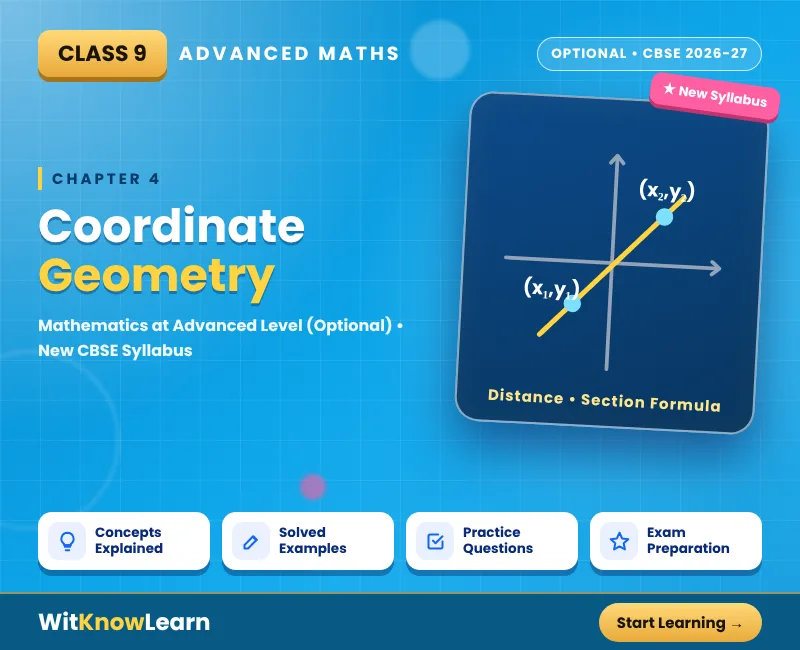
Slopem = y2 – y1x2 – x1, the steepness of a line.
Parallel linesLines with equal slopes.
Perpendicular linesLines whose slopes multiply to –1.
InterceptThe point where a line meets an axis.
Intercept formxa + yb = 1.
Coordinate Geometry Class 9 Advanced Maths Solutions
Every exercise question of Chapter 4 is solved below in the order of the book. Each solution starts with what is given and the formula used, then shows every step on its own line, a check where possible, and the final answer.
🔷 Exercise 4.1
1P lies in Quadrant III. It is reflected in the y-axis to P′, then P′ is reflected in the x-axis to P″. In which quadrants do P′ and P″ lie?
Let P = (–a, –b) with a, b > 0 (both coordinates negative in Quadrant III).
Reflection in the y-axis: (x, y) → (–x, y)
P′ = (a, –b) ⇒ x positive, y negative ⇒ Quadrant IV
Reflection in the x-axis: (x, y) → (x, –y)
P″ = (a, b) ⇒ both positive ⇒ Quadrant I
✅ Answer: P′ in Quadrant IV; P″ in Quadrant I
2A(a, b) is reflected in the x-axis to B. B is exactly 8 units below A. Find the y-coordinate of A.
Reflection in the x-axis: B = (a, –b)
A and B have the same x-coordinate, so the distance between them is vertical.
AB = b – (–b) = 2b (A is above B, so b > 0)
2b = 8
b = 4
✅ Answer: The y-coordinate of A is 4
🟢 Exercise 4.2
1P(a, b) is in Quadrant IV. Its distance from the y-axis is 3 more than its distance from the x-axis, and ab = –28. Find a2 + b.
Step 1: Signs in Quadrant IV: a > 0, b < 0
Distance from the y-axis = |a| = a; distance from the x-axis = |b| = –b
Step 2: a = –b + 3 ⇒ b = 3 – a
Step 3: ab = –28 ⇒ a(3 – a) = –28
3a – a2 = –28 ⇒ a2 – 3a – 28 = 0
(a – 7)(a + 4) = 0 ⇒ a = 7 or a = –4
a > 0 ⇒ a = 7, so b = 3 – 7 = –4
Check: 7 = 4 + 3 ✓ and 7 × (–4) = –28 ✓
Step 4: a2 + b = 49 + (–4) = 45
✅ Answer: 45
2Q(k – 4, 2k + 7) lies strictly in Quadrant II. Its distance from the y-axis is twice its distance from the x-axis. Find k and k3 + 10.
Step 1: Quadrant II ⇒ x < 0 and y > 0
k – 4 < 0 and 2k + 7 > 0
Step 2: Distance from the y-axis = |k – 4| = 4 – k; from the x-axis = 2k + 7
Step 3: 4 – k = 2(2k + 7)
4 – k = 4k + 14
4 – 14 = 4k + k ⇒ –10 = 5k ⇒ k = –2
Check: Q = (–6, 3) is in Quadrant II and 6 = 2 × 3 ✓
Step 4: k3 + 10 = (–2)3 + 10 = –8 + 10 = 2
✅ Answer: k = –2; k3 + 10 = 2
3P(3, –4) is reflected in the y-axis to Q(a, b), and Q in the x-axis to R(c, d). Find √ac – bd.
Reflection in the y-axis changes the sign of x: Q = (–3, –4) ⇒ a = –3, b = –4
Reflection in the x-axis changes the sign of y: R = (–3, 4) ⇒ c = –3, d = 4
ac = (–3)(–3) = 9
bd = (–4)(4) = –16
ac – bd = 9 – (–16) = 25
√25 = 5
✅ Answer: 5
🟣 Exercise 4.3
1A line of slope 12 passes through A(x, 2), B(3, 4) and C(7, y). Find A, C and x + y.
Formula: slope m = y2 – y1x2 – x1
Step 1: Using A and B
4 – 23 – x = 12 ⇒ 23 – x = 12
Cross-multiply: 4 = 3 – x ⇒ x = –1
Step 2: Using B and C
y – 47 – 3 = 12 ⇒ y – 44 = 12
y – 4 = 2 ⇒ y = 6
Step 3: A(–1, 2), C(7, 6)
x + y = –1 + 6 = 5
✅ Answer: A(–1, 2), C(7, 6), x + y = 5
2P(2, 3), Q(5, 7) and R(13, k) are consecutive vertices of a rectangle. Find k.
Adjacent sides of a rectangle meet at 90° ⇒ PQ ⊥ QR ⇒ mPQ × mQR = –1
mPQ = 7 – 35 – 2 = 43
mQR = k – 713 – 5 = k – 78
43 × k – 78 = –1
4(k – 7)24 = –1 ⇒ 4(k – 7) = –24
k – 7 = –6 ⇒ k = 1
✅ Answer: k = 1
3Line l passes through the origin and meets the segment joining A(2, 8) and B(6, 2). Find the range of its slope m.
Step 1: Slope of OA = 8 – 02 – 0 = 4
Step 2: Slope of OB = 2 – 06 – 0 = 13
Step 3: Any line through O that cuts AB lies between OB and OA.
As the line turns from OB to OA, its slope increases from 13 to 4.
✅ Answer: 13 ≤ m ≤ 4
4l1 passes through A(1, k) and B(k, 7); l2 through C(–2, 4) and D(1, 10). If l1 ∥ l2, find k and k2 + 5.
Parallel lines have equal slopes.
m2 = 10 – 41 – (–2) = 63 = 2
m1 = 7 – kk – 1
7 – kk – 1 = 2 ⇒ 7 – k = 2k – 2
9 = 3k ⇒ k = 3
k2 + 5 = 9 + 5 = 14
✅ Answer: k = 3; k2 + 5 = 14
5Line p has slope 2. Line q through M(3a, 4) and N(a, 5) meets p at a right angle. Find a, M and N.
For Ax + By + C = 0, slope = –AB, x-intercept = –CA and y-intercept = –CB.
Slope-intercept form y = mx + c uses the slope and y-intercept; intercept form xa + yb = 1 uses both intercepts. The triangle a line makes with the axes has area 12|a||b|.
Coordinate Geometry Class 9 Mind Map
Important Points to Remember
1Quadrant II: (–, +).
2Quadrant IV: (+, –).
3m = rise ÷ run.
4Horizontal line: m = 0.
5Parallel ⇒ equal slopes.
6Perpendicular ⇒ m1m2 = –1.
7y = mx + c.
8xa + yb = 1.
9Area with axes = 12|ab|.
10Check by substituting the point.
Common Mistakes Students Make
❌ Taking distance from the x-axis as |x|
✅ Distance from the x-axis is |y|.
❌ Subtracting coordinates in different orders
✅ Use (y2 – y1) and (x2 – x1) in the same order.
❌ Writing slope of Ax + By + C = 0 as AB
✅ It is –AB.
❌ Forgetting negative k values
✅ Area problems usually give two signs of k; check both.
❌ Missing the line through the origin
✅ When the intercepts are both zero, the line passes through the origin.
Coordinate Geometry in Real Life
🏠Maps and GPS use coordinates.
🐝Ramps and roads are designed with a safe slope.
🌻Graphs of distance and time show speed as slope.
🕒Architects use perpendicular lines for walls and floors.
💻Computer games place objects using coordinates.
Extra Questions with Answers
These questions are not from the book. They are made for extra practice and class tests, and every answer has been checked.
Very short answer questions
1Find the slope of the line through (1, 2) and (4, 8).
Formula: m = y2 – y1x2 – x1
(x1, y1) = (1, 2), (x2, y2) = (4, 8)
m = 8 – 24 – 1 = 63 = 2
✅ Answer: m = 2
2In which quadrant does (–3, –7) lie?
x = –3 < 0 and y = –7 < 0
Both coordinates negative ⇒ (–, –)
(–, –) is Quadrant III
✅ Answer: Quadrant III
3Find the y-intercept of 3x + 2y = 12.
y-intercept: put x = 0
3(0) + 2y = 12
2y = 12 ⇒ y = 6
✅ Answer: y-intercept = 6, i.e. the point (0, 6)
Short answer questions
1Find the equation of the line with slope –3 through (0, 4).
Slope-intercept form: y = mx + c
m = –3
(0, 4) is on the y-axis ⇒ c = 4
y = –3x + 4
Check: at x = 0, y = 4 ✓
✅ Answer: y = –3x + 4
2Is the line through (1, 3) and (3, 7) parallel to y = 2x + 5?
Slope of the first line: m1 = 7 – 33 – 1 = 42 = 2
Slope of y = 2x + 5: m2 = 2
Parallel lines have equal slopes: m1 = m2 = 2
✅ Answer: Yes, the lines are parallel
3Find k if (k, 5) lies on 2x – y + 1 = 0.
A point lies on a line if it satisfies the equation.
Put x = k, y = 5: 2k – 5 + 1 = 0
2k – 4 = 0
2k = 4 ⇒ k = 2
Check: 2(2) – 5 + 1 = 0 ✓
✅ Answer: k = 2
Long answer question
1A line through (4, 3) makes equal positive intercepts on the axes. Find its equation and the area of the triangle it forms with the axes.
Step 1: Intercept form: xa + yb = 1
Equal intercepts ⇒ b = a
xa + ya = 1 ⇒ x + y = a
Step 2: The line passes through (4, 3)
4 + 3 = a ⇒ a = 7
Step 3: Equation: x + y = 7
Step 4: Area = 12 × a × b
= 12 × 7 × 7
= 492 = 24.5
Check: (4, 3): 4 + 3 = 7 ✓
✅ Answer: x + y = 7; area = 24.5 square units
Exam Tips for Chapter 4
Draw a rough sketch for every coordinate question.
Write the sign of each coordinate before using distance from an axis.
Write the formula, then substitute.
Check the answer by putting the point back into the equation.
Give final equations in the form the question asks for.
Coordinate Geometry in Mathematics for Class 9
Read the full chapter descriptionTap to open
Coordinate geometry, also called analytic geometry, studies geometric figures using numbers. Every point in a plane is given by an ordered pair (x, y), measured from two perpendicular number lines called the x-axis and the y-axis, which meet at the origin O(0, 0). The method was introduced by René Descartes, so the plane is called the Cartesian plane.
Quadrants and reflections
The axes divide the plane into four quadrants: I (+, +), II (–, +), III (–, –) and IV (+, –). The x-coordinate of a point is its perpendicular distance from the y-axis (with sign) and the y-coordinate is its distance from the x-axis. Reflection in the x-axis sends (x, y) to (x, –y) and reflection in the y-axis sends it to (–x, y).
Slope of a line
The slope or gradient m of a line measures its steepness: m = (y2 – y1) ÷ (x2 – x1), the rise divided by the run. A line rising from left to right has positive slope, a falling line has negative slope, a horizontal line has slope 0 and a vertical line has undefined slope. If a line makes angle θ with the positive x-axis, m = tan θ.
Parallel and perpendicular lines
Two non-vertical lines are parallel when their slopes are equal and perpendicular when the product of their slopes is –1. For example, the lines 3x – 5y + 10 = 0 and 5x + 3y + K = 0 have slopes 3/5 and –5/3, whose product is –1.
Forms of the equation of a line
Form
Equation
Used when you know
General form
Ax + By + C = 0
any line
Slope-intercept form
y = mx + c
slope and y-intercept
Intercept form
x/a + y/b = 1
both intercepts
Intercepts and area
The x-intercept is where y = 0 and the y-intercept is where x = 0. A line with intercepts a and b forms a right-angled triangle with the axes whose area is ½|ab| and whose hypotenuse is √(a2 + b2). These ideas are used to find lines that satisfy given conditions, and later lead to the distance formula, section formula and conic sections in higher classes.
Coordinate Geometry Class 9 Advanced Maths FAQs
What is Chapter 4 of Class 9 Mathematics at Advanced Level?
Chapter 4 is Coordinate Geometry, covering quadrants, reflections, slope, intercepts and equations of lines.
How many exercises are in Class 9 Advanced Maths Coordinate Geometry?
Six exercises, Exercise 4.1 to Exercise 4.6, all solved on this page.
What is the formula for the slope of a line?
m = (y2 – y1) ÷ (x2 – x1).
When are two lines perpendicular?
When the product of their slopes is –1.
What is the slope of Ax + By + C = 0?
–A/B.
What is the intercept form of a line?
x/a + y/b = 1, where a and b are the x- and y-intercepts.
How do you find the area of the triangle a line makes with the axes?
Find both intercepts a and b, then area = ½|ab|.
Are these solutions for the CBSE 2026-27 Advanced Maths book?
Yes, they follow the Class 9 Mathematics at Advanced Level book for 2026-27.
More Class 9 Maths Practice
Keep learning with these worksheets, notes and tools on WitKnowLearn.

 Download