
Cubes and Cube Roots Class 8 Maths Worksheet with Quiz and Activities
Work with cubes and cube roots: spot perfect cubes, use patterns, group prime factors in triples and stack small cubes into bigger cubes. On WitKnowLearn you get the Cubes and Cube Roots Class 8 online quiz, online activities and interactive games, a cube lab, a virtual lab and a worksheet-style practice sheet for Class 8 Maths.
Cubes and Cube Roots Class 8 Online Quiz
20 questions: 10 easy, 5 average and 5 thinking. Tap an answer and the next question comes up.
Cubes and Cube Roots Class 8 Activities
👆 Tap a tab to switch: Learn, Games, Labs, Challenges, Virtual Lab and Practice sheet
Cubes and Cube Roots: Perfect Cubes, Roots and the Taxicab Number
A short read for Class 8 before you play. These notes cover Cubes and Cube Roots.
🧊 What is a cube number?
A cube number is a number multiplied by itself three times, such as 4 x 4 x 4 = 64. It is also the volume of a cube whose side is that number. Cubes of even numbers are even, cubes of odd numbers are odd, and the cube of a negative number is negative.
🧩 Patterns and the taxicab number
The sum of the first n cubes is a perfect square, so 1 + 8 + 27 + 64 = 100. The number 1729 is called the taxicab number because it is the smallest number that is a sum of two cubes in two different ways, 1 cubed + 12 cubed and 9 cubed + 10 cubed.
∛ Finding cube roots
The cube root undoes cubing. To find the cube root of a large number, write it as a product of primes, group equal factors in triples and take one factor from each triple. If a factor is left over, multiply or divide to complete the triple, or estimate the root between two perfect cubes.
Cubes and Cube Roots Class 8 Maths Activities
Follow every step on the Number Train. Earn up to 3 stars in every activity.
This page covers Cubes and Cube Roots for Class 8 maths. It covers perfect cubes, patterns in cubes, the taxicab number 1729 and cube roots by prime factorisation and estimation.
The activities are pitched at Class 8 level. Sort perfect cubes, match roots, complete prime factor triples and stack small cubes into bigger cubes in the studio. Explore more Class 8 maths worksheets on WitKnowLearn after this chapter.
Key ideas and facts to know
| Number | Prime factors | Cube root |
|---|---|---|
| 216 | 2 x 2 x 2 x 3 x 3 x 3 | 6 |
| 3375 | 3 x 3 x 3 x 5 x 5 x 5 | 15 |
| 108 | 2 x 2 x 3 x 3 x 3 | not perfect |
How to use this page
- Flip the six cards and try the Cube Lab in the Learn tab.
- Play the five games and the five labs to practise each idea.
- Finish the five challenges to collect up to 15 points.
- Do two virtual experiments and stack cubes in the studio.
- Take the 20-question online quiz, with assertion and reason and case study questions, and fill in the practice sheet.
Worked examples
3375 = 3 x 3 x 3 x 5 x 5 x 5, so the root is 3 x 5 = 15.
108 = 2 x 2 x 3 x 3 x 3. Multiply by 2 to get 216.
This Cubes and Cube Roots worksheet for Class 8 science gives you online activities and interactive games that make the chapter clear. Every activity has a goal, a hint and a short fact, so students learn while they enjoy.
Complete Guide: Class 8 Maths Cubes and Cube Roots
This guide is for Class 8 students, parents and teachers. It covers Cubes and Cube Roots for Class 8 maths and shows how to use the quiz, labs and games on this page.
Introduction to Cubes and Cube Roots
Cubes link number patterns with the volume of solids. This topic shows how to recognise perfect cubes, find cube roots by factorising and solve problems about tanks and boxes.
What is there in this chapter
- Cube numbers and their properties
- Patterns in cubes
- The taxicab number 1729
- Cube root by prime factorisation
- Estimating cube roots
Learning objectives
- Recognise perfect cubes.
- Use patterns in cubes.
- Find cube roots by factorisation.
- Estimate cube roots of other numbers.
- Reason with assertions and case studies.
Learning outcomes
- I can tell if a number is a perfect cube.
- I can find cube roots using triples of prime factors.
- I can find the side of a cube from its volume.
Cubes and Cube Roots Class 8 resources on this page
| Resource | What it gives |
|---|---|
| Online quiz | 20 questions: 10 easy, 5 average and 5 thinking, with assertion and reason and case study questions and a full review |
| Flip cards | 6 picture cards with one-line rules |
| Cube Lab | A hands-on lab with 3 rounds |
| Games | 5 interactive games |
| Labs | 5 activity labs |
| Virtual Lab | 2 experiments plus a studio that stacks small cubes into bigger cubes |
| Challenges | 5 challenges, 15 points in all |
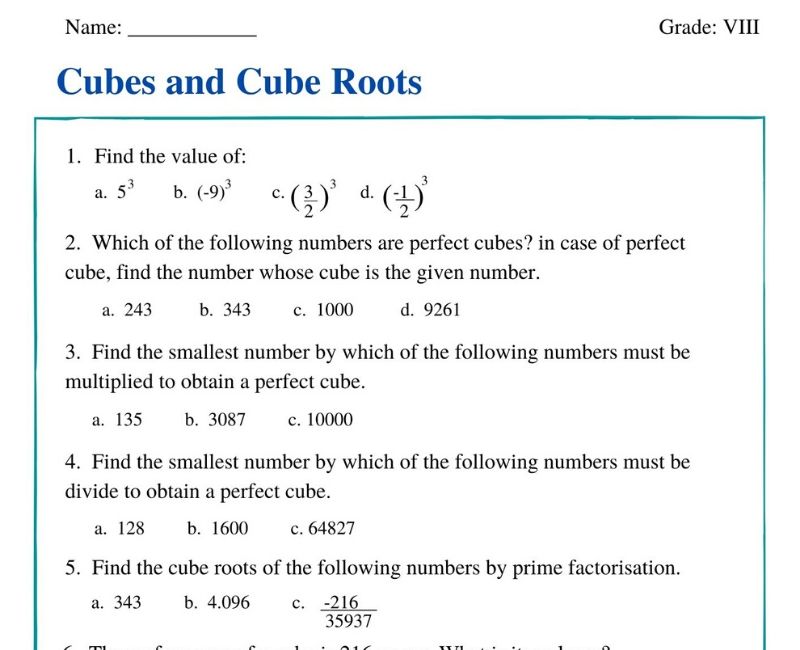
| Practice sheet | A worksheet-style sheet with 16 questions, name and date lines and a live score |
Key facts
| Idea | Rule |
|---|---|
| Perfect cube | cube of a whole number |
| Prime factors | come in triples |
| Negative cube | cube of a negative number is negative |
| Odd and even | cube has the same parity |
| Volume of a cube | side cubed |
Types of questions you may see
- Identify perfect cubes
- Assertion and reason on parity and 1729
- Case study on a cubical tank
- Multiplying or dividing to make a cube
Solved examples
0.3 x 0.3 x 0.3 = 0.027, so the root is 0.3.
500 = 2 x 2 x 5 x 5 x 5. Divide by 2 x 2 = 4 to get 125.
Common mistakes
| Mistake | Correct idea |
|---|---|
| Saying the cube of 5 is 15 | The cube of 5 is 5 x 5 x 5 = 125 |
| Saying 100 is a perfect cube | 100 is between 64 and 125 |
| Grouping prime factors in pairs | Group the prime factors in triples |
Cubes and Cube Roots in daily life
Cubes give the volume of boxes, tanks and dice, and cube roots help find the side of a cube from the amount of material it holds.
Tips for parents and teachers
- Learn the cubes up to 10.
- Check the units digit before factorising.
- Practise one assertion and one case study each week.
Related Class 8 Maths Worksheets
Cubes and Cube Roots Class 8 FAQs
What is a perfect cube?
A perfect cube is the cube of a whole number, such as 125 = 5 x 5 x 5. It is also the volume of a cube with that whole-number side.
How do you find a cube root by prime factorisation?
Write the number as a product of primes, group equal factors in triples and multiply one factor from each triple. For 216 the root is 2 x 3 = 6.
What is the taxicab number 1729?
It is the smallest number that can be written as a sum of two cubes in two ways: 1 cubed + 12 cubed and 9 cubed + 10 cubed.
Is the cube of a negative number negative?
Yes. Three negative factors multiply to a negative number, so the cube of -3 is -27.
What can students do on this page?
Students can take a 20-question online quiz with assertion and reason and case study questions, play five games, try five online activities, finish five challenges, run the Cube Lab, do two virtual experiments, stack small cubes in the stack and table views,, and fill in a 16-question practice sheet with a Show answers button.
 Download


