We Distribute, Yet Things Multiply Class 8 Maths Worksheet with Quiz and Activities
In this chapter: the distributive property and identities. Expand brackets, use the three identities and multiply large numbers in your head. On WitKnowLearn you get the We Distribute, Yet Things Multiply Class 8 online quiz, online activities and interactive games, a distribute lab, a virtual lab and a worksheet-style practice sheet for Class 8 Maths.
We Distribute, Yet Things Multiply Class 8 Online Quiz
20 questions: 10 easy, 5 average and 5 thinking. Tap an answer and the next question comes up.
We Distribute, Yet Things Multiply Class 8 Activities
👆 Tap a tab to switch: Learn, Games, Labs, Challenges, Virtual Lab and Practice sheet
We Distribute, Yet Things Multiply: We Distribute, Yet Things Multiply
A short read for Class 8 before you play. These notes cover We Distribute, Yet Things Multiply: the distributive property and identities.
🔓 The distributive property
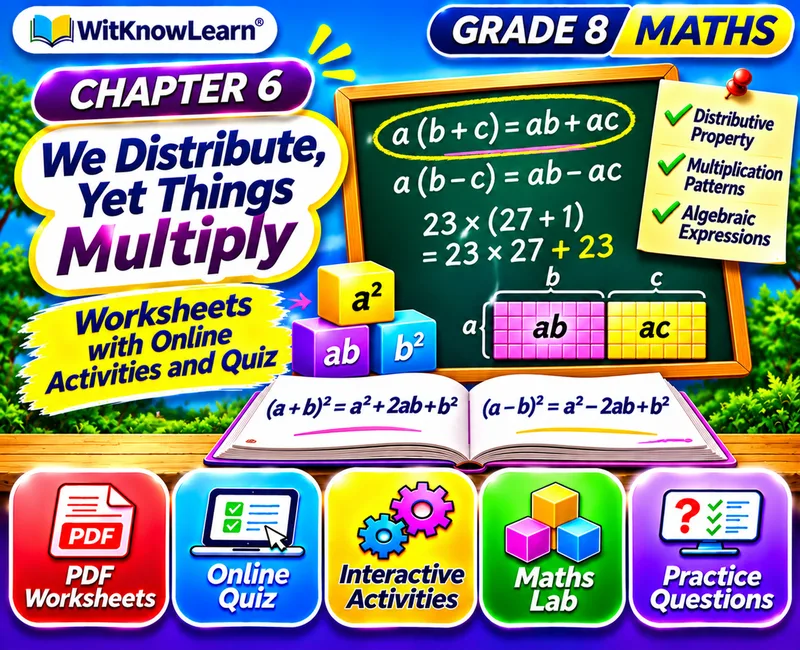
a(b + c) = ab + ac, so multiplication spreads over addition. It lets you split a hard product like 7 × 13 into 7 × 10 + 7 × 3, and it also works with subtraction and with brackets on both sides.
🟦 Identities for squares
Expanding (a + b)(a + b) gives (a + b)² = a² + 2ab + b², and (a − b)² = a² − 2ab + b². An area model shows why the middle term has two equal strips of ab.
⚡ Difference of squares and speed
(a + b)(a − b) = a² − b² because the middle terms cancel. It turns 98 × 102 into 100² − 2² = 9996. If a and b both increase by 1, the product ab increases by a + b + 1.
We Distribute, Yet Things Multiply Class 8 Maths Activities
Follow every step on the Number Train. Earn up to 3 stars in every activity.
This page covers We Distribute, Yet Things Multiply: the distributive property and identities for Class 8 maths. It covers the distributive property, expanding products, the identities for (a + b)², (a − b)² and (a + b)(a − b), and quick mental multiplication.
The activities are pitched at Class 8 level. Split products, expand identities, multiply quickly and build the area model of (x + 3)² in the studio. Explore more Class 8 maths worksheets on WitKnowLearn after this chapter.
Key ideas and facts to know
| Identity | Expansion | Terms |
|---|---|---|
| (a + b)² | a² + 2ab + b² | 3 |
| (a − b)² | a² − 2ab + b² | 3 |
| (a + b)(a − b) | a² − b² | 2 |
| a(b + c) | ab + ac | 2 |
How to use this page
- Flip the six cards and try the Distribute Lab in the Learn tab.
- Play the five games and the five labs to practise each idea.
- Finish the five challenges to collect up to 15 points.
- Do two virtual experiments and build the area model of (x + 3)² in the studio.
- Take the 20-question online quiz, with assertion and reason and case study questions, and fill in the practice sheet.
Worked examples
(50 + 2)² = 2500 + 200 + 4 = 2704.
(60 + 3)(60 − 3) = 3600 − 9 = 3591.
This We Distribute, Yet Things Multiply worksheet for Class 8 science gives you online activities and interactive games that make the chapter clear. Every activity has a goal, a hint and a short fact, so students learn while they enjoy.
Complete Guide: Class 8 Maths We Distribute, Yet Things Multiply
This guide is for Class 8 students, parents and teachers. It covers We Distribute, Yet Things Multiply: the distributive property and identities for Class 8 maths and shows how to use the quiz, labs and games on this page.
Introduction to We Distribute, Yet Things Multiply
The distributive property is the engine behind algebra. This topic uses it to expand brackets, build identities and multiply large numbers in your head.
What is there in this chapter
- Distributing over addition and subtraction
- Expanding products of brackets
- Squares of sums and differences
- Difference of squares
- Quick multiplication
Learning objectives
- Expand brackets.
- State the three identities.
- Use identities to multiply quickly.
- Reason with assertions and case studies.
Learning outcomes
- I can expand products.
- I can use the three identities.
- I can multiply large numbers mentally.
We Distribute, Yet Things Multiply Class 8 resources on this page
| Resource | What it gives |
|---|---|
| Online quiz | 20 questions: 10 easy, 5 average and 5 thinking, with assertion and reason and case study questions and a full review |
| Flip cards | 6 picture cards with one-line rules |
| Distribute Lab | A hands-on lab with 3 rounds |
| Games | 5 interactive games |
| Labs | 5 activity labs |
| Virtual Lab | 2 experiments plus a studio that builds the area model of (x + 3)² |
| Challenges | 5 challenges, 15 points in all |
| Practice sheet | A worksheet-style sheet with 16 questions, name and date lines and a live score |
Key facts
| Idea | Rule |
|---|---|
| a(b + c) | ab + ac |
| (a + b)² | a² + 2ab + b² |
| (a − b)² | a² − 2ab + b² |
| (a + b)(a − b) | a² − b² |
| Product rise | a + b + 1 |
Types of questions you may see
- Expand a product
- Quick multiplication
- Assertion and reason on identities
- Find a² + b² from a + b and ab
Solved examples
(a + b)² = 100, so a² + b² = 100 − 42 = 58.
(1005 − 995)(1005 + 995) = 10 × 2000 = 20000.
Common mistakes
| Mistake | Correct idea |
|---|---|
| Writing (a + b)² = a² + b² | Include 2ab |
| Dropping a sign in (a − b)² | The middle term is minus |
| Multiplying only the first term | Distribute to every term |
We Distribute, Yet Things Multiply in daily life
The distributive property helps in mental arithmetic, shop bills, area calculations of enlarged plots and algebra in science formulas.
Tips for parents and teachers
- Draw an area model to check an identity.
- Test an identity with small numbers.
- Practise one assertion and one case study each week.
Related Class 8 Maths Worksheets
- 🔤Class 8 Maths Worksheet: Algebraic Expressions
- 🟦Class 8 Maths Worksheet: Algebraic Expressions and Identities
- 🔵Class 8 Maths Worksheet: Squares and Square Roots
- ✖Class 8 Maths Worksheet: Exponents and Powers
- 🧠Class 8 Maths Notes and Mind Maps
- 📚Class 8 Maths Worksheets, page 1
- 📚Class 8 Maths Worksheets, page 2
- 📚Class 8 Maths Worksheets, page 3
We Distribute, Yet Things Multiply Class 8 FAQs
What is the distributive property?
It says a(b + c) = ab + ac, so multiplying a sum can be done term by term.
What is the identity for (a + b)²?
(a + b)² = a² + 2ab + b². It is not a² + b².
How can I multiply 98 × 102 quickly?
Write it as (100 − 2)(100 + 2) = 100² − 2² = 9996.
Why does the middle term disappear in (a + b)(a − b)?
Because +ab and −ab cancel.
What can students do on this page?
Students can take a 20-question online quiz with assertion and reason and case study questions, play five games, try five online activities, finish five challenges, run the Distribute Lab, do two virtual experiments, build the area model of (x + 3)² with x = 6 in the square and areas views,, and fill in a 16-question practice sheet with a Show answers button.
 Download