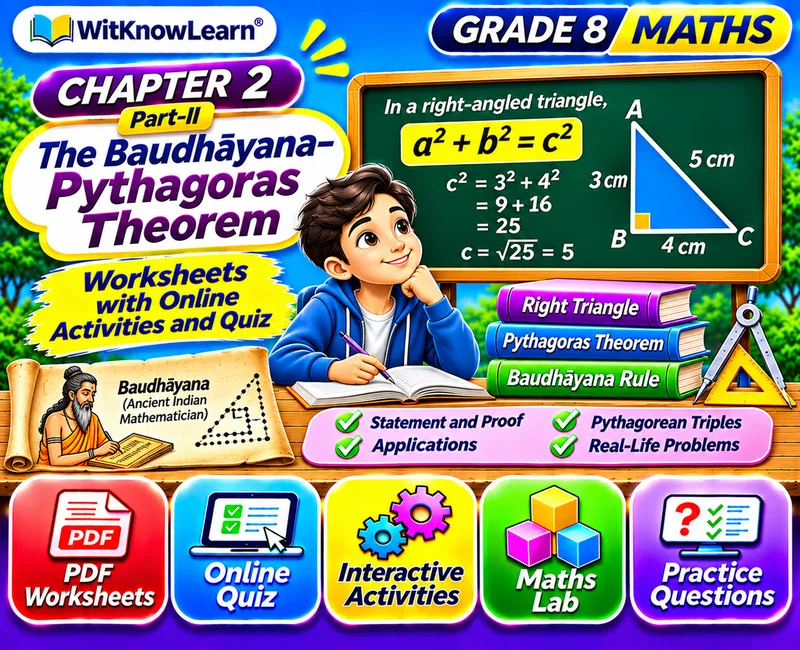
Baudhayana-Pythagoras Theorem Class 8 Maths Worksheet with Quiz and Activities
Double squares, find hypotenuses and test triples. On WitKnowLearn you get the Baudhayana-Pythagoras Theorem Class 8 online quiz, online activities and interactive games, a triangle lab, a virtual lab and a worksheet-style practice sheet for Class 8 Maths.
Baudhayana-Pythagoras Theorem Class 8 Online Quiz
20 questions: 10 easy, 5 average and 5 thinking. Tap an answer and the next question comes up.
Baudhayana-Pythagoras Theorem Class 8 Activities
👆 Tap a tab to switch: Learn, Games, Labs, Challenges, Virtual Lab and Practice sheet
Baudhayana-Pythagoras Theorem: Baudhayana-Pythagoras Theorem
A short read for Class 8 before you play. These notes cover Baudhayana-Pythagoras Theorem: doubling a square, the theorem, triples and applications.
🔲 Doubling a square
Around 800 BCE Baudhayana noticed that the square built on the diagonal of a square has double the area of the original. This was the first step towards one of the most famous results in mathematics.
📐 The theorem
In a right triangle the square on the hypotenuse equals the sum of the squares on the two legs. For legs 3 and 4 we get 9 + 16 = 25, so the hypotenuse is 5. Whole numbers such as 3, 4, 5 that fit are called triples.
🪜 Using it
The theorem finds the height a ladder reaches, the diagonal of a screen and the straight-line distance between two places. If the squares of two sides add up to the square of the third, the triangle is right-angled.
Baudhayana-Pythagoras Theorem Class 8 Maths Activities
Follow every step on the Number Train. Earn up to 3 stars in every activity.
This page covers Baudhayana-Pythagoras Theorem: doubling a square, the theorem, triples and applications for Class 8 maths. It covers doubling a square, areas of squares on the sides, the theorem, Pythagorean triples, the converse and real-life applications.
The activities are pitched at Class 8 level. Find hypotenuses and missing legs, test triples, solve ladder problems and scale the 3-4-5 triangle in the studio. Explore more Class 8 maths worksheets on WitKnowLearn after this chapter.
Key ideas and facts to know
| Legs | Hypotenuse | Triple? |
|---|---|---|
| 3, 4 | 5 | Yes |
| 5, 12 | 13 | Yes |
| 8, 15 | 17 | Yes |
| 4, 5 | not whole | No |
How to use this page
- Flip the six cards and try the Triangle Lab in the Learn tab.
- Play the five games and the five labs to practise each idea.
- Finish the five challenges to collect up to 15 points.
- Do two virtual experiments and scale the 3-4-5 triangle in the studio.
- Take the 20-question online quiz, with assertion and reason and case study questions, and fill in the practice sheet.
Worked examples
169 - 25 = 144, so the height is 12 m.
49 + 576 = 625 = 25 × 25, so yes.
This Baudhayana-Pythagoras Theorem worksheet for Class 8 science gives you online activities and interactive games that make the chapter clear. Every activity has a goal, a hint and a short fact, so students learn while they enjoy.
Complete Guide: Class 8 Maths Baudhayana-Pythagoras Theorem
This guide is for Class 8 students, parents and teachers. It covers Baudhayana-Pythagoras Theorem: doubling a square, the theorem, triples and applications for Class 8 maths and shows how to use the quiz, labs and games on this page.
Introduction to Baudhayana-Pythagoras Theorem
The theorem connects the three sides of a right triangle, and it lets you find lengths you cannot measure directly.
What is there in this chapter
- Doubling a square
- Halving a square
- Squares on the sides
- Pythagorean triples
- Applications
Learning objectives
- State the theorem.
- Find a missing side.
- Recognise triples and test right triangles.
- Reason with assertions and case studies.
Learning outcomes
- I can find a hypotenuse.
- I can find a missing leg.
- I can test if a triangle is right-angled.
Baudhayana-Pythagoras Theorem Class 8 resources on this page
| Resource | What it gives |
|---|---|
| Online quiz | 20 questions: 10 easy, 5 average and 5 thinking, with assertion and reason and case study questions and a full review |
| Flip cards | 6 picture cards with one-line rules |
| Triangle Lab | A hands-on lab with 3 rounds |
| Games | 5 interactive games |
| Labs | 5 activity labs |
| Virtual Lab | 2 experiments plus a studio that scales the 3-4-5 triangle |
| Challenges | 5 challenges, 15 points in all |
| Practice sheet | A worksheet-style sheet with 16 questions, name and date lines and a live score |
Key facts
| Idea | Rule |
|---|---|
| Hypotenuse | longest side |
| Theorem | a² + b² = c² |
| Triple | whole numbers that fit |
| Diagonal square | double area |
| Test | squares add up |
Types of questions you may see
- Find the hypotenuse
- Find the missing leg
- Triples
- Assertion and reason on the theorem
Solved examples
81 + 144 = 225, so the hypotenuse is 15.
625 - 49 = 576, so the side is 24.
Common mistakes
| Mistake | Correct idea |
|---|---|
| Adding the legs instead of their squares | Square first, then add |
| Using a leg as the hypotenuse | The hypotenuse is the longest |
| Forgetting the square root at the end | Take the root |
Baudhayana-Pythagoras Theorem in daily life
The theorem is used in construction, navigation, screen sizes, ladders, ramps and computing distance on maps.
Tips for parents and teachers
- Learn the triples 3-4-5 and 5-12-13.
- Check the answer is larger than each leg.
- Practise one assertion and one case study each week.
Related Class 8 Maths Worksheets
- 📐Class 8 Maths Worksheet: Mensuration
- ➗Class 8 Maths Worksheet: Rational Numbers
- 📉Class 8 Maths Worksheet: Direct and Inverse Proportions
- ⚖Class 8 Maths Worksheet: Comparing Quantities
- 🧠Class 8 Maths Notes and Mind Maps
- 📚Class 8 Maths Worksheets, page 1
- 📚Class 8 Maths Worksheets, page 2
- 📚Class 8 Maths Worksheets, page 3
Baudhayana-Pythagoras Theorem Class 8 FAQs
What is the Baudhayana-Pythagoras theorem?
In a right triangle the square on the hypotenuse equals the sum of the squares on the legs.
Who was Baudhayana?
An Indian mathematician who recorded the result in his Sulba-Sutra around 800 BCE.
What is a Pythagorean triple?
Three whole numbers a, b and c with a² + b² = c², such as 3, 4, 5.
How do I check for a right triangle?
Add the squares of the two shorter sides and compare with the square of the longest side.
What can students do on this page?
Students can take a 20-question online quiz with assertion and reason and case study questions, play five games, try five online activities, finish five challenges, run the Triangle Lab, do two virtual experiments, scale the 3-4-5 triangle five times and compare the triangles and numbers views,, and fill in a 16-question practice sheet with a Show answers button.
 Download