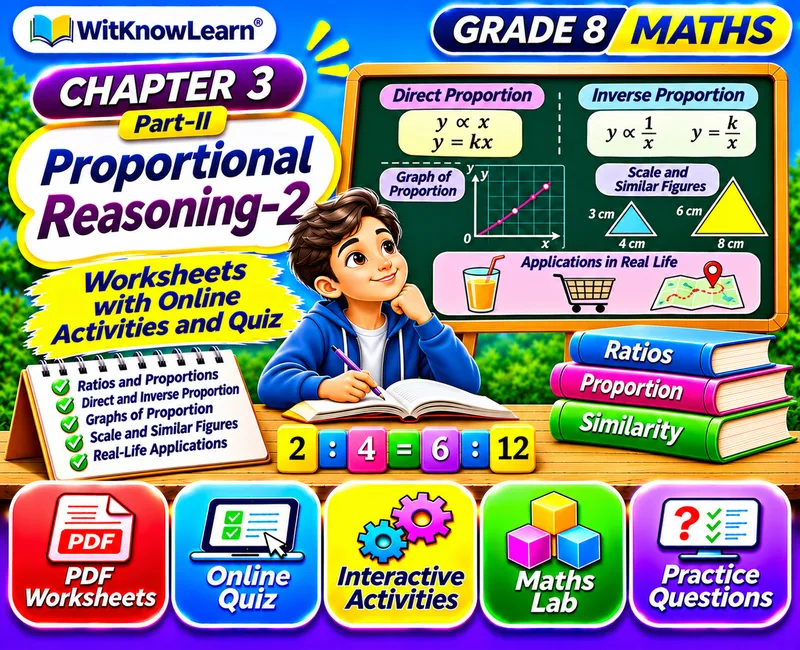
Proportional Reasoning 2 Class 8 Maths Worksheet with Quiz and Activities
Read maps, share in ratios, draw pie charts and solve inverse proportion. On WitKnowLearn you get the Proportional Reasoning 2 Class 8 online quiz, online activities and interactive games, a proportion lab, a virtual lab and a worksheet-style practice sheet for Class 8 Maths.
Proportional Reasoning 2 Class 8 Online Quiz
20 questions: 10 easy, 5 average and 5 thinking. Tap an answer and the next question comes up.
Proportional Reasoning 2 Class 8 Activities
👆 Tap a tab to switch: Learn, Games, Labs, Challenges, Virtual Lab and Practice sheet
🧪 Proportion Lab
Do the experiment on screen: 3 rounds, then see what we found.
Lab progress
- 🧪 Round 1 of 3
- ⬜ Round 2 of 3
- ⬜ Round 3 of 3
- ⬜ What did we find?
🔀 Direct or Inverse?
⭐⭐⭐Goal: Sort 8 pairs of quantities by how they vary.
How to play: Drag each card into its bin, or tap a card and then tap a bin.
Ask: when one goes up, does the other go up or down?
Direct proportion
both go up togetherInverse proportion
one up, one downFACTS: Up and up, or up and down.
🫧 Proportion Bubbles
⭐⭐⭐Goal: Pop the 5 true facts. Leave the 4 false ones.
How to play: Tap a bubble to pop it. False bubbles wobble and stay.
Think about what stays constant.
FACTS: Ratio or product stays fixed.
🧠 Scale and Share Memory
⭐⭐⭐Goal: Match each clue with its answer.
How to play: Flip two cards. If they match, they stay open. Find all 6 pairs.
Work out each clue.
FACTS: Proportion in action.
📝 Proportion Word Gaps
⭐⭐⭐Goal: Fill each gap with the right word from the tray. One word is extra.
How to play: Drag a word into a gap, or tap a word and then tap a gap.
Read the whole sentence before you choose a word.
A map scale compares map length with real .
Quantities with a constant product are in proportion.
A slice of a pie chart is called a .
For inverse proportion the product xy is a .
A ratio with three numbers has three .
FACTS: Proportion has its words.
⚖ Which Is Greater?
⭐⭐⭐Goal: In each pair, tap the greater value.
How to play: Tap one card in every pair.
Work out each value first.
FACTS: Computing decides.
🗺 Map Lab
⭐⭐⭐Goal: Read distances from a 1 cm : 5 km map.
How to play: Drag a number into each gap, or tap a number and then a gap.
Multiply the map length by 5.
On the map 2 cm shows km.
On the map 6 cm shows km.
On the map 9 cm shows km.
On the map 12 cm shows km.
FACTS: The scale is fixed.
🍕 Three-Way Share Lab
⭐⭐⭐Goal: Share a whole in a three-term ratio.
How to play: Drag the right number into each gap.
Find the value of one part.
Share 60 in 1 : 2 : 3, smallest gets .
Share 90 in 2 : 3 : 4, largest gets .
Share 72 in 1 : 2 : 3, middle gets .
Share 100 in 1 : 4 : 5, largest gets .
FACTS: Parts make the whole.
🥧 Pie Chart Lab
⭐⭐⭐Goal: Find sector angles in degrees.
How to play: Drag the right number into each gap.
Percent of 360.
A 25% share is an angle of degrees.
A 50% share is an angle of degrees.
A 10% share is an angle of degrees.
A 40% share is an angle of degrees.
FACTS: A pie is 360 degrees.
🔁 Inverse Lab
⭐⭐⭐Goal: Solve inverse proportion problems.
How to play: Drag the right number into each gap.
The product stays the same.
6 workers take 10 days, so 12 workers take days.
4 pipes take 15 hours, so 10 pipes take hours.
8 painters take 9 days, so 6 painters take days.
60 km/h takes 5 hours, so 75 km/h takes hours.
FACTS: xy = k.
🔬 Up or Down?
⭐⭐⭐Goal: Sort 6 changes by what happens to the second quantity.
How to play: Drag each card into a bin, or tap a card and then tap a bin.
Direct goes the same way; inverse the opposite way.
Second quantity increases
goes upSecond quantity decreases
goes downFACTS: Same way or opposite.
❓ Proportion Quiz
⭐⭐⭐Goal: Answer 3 questions. Each correct answer earns 1 point.
How to play: Tap the best option.
Recall the basics.
1. If x and y are inversely proportional then
2. A full circle in a pie chart is
3. A map scale 1 cm : 2 km shows 5 cm as
FACTS: Three basics.
💦 True or False Splash
⭐⭐⭐Goal: Decide if each statement is true or false.
How to play: Tap True or False.
Check which quantity is fixed.
1. Twice the workers take half the time.
2. A 30% sector has 30 degrees.
3. Map length and real length are in direct proportion.
FACTS: Find the constant.
➗ Quick Sums
⭐⭐⭐Goal: Solve 3 calculations. Type the number.
How to play: Type your answer and press Check.
Find the constant first.
1. 9 taps fill a tank in 8 hours; 12 taps need how many hours
2. Largest share of 120 in 2 : 3 : 5
3. Angle for 15% of a pie chart
FACTS: Practice builds speed.
🔗 Match the Term
⭐⭐⭐Goal: Match each term with its meaning.
How to play: Drag each card onto its partner, or tap a card and then tap a partner.
Think about what stays constant.
FACTS: Each has a meaning.
📖 Story Problems
⭐⭐⭐Goal: Read 3 short stories and choose the best answer.
How to play: Tap an answer.
Is it direct or inverse?
1. 🚴 A cyclist at 15 km/h takes 4 hours. At 20 km/h the trip takes
2. 🧱 5 workers build a wall in 12 days. 10 workers take
3. 🗺 On a 1 cm : 20 km map two towns are 6.5 cm apart. The real distance is
FACTS: Proportion tells stories.
👷 Workers and Days
⭐⭐⭐Aim
To find how many days different numbers of workers need for a job that takes 60 worker-days.
Objectives
- Find the days for each team.
Procedure
- Take the number of workers.
- Divide 60 by it.
- Type the days.
- Choose the conclusion.
Days = 60 ÷ workers.
Observation table
| Workers | Days |
|---|---|
| 2 workers | |
| 4 workers | |
| 5 workers | |
| 10 workers |
Conclusion
Outcomes
- I can solve an inverse proportion problem.
- I know the product stays the same.
🗺 Map Scale Experiment
⭐⭐⭐Aim
To convert map lengths into real distances using the scale 1 cm : 5 km.
Objectives
- Multiply by the scale.
Procedure
- Take the map length.
- Multiply by 5.
- Type the real distance.
- Choose the conclusion.
Real distance = map length × 5.
Observation table
| Map length (cm) | Real distance (km) |
|---|---|
| 2 | |
| 5 | |
| 8 | |
| 12 |
Conclusion
Outcomes
- I can use a map scale.
- I know a scale gives a direct proportion.
🚗 Speed and Time over 120 km
⭐⭐⭐Aim
To find the time for a 120 km trip at five speeds and see that speed times time stays constant.
Objectives
- Divide the distance by the speed.
- Compare the heights of the bars.
- See the constant product.
Procedure
- Type each travel time and the next bar is drawn.
- Use the Bars view and Numbers view buttons.
- Read the finished results.
- Answer the questions and choose the conclusion.
Time = 120 ÷ speed.
Read your figure
Outcomes
- I can find a time from a speed.
- I know the product stays constant.
- I can spot inverse proportion.
Read the chapter first. Write each answer on the line. The page checks your answer as you type.
A. Maps
B. Sharing
C. Pie charts
D. Inverse
Proportional Reasoning 2: Proportional Reasoning 2
A short read for Class 8 before you play. These notes cover Proportional Reasoning 2: map scales, three-term ratios, pie charts and inverse proportion.
🗺 Ratios on maps
A map scale such as 1 cm : 5 km is a ratio. A road that measures 4 cm on the map is 4 × 5 = 20 km long. Ratios with three terms, like 1 : 2 : 3, share a whole into three parts.
🥧 Slices of a pie
A pie chart divides a circle of 360 degrees into sectors. A 25% share takes 25% of 360 degrees, which is 90 degrees. Ratios and percentages draw the sectors.
🔁 Inverse proportion
When quantities change in opposite directions with a constant product, they are in inverse proportion. If 6 workers take 10 days, 12 workers take 5 days, because 6 × 10 = 12 × 5.
Proportional Reasoning 2 Class 8 Maths Activities
Follow every step on the Number Train. Earn up to 3 stars in every activity.
This page covers Proportional Reasoning 2: map scales, three-term ratios, pie charts and inverse proportion for Class 8 maths. It covers a quick recap of proportionality, ratios in maps, ratios with three terms, dividing a whole, pie charts and inverse proportion.
The activities are pitched at Class 8 level. Read map scales, share a whole in a ratio, find pie chart angles, solve inverse proportion problems and plot speed against time in the studio. Explore more Class 8 maths worksheets on WitKnowLearn after this chapter.
Key ideas and facts to know
| Workers | Days | Product |
|---|---|---|
| 2 | 30 | 60 |
| 4 | 15 | 60 |
| 5 | 12 | 60 |
| 10 | 6 | 60 |
How to use this page
- Flip the six cards and try the Proportion Lab in the Learn tab.
- Play the five games and the five labs to practise each idea.
- Finish the five challenges to collect up to 15 points.
- Do two virtual experiments and plot speed against time in the studio.
- Take the 20-question online quiz, with assertion and reason and case study questions, and fill in the practice sheet.
Worked examples
4 × 15 = 60, and 60 ÷ 10 = 6 hours.
6 parts make 60, so a part is 10. The shares are 10, 20 and 30.
This Proportional Reasoning 2 worksheet for Class 8 science gives you online activities and interactive games that make the chapter clear. Every activity has a goal, a hint and a short fact, so students learn while they enjoy.
Complete Guide: Class 8 Maths Proportional Reasoning 2
This guide is for Class 8 students, parents and teachers. It covers Proportional Reasoning 2: map scales, three-term ratios, pie charts and inverse proportion for Class 8 maths and shows how to use the quiz, labs and games on this page.
Introduction to Proportional Reasoning 2
Proportional reasoning helps you read maps, share quantities, draw pie charts and decide how time changes when speed or workers change.
What is there in this chapter
- Proportionality recap
- Ratios in maps
- Ratios with more than two terms
- Dividing a whole in a ratio
- Pie charts
- Inverse proportions
Learning objectives
- Use a map scale.
- Share a whole in a three-term ratio.
- Solve direct and inverse proportion problems.
- Reason with assertions and case studies.
Learning outcomes
- I can read a map scale.
- I can draw and read a pie chart.
- I can solve inverse proportion problems.
Proportional Reasoning 2 Class 8 resources on this page
| Resource | What it gives |
|---|---|
| Online quiz | 20 questions: 10 easy, 5 average and 5 thinking, with assertion and reason and case study questions and a full review |
| Flip cards | 6 picture cards with one-line rules |
| Proportion Lab | A hands-on lab with 3 rounds |
| Games | 5 interactive games |
| Labs | 5 activity labs |
| Virtual Lab | 2 experiments plus a studio that plots time for five speeds over 120 km |
| Challenges | 5 challenges, 15 points in all |
| Practice sheet | A worksheet-style sheet with 16 questions, name and date lines and a live score |
Key facts
| Idea | Rule |
|---|---|
| Map scale | fixed ratio |
| Three-term ratio | add the parts |
| Pie chart | 360 degrees |
| Direct | ratio constant |
| Inverse | product constant |
Types of questions you may see
- Map scale
- Sharing in three parts
- Pie chart angles
- Inverse proportion
- Assertion and reason on proportion
Solved examples
60 × 5 = 300 km, and 300 ÷ 75 = 4 hours.
20% of 360 is 72 degrees.
Common mistakes
| Mistake | Correct idea |
|---|---|
| Treating workers and days as direct | More workers means fewer days |
| Forgetting 360 degrees in a pie chart | A whole circle is 360 |
| Not adding all parts of a ratio | Add every part first |
Proportional Reasoning 2 in daily life
Proportion appears in maps, recipes, travel time, building work, budgets and charts.
Tips for parents and teachers
- Write the constant before solving.
- Check that the answer moves the right way.
- Practise one assertion and one case study each week.
Related Class 8 Maths Worksheets
- 📉Class 8 Maths Worksheet: Direct and Inverse Proportions
- 📊Class 8 Maths Worksheet: Data Handling
- %Class 8 Maths Worksheet: Percentage
- ⚖Class 8 Maths Worksheet: Comparing Quantities
- 🧠Class 8 Maths Notes and Mind Maps
- 📚Class 8 Maths Worksheets, page 1
- 📚Class 8 Maths Worksheets, page 2
- 📚Class 8 Maths Worksheets, page 3
Proportional Reasoning 2 Class 8 FAQs
What is inverse proportion?
Two quantities are inversely proportional when their product stays constant. One rises as the other falls.
How do I read a map scale?
Multiply the map length by the scale to get the real distance.
How do I find a pie chart angle?
Take the percentage of 360 degrees.
How do I share a whole in a three-term ratio?
Add the parts, find the value of one part, then multiply.
What can students do on this page?
Students can take a 20-question online quiz with assertion and reason and case study questions, play five games, try five online activities, finish five challenges, run the Proportion Lab, do two virtual experiments, find the time for five speeds over 120 km and compare the bars and numbers views,, and fill in a 16-question practice sheet with a Show answers button.
 Download