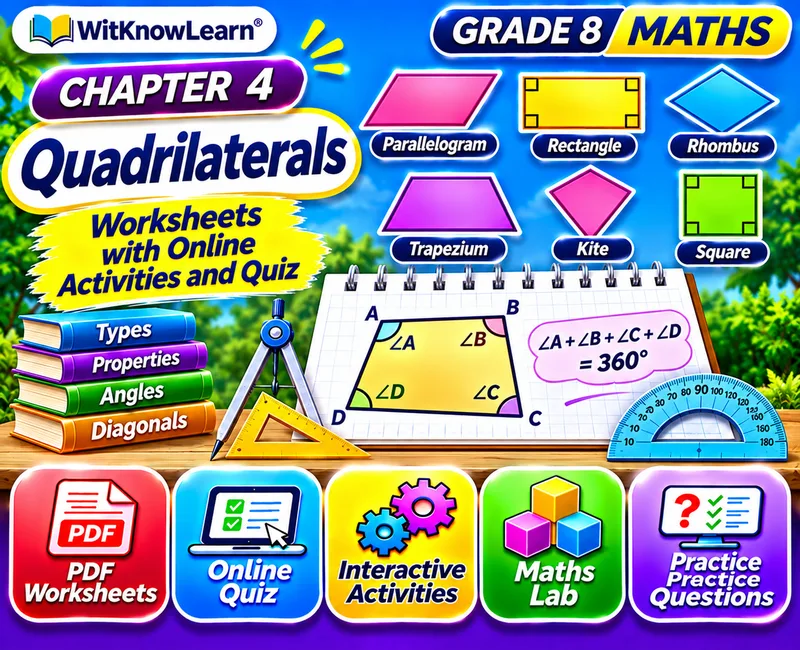
Quadrilaterals Class 8 Maths Worksheet with Quiz and Activities
In this chapter: angle sum, diagonals and the parallelogram family. Find missing angles, compare diagonals and tell rectangles, rhombuses, kites and trapezia apart. On WitKnowLearn you get the Quadrilaterals Class 8 online quiz, online activities and interactive games, a quadrilateral lab, a virtual lab and a worksheet-style practice sheet for Class 8 Maths.
Quadrilaterals Class 8 Online Quiz
20 questions: 10 easy, 5 average and 5 thinking. Tap an answer and the next question comes up.
Quadrilaterals Class 8 Activities
👆 Tap a tab to switch: Learn, Games, Labs, Challenges, Virtual Lab and Practice sheet
Quadrilaterals: Quadrilaterals
A short read for Class 8 before you play. These notes cover Quadrilaterals: angle sum, diagonals and the parallelogram family.
📐 Angle sum of 360
A diagonal splits any quadrilateral into two triangles. Each triangle has an angle sum of 180 degrees, so every quadrilateral has an angle sum of 360 degrees. This lets you find a missing angle by subtraction.
▱ The parallelogram family
A parallelogram has opposite sides parallel and equal, adjacent angles that add to 180 and diagonals that bisect each other. A rectangle, a rhombus and a square are special parallelograms with extra properties.
🪁 Kites and trapezia
A kite has two pairs of equal neighbouring sides and perpendicular diagonals. A trapezium has exactly one pair of parallel sides, and the two angles on each leg add up to 180 degrees.
Quadrilaterals Class 8 Maths Activities
Follow every step on the Number Train. Earn up to 3 stars in every activity.
This page covers Quadrilaterals: angle sum, diagonals and the parallelogram family for Class 8 maths. It covers the angle sum of a quadrilateral, diagonals, parallelograms, rectangles, rhombuses, squares, kites and trapezia.
The activities are pitched at Class 8 level. Split a quadrilateral into triangles in the studio, find missing angles, compare diagonals and sort shapes by their properties. Explore more Class 8 maths worksheets on WitKnowLearn after this chapter.
Key ideas and facts to know
| Shape | Diagonals equal | Diagonals perpendicular |
|---|---|---|
| Rectangle | Yes | No |
| Rhombus | No | Yes |
| Square | Yes | Yes |
| Parallelogram | No | No |
| Kite | No | Yes |
How to use this page
- Flip the six cards and try the Quadrilateral Lab in the Learn tab.
- Play the five games and the five labs to practise each idea.
- Finish the five challenges to collect up to 15 points.
- Do two virtual experiments and split a quadrilateral into triangles in the studio.
- Take the 20-question online quiz, with assertion and reason and case study questions, and fill in the practice sheet.
Worked examples
85 + 95 + 100 = 280, so the fourth angle is 360 - 280 = 80 degrees.
Adjacent angles add to 180, so it is 115 degrees.
This Quadrilaterals worksheet for Class 8 science gives you online activities and interactive games that make the chapter clear. Every activity has a goal, a hint and a short fact, so students learn while they enjoy.
Complete Guide: Class 8 Maths Quadrilaterals
This guide is for Class 8 students, parents and teachers. It covers Quadrilaterals: angle sum, diagonals and the parallelogram family for Class 8 maths and shows how to use the quiz, labs and games on this page.
Introduction to Quadrilaterals
Quadrilaterals are shapes with four sides. This topic shows why their angles add to 360 degrees and uses angles and diagonals to tell the special shapes apart.
What is there in this chapter
- Angle sum of a quadrilateral
- Properties of a rectangle and a square
- Parallelograms
- Rhombus and kite
- Trapezium
Learning objectives
- Use the angle sum of 360 degrees.
- State properties of special quadrilaterals.
- Use diagonals to identify a shape.
- Reason with assertions and case studies.
Learning outcomes
- I can find a missing angle.
- I can list properties of a parallelogram.
- I can tell special quadrilaterals apart.
Quadrilaterals Class 8 resources on this page
| Resource | What it gives |
|---|---|
| Online quiz | 20 questions: 10 easy, 5 average and 5 thinking, with assertion and reason and case study questions and a full review |
| Flip cards | 6 picture cards with one-line rules |
| Quadrilateral Lab | A hands-on lab with 3 rounds |
| Games | 5 interactive games |
| Labs | 5 activity labs |
| Virtual Lab | 2 experiments plus a studio that splits a quadrilateral into two triangles |
| Challenges | 5 challenges, 15 points in all |
| Practice sheet | A worksheet-style sheet with 16 questions, name and date lines and a live score |
Key facts
| Idea | Rule |
|---|---|
| Angle sum | 360 degrees |
| Parallelogram diagonals | bisect each other |
| Rectangle diagonals | equal |
| Rhombus diagonals | perpendicular |
| Trapezium | one parallel pair |
Types of questions you may see
- Missing angle
- Properties of special quadrilaterals
- Assertion and reason on shapes
- Angles in a ratio
Solved examples
10 parts make 360, so one part is 36 and the largest is 4 × 36 = 144 degrees.
The diagonal bisects it into 35 degrees each.
Common mistakes
| Mistake | Correct idea |
|---|---|
| Using 180 instead of 360 | Quadrilaterals have 360 |
| Thinking every parallelogram has equal diagonals | Only rectangles do |
| Mixing up rhombus and kite | A rhombus has four equal sides |
Quadrilaterals in daily life
Quadrilaterals appear in windows, tiles, kites, bridges, roof frames, picture frames and the layout of fields.
Tips for parents and teachers
- Draw the shape and mark equal sides and angles.
- Check which properties the shape inherits.
- Practise one assertion and one case study each week.
Related Class 8 Maths Worksheets
- ▱Class 8 Maths Worksheet: Understanding Quadrilaterals
- 🧊Class 8 Maths Worksheet: Visualising Solid Shapes
- 📏Class 8 Maths Worksheet: Mensuration
- 🔵Class 8 Maths Worksheet: Squares and Square Roots
- 🧠Class 8 Maths Notes and Mind Maps
- 📚Class 8 Maths Worksheets, page 1
- 📚Class 8 Maths Worksheets, page 2
- 📚Class 8 Maths Worksheets, page 3
Quadrilaterals Class 8 FAQs
Why do the angles of a quadrilateral add up to 360 degrees?
A diagonal splits it into two triangles and each has an angle sum of 180 degrees, so the total is 180 + 180 = 360 degrees.
What is a parallelogram?
A quadrilateral with both pairs of opposite sides parallel. Its opposite sides are equal and its diagonals bisect each other.
How is a rhombus different from a square?
A rhombus has four equal sides, while a square also has four right angles.
What is a trapezium?
A quadrilateral with exactly one pair of parallel sides.
What can students do on this page?
Students can take a 20-question online quiz with assertion and reason and case study questions, play five games, try five online activities, finish five challenges, run the Quadrilateral Lab, do two virtual experiments, split a quadrilateral into two triangles and find its angle sum in the figure and steps views,, and fill in a 16-question practice sheet with a Show answers button.
 Download