Visualizing Solid Shapes Class 8 Maths Worksheet with Quiz and Activities
Work with solid shapes: count faces, edges and vertices, use nets and views and check the Euler formula on a prism. On WitKnowLearn you get the Visualizing Solid Shapes Class 8 online quiz, online activities and interactive games, a solid lab, a virtual lab and a worksheet-style practice sheet for Class 8 Maths.
Visualizing Solid Shapes Class 8 Online Quiz
20 questions: 10 easy, 5 average and 5 thinking. Tap an answer and the next question comes up.
Visualizing Solid Shapes Class 8 Activities
👆 Tap a tab to switch: Learn, Games, Labs, Challenges, Virtual Lab and Practice sheet
Visualizing Solid Shapes: Faces, Edges, Nets and Views
A short read for Class 8 before you play. These notes cover Visualizing Solid Shapes.
🧊 Faces, edges and vertices
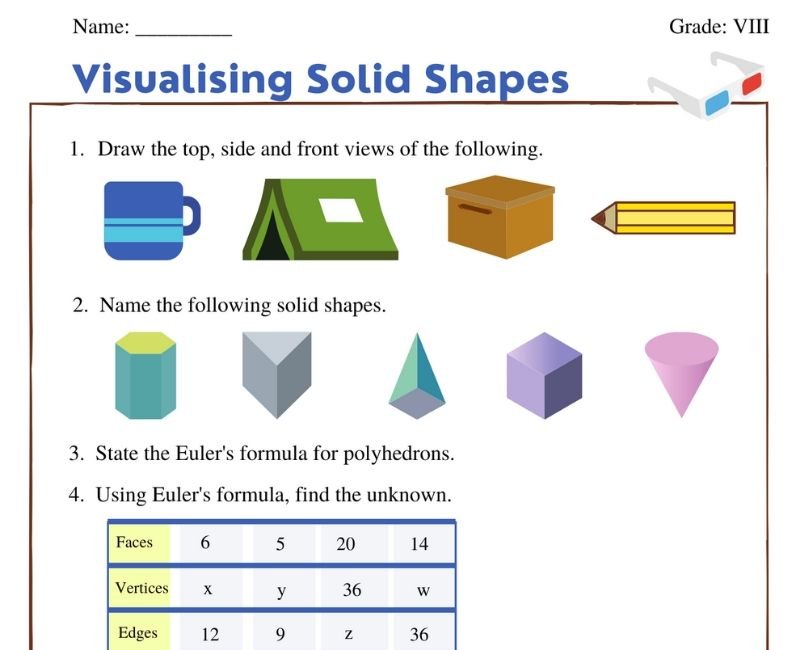
A solid shape has flat or curved faces, edges where faces meet, and vertices where edges meet. A cube has 6 faces, 12 edges and 8 vertices. A polyhedron has only flat faces, while a sphere, cylinder and cone have curved surfaces.
📐 Euler formula
For every polyhedron the faces plus the vertices minus the edges equals 2. A triangular prism has 5 faces, 6 vertices and 9 edges, and 5 + 6 - 9 = 2. This lets you find a missing count when two are known.
✂ Nets and views
A net is a flat pattern that folds into a solid, such as six squares for a cube. A solid also looks different from the front, the top and the side, and drawing these views helps us picture it.
Visualizing Solid Shapes Class 8 Maths Activities
Follow every step on the Number Train. Earn up to 3 stars in every activity.
This page covers Visualizing Solid Shapes for Class 8 maths. It covers faces, edges and vertices, prisms and pyramids, nets, front, top and side views and the Euler formula.
The activities are pitched at Class 8 level. Sort solids, count parts, fold nets and check the Euler formula on a prism in the studio. Explore more Class 8 maths worksheets on WitKnowLearn after this chapter.
Key ideas and facts to know
| Solid | Faces | Edges | Vertices |
|---|---|---|---|
| Cube | 6 | 12 | 8 |
| Triangular prism | 5 | 9 | 6 |
| Square pyramid | 5 | 8 | 5 |
How to use this page
- Flip the six cards and try the Solid Lab in the Learn tab.
- Play the five games and the five labs to practise each idea.
- Finish the five challenges to collect up to 15 points.
- Do two virtual experiments and check Euler formula on a prism in the studio.
- Take the 20-question online quiz, with assertion and reason and case study questions, and fill in the practice sheet.
Worked examples
V = 2 + 18 - 8 = 12.
5 base edges plus 5 slanting edges make 10.
This Visualizing Solid Shapes worksheet for Class 8 science gives you online activities and interactive games that make the chapter clear. Every activity has a goal, a hint and a short fact, so students learn while they enjoy.
Complete Guide: Class 8 Maths Visualizing Solid Shapes
This guide is for Class 8 students, parents and teachers. It covers Visualizing Solid Shapes for Class 8 maths and shows how to use the quiz, labs and games on this page.
Introduction to Visualizing Solid Shapes
Solid shapes surround us in boxes, tents, dice and buildings. This topic shows how to describe a solid, count its parts and picture it from different sides.
What is there in this chapter
- Faces, edges and vertices
- Prisms and pyramids
- Euler formula
- Nets
- Views of solids
Learning objectives
- Count faces, edges and vertices.
- Use Euler formula.
- Identify nets.
- Draw and read views.
- Reason with assertions and case studies.
Learning outcomes
- I can describe a solid by its faces, edges and vertices.
- I can use Euler formula.
- I can match nets and views to solids.
Visualizing Solid Shapes Class 8 resources on this page
| Resource | What it gives |
|---|---|
| Online quiz | 20 questions: 10 easy, 5 average and 5 thinking, with assertion and reason and case study questions and a full review |
| Flip cards | 6 picture cards with one-line rules |
| Solid Lab | A hands-on lab with 3 rounds |
| Games | 5 interactive games |
| Labs | 5 activity labs |
| Virtual Lab | 2 experiments plus a studio that checks Euler formula on a prism |
| Challenges | 5 challenges, 15 points in all |
| Practice sheet | A worksheet-style sheet with 16 questions, name and date lines and a live score |
Key facts
| Idea | Rule |
|---|---|
| Cube | 6 faces, 12 edges, 8 vertices |
| Euler | F + V - E = 2 |
| Net | flat pattern of a solid |
| Prism | two parallel bases |
| Pyramid | one base and an apex |
Types of questions you may see
- Count the parts
- Assertion and reason on solids
- Case study on a tent or box
- Euler formula problems
Solved examples
V = 2 + 24 - 10 = 16.
F = 2 + 10 - 6 = 6.
Common mistakes
| Mistake | Correct idea |
|---|---|
| Calling a cylinder a polyhedron | It has a curved face |
| Miscounting hidden edges | Picture the back of the solid |
| Using F + V + E | The formula subtracts the edges |
Visualizing Solid Shapes in daily life
Solid shapes appear in boxes, dice, tents, buildings, tins and toys, and views and nets are used in packaging and design.
Tips for parents and teachers
- Imagine rotating the solid.
- Check counts with Euler formula.
- Practise one assertion and one case study each week.
Related Class 8 Maths Worksheets
- ➗Class 8 Maths Worksheet: Rational Numbers
- 🔷Class 8 Maths Worksheet: Understanding Quadrilaterals
- 📈Class 8 Maths Worksheet: Direct and Inverse Proportions
- ⚖Class 8 Maths Worksheet: Linear Equations in One Variable
- 🧠Class 8 Maths Notes and Mind Maps
- 📚Class 8 Maths Worksheets, page 1
- 📚Class 8 Maths Worksheets, page 2
- 📚Class 8 Maths Worksheets, page 3
Visualizing Solid Shapes Class 8 FAQs
What is a polyhedron?
A polyhedron is a solid with only flat faces, such as a cube, a prism or a pyramid.
What is Euler formula?
For any polyhedron the faces plus the vertices minus the edges equals 2.
What is a net?
A net is a flat pattern that can be folded to make a solid.
How many faces, edges and vertices does a cube have?
A cube has 6 faces, 12 edges and 8 vertices.
What can students do on this page?
Students can take a 20-question online quiz with assertion and reason and case study questions, play five games, try five online activities, finish five challenges, run the Solid Lab, do two virtual experiments, check Euler formula on a prism in the prism and table views,, and fill in a 16-question practice sheet with a Show answers button.
 Download