Number Play Class 8 Maths Worksheet with Quiz and Activities
In this chapter: parity, divisibility reasoning and tests for 3, 9 and 11. Play with odd and even, find remainders and see why the divisibility tests work. On WitKnowLearn you get the Number Play Class 8 online quiz, online activities and interactive games, a number play lab, a virtual lab and a worksheet-style practice sheet for Class 8 Maths.
Number Play Class 8 Online Quiz
20 questions: 10 easy, 5 average and 5 thinking. Tap an answer and the next question comes up.
Number Play Class 8 Activities
👆 Tap a tab to switch: Learn, Games, Labs, Challenges, Virtual Lab and Practice sheet
🧪 Number Play Lab
Do the experiment on screen: 3 rounds, then see what we found.
Lab progress
- 🧪 Round 1 of 3
- ⬜ Round 2 of 3
- ⬜ Round 3 of 3
- ⬜ What did we find?
🎲 Odd or Even Result?
⭐⭐⭐Goal: Sort 8 expressions by whether their result is even or odd.
How to play: Drag each card into its bin, or tap a card and then tap a bin.
Think about the parity rules.
Even result
alwaysOdd result
alwaysFACTS: Parity rules save calculation.
🫧 Rule Bubbles
⭐⭐⭐Goal: Pop the 5 true facts. Leave the 4 false ones.
How to play: Tap a bubble to pop it. False bubbles wobble and stay.
Test each fact with a small number.
FACTS: Test before you trust.
🧠 Number Memory
⭐⭐⭐Goal: Match each clue with its answer.
How to play: Flip two cards. If they match, they stay open. Find all 6 pairs.
Work out each clue.
FACTS: Remainders and sums.
📝 Number Word Gaps
⭐⭐⭐Goal: Fill each gap with the right word from the tray. One word is extra.
How to play: Drag a word into a gap, or tap a word and then tap a gap.
Read the whole sentence before you choose a word.
The word tells whether any number is odd or even.
The sum of two odd numbers is always .
A number and its digit sum leave the same when divided by 9.
A number is divisible by 9 if the sum of its is divisible by 9.
Every of 7 is divisible by 7.
FACTS: Number play has words.
⚖ Which Is Greater?
⭐⭐⭐Goal: In each pair, tap the greater value.
How to play: Tap one card in every pair.
Work out each value first.
FACTS: Computing decides.
➗ Remainder Lab
⭐⭐⭐Goal: Find remainders.
How to play: Drag a number into each gap, or tap a number and then a gap.
Divide and see what is left.
Dividing 47 by 9 leaves remainder .
Dividing 50 by 11 leaves remainder .
Dividing 100 by 9 leaves remainder .
Dividing 35 by 8 leaves remainder .
FACTS: A remainder is smaller than the divisor.
➕ Digit Sum Lab
⭐⭐⭐Goal: Find digit sums.
How to play: Drag the right number into each gap.
Add every digit.
3456 has digit sum .
2024 has digit sum .
9999 has digit sum .
The digits of 1234 add up to .
FACTS: Digit sums test 3 and 9.
🔤 Expression Lab
⭐⭐⭐Goal: Evaluate expressions that show parity.
How to play: Drag the right number into each gap.
Replace the letter with the number.
2n + 6 at n = 3 equals .
4m + 2 at m = 5 equals .
2n + 1 at n = 8 equals .
6j - 1 at j = 4 equals .
FACTS: Letters describe all cases.
🔢 Divisible Lab
⭐⭐⭐Goal: Use divisibility.
How to play: Drag the right number into each gap.
Use multiples and the LCM.
Smallest 3-digit multiple of 9: .
Smallest 2-digit multiple of 11: .
A number divisible by 6 and 4 is divisible by .
Add to 100 to get a multiple of 9.
FACTS: Multiples and LCMs help.
🔬 Divisible by 9?
⭐⭐⭐Goal: Sort 6 numbers by whether they are divisible by 9.
How to play: Drag each card into a bin, or tap a card and then tap a bin.
Add the digits.
Divisible by 9
digit sum a multiple of 9Not divisible by 9
digit sum is notFACTS: The digit sum decides.
❓ Number Quiz
⭐⭐⭐Goal: Answer 3 questions. Each correct answer earns 1 point.
How to play: Tap the best option.
Recall the rules.
1. Odd + odd =
2. The digit sum of 45 is
3. A number divisible by 6 and 4 is also divisible by
FACTS: Three basics.
💦 True or False Splash
⭐⭐⭐Goal: Decide if each statement is true or false.
How to play: Tap True or False.
Test with a number.
1. The sum of two even numbers is even.
2. A number with digit sum 15 is divisible by 9.
3. Every multiple of 7 is divisible by 7.
FACTS: Test before you trust.
➗ Quick Sums
⭐⭐⭐Goal: Solve 3 calculations. Type the number.
How to play: Type your answer and press Check.
Use remainders and digit sums.
1. Remainder of 100 ÷ 9
2. Digit sum of 7777
3. 6j - 1 at j = 5
FACTS: Practice builds speed.
🔗 Match the Word
⭐⭐⭐Goal: Match each word with its meaning.
How to play: Drag each card onto its partner, or tap a card and then tap a partner.
Think about numbers.
FACTS: Each has a meaning.
📖 Story Problems
⭐⭐⭐Goal: Read 3 short stories and choose the best answer.
How to play: Tap an answer.
Use the rules.
1. 🎟 A ticket number is 6345. Its digit sum is
2. 🍬 100 sweets are shared equally among 9 children. Sweets left over
3. 🔢 The palindrome 2662 has alternating sum 2 - 6 + 6 - 2 equal to
FACTS: Numbers tell stories.
🎲 Parity Experiment
⭐⭐⭐Aim
To find the value of expressions and see which are always even.
Objectives
- Substitute values.
Procedure
- Take the expression.
- Replace the letter.
- Type the value.
- Choose the conclusion.
Replace the letter with the number.
Observation table
| Expression | Value |
|---|---|
| 2n + 4, n = 3 | |
| 2m + 1, m = 5 | |
| 3n, n = 4 | |
| n squared + 2, n = 3 |
Conclusion
Outcomes
- I can test an expression.
- I know one example can disprove a claim.
➕ Digit Sum Experiment
⭐⭐⭐Aim
To find digit sums and use them to test divisibility by 9.
Objectives
- Add the digits.
Procedure
- Take the number.
- Add its digits.
- Type the digit sum.
- Choose the conclusion.
Add every digit.
Observation table
| Number | Digit sum |
|---|---|
| 729 | |
| 4572 | |
| 1001 | |
| 3963 |
Conclusion
Outcomes
- I can find digit sums.
- I know the test for 9.
🔍 Why the Digit Sum Test Works
⭐⭐⭐Aim
To see why every power of 10 leaves remainder 1 when divided by 9, and so why the digit sum shows divisibility by 9.
Objectives
- Find remainders of 10, 100 and 1000 when divided by 9.
- Add the digits.
- Decide divisibility.
Procedure
- Type each answer and the next row appears.
- Use the Picture view and Steps view buttons.
- Read the finished results.
- Answer the questions and choose the conclusion.
10 = 9 + 1, 100 = 99 + 1 and so on.
Read your figure
Outcomes
- I can explain the test for 9.
- I can find remainders with digit sums.
- I can test divisibility without dividing.
Read the chapter first. Write each answer on the line. The page checks your answer as you type.
A. Expressions
B. Digit sums
C. Remainders
D. Multiples
Number Play: Number Play
A short read for Class 8 before you play. These notes cover Number Play: parity, divisibility reasoning and tests for 3, 9 and 11.
🎲 Parity
Parity says whether a number is odd or even. Odd plus odd and even plus even are even, while odd plus even is odd. Writing even numbers as 2n and odd numbers as 2n + 1 proves such rules for every integer.
🔗 Divisibility reasoning
If A is divisible by k, then every multiple of A is divisible by k and A is divisible by every factor of k. If A is divisible by two numbers, it is divisible by their LCM, so a number divisible by 6 and 4 is divisible by 12.
🔍 Why the tests work
Every power of 10 is one more than a multiple of 9, so a number leaves the same remainder as its digit sum when divided by 9. That gives the digit sum tests for 9 and 3, and an alternating digit sum gives the test for 11.
Number Play Class 8 Maths Activities
Follow every step on the Number Train. Earn up to 3 stars in every activity.
This page covers Number Play: parity, divisibility reasoning and tests for 3, 9 and 11 for Class 8 maths. It covers parity of sums, expressions that are always even, divisibility reasoning, remainders and the digit tests for 3, 9 and 11.
The activities are pitched at Class 8 level. Sort results as odd or even, test expressions, find digit sums and see why the test for 9 works in the studio. Explore more Class 8 maths worksheets on WitKnowLearn after this chapter.
Key ideas and facts to know
| Sum or difference | Result |
|---|---|
| odd ± odd | even |
| even ± even | even |
| odd ± even | odd |
| even × odd | even |
| odd × odd | odd |
How to use this page
- Flip the six cards and try the Number Play Lab in the Learn tab.
- Play the five games and the five labs to practise each idea.
- Finish the five challenges to collect up to 15 points.
- Do two virtual experiments and see why the test for 9 works in the studio.
- Take the 20-question online quiz, with assertion and reason and case study questions, and fill in the practice sheet.
Worked examples
The digit sum is 4 + 5 + 7 + 2 = 18, a multiple of 9, so yes.
No. For n = 3 it gives 13, which is odd.
This Number Play worksheet for Class 8 science gives you online activities and interactive games that make the chapter clear. Every activity has a goal, a hint and a short fact, so students learn while they enjoy.
Complete Guide: Class 8 Maths Number Play
This guide is for Class 8 students, parents and teachers. It covers Number Play: parity, divisibility reasoning and tests for 3, 9 and 11 for Class 8 maths and shows how to use the quiz, labs and games on this page.
Introduction to Number Play
Number play asks why the rules for odd, even and divisibility work. This topic uses letters and remainders to prove them for every number.
What is there in this chapter
- Parity of sums and differences
- Letter-numbers and expressions
- Divisibility of multiples
- Remainders
- Tests for 3, 9 and 11
Learning objectives
- Use parity rules.
- Write even and odd numbers with letters.
- Explain the digit sum test.
- Reason with assertions and case studies.
Learning outcomes
- I can predict parity.
- I can test divisibility.
- I can find remainders with digit sums.
Number Play Class 8 resources on this page
| Resource | What it gives |
|---|---|
| Online quiz | 20 questions: 10 easy, 5 average and 5 thinking, with assertion and reason and case study questions and a full review |
| Flip cards | 6 picture cards with one-line rules |
| Number Play Lab | A hands-on lab with 3 rounds |
| Games | 5 interactive games |
| Labs | 5 activity labs |
| Virtual Lab | 2 experiments plus a studio that shows why powers of 10 leave remainder 1 |
| Challenges | 5 challenges, 15 points in all |
| Practice sheet | A worksheet-style sheet with 16 questions, name and date lines and a live score |
Key facts
| Idea | Rule |
|---|---|
| Odd + odd | even |
| Even number | 2n |
| Divisible by 9 | digit sum is a multiple of 9 |
| Divisible by 6 and 4 | divisible by 12 |
| Power of 10 | leaves 1 when divided by 9 |
Types of questions you may see
- Parity of expressions
- Digit sums and remainders
- Assertion and reason on divisibility
- Smallest number to add or subtract
Solved examples
100 leaves remainder 1 when divided by 9, so add 8 to reach 108.
The alternating sum 8 - 2 + 7 - 2 is 11, so yes.
Common mistakes
| Mistake | Correct idea |
|---|---|
| Believing one example proves a rule | Use letters to prove it |
| Using a digit sum of 12 for 9 | It must be a multiple of 9 |
| Mixing up 2n and 2n + 1 | Odd numbers are 2n + 1 |
Number Play in daily life
Parity and divisibility help in checking calculations, designing codes and ticket numbers, splitting items equally and finding patterns in data.
Tips for parents and teachers
- Test small numbers first.
- Use the digit sum to check a long answer.
- Practise one assertion and one case study each week.
Related Class 8 Maths Worksheets
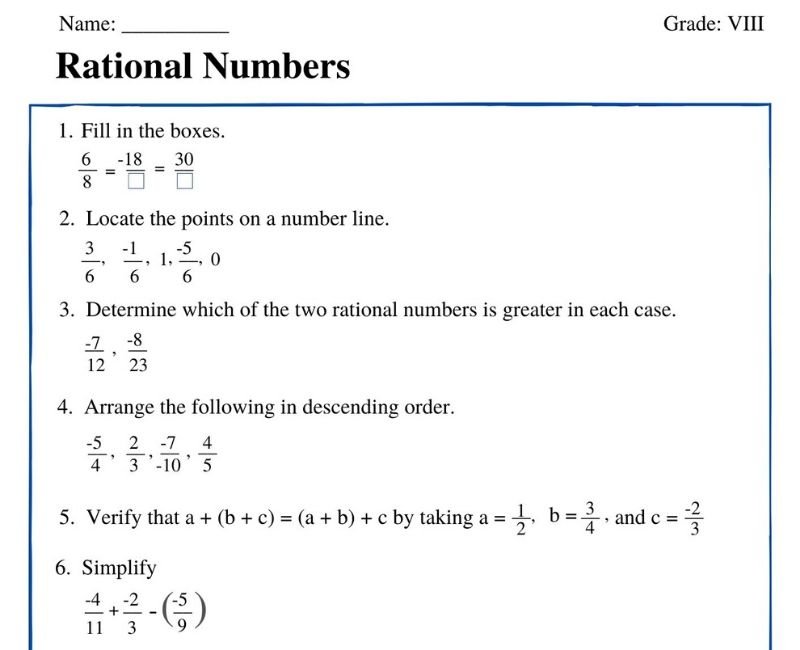
- ➗Class 8 Maths Worksheet: Rational Numbers
- 🔤Class 8 Maths Worksheet: Algebraic Expressions
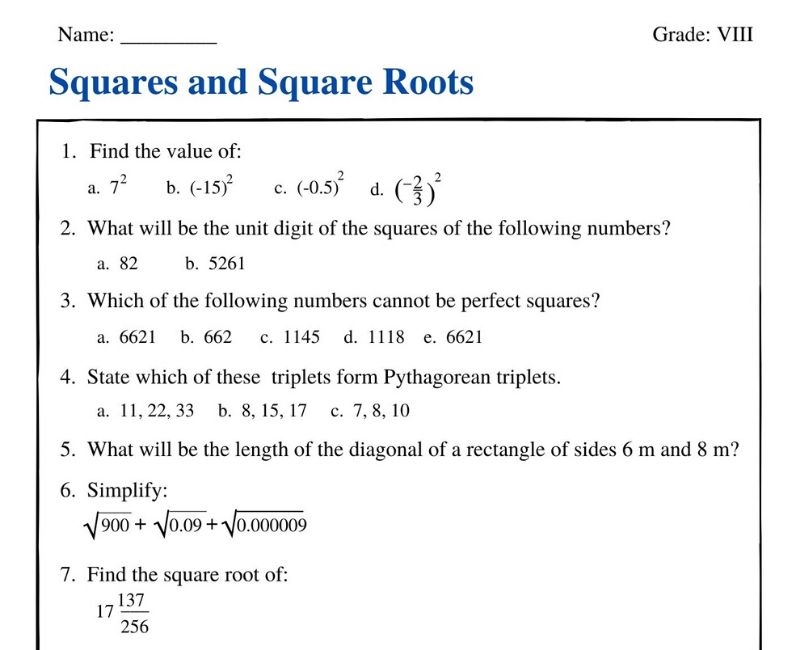
- 🔵Class 8 Maths Worksheet: Squares and Square Roots
- ⚖Class 8 Maths Worksheet: Linear Equations in One Variable
- 🧠Class 8 Maths Notes and Mind Maps
- 📚Class 8 Maths Worksheets, page 1
- 📚Class 8 Maths Worksheets, page 2
- 📚Class 8 Maths Worksheets, page 3
Number Play Class 8 FAQs
What is parity?
Parity tells whether a number is odd or even.
How do I test divisibility by 9?
Add the digits. If the digit sum is divisible by 9, so is the number.
Why does the digit sum test work?
Every power of 10 is one more than a multiple of 9, so a number leaves the same remainder as its digit sum.
How do I test for 11?
Alternately add and subtract the digits from the right. If the result is a multiple of 11, the number is divisible by 11.
What can students do on this page?
Students can take a 20-question online quiz with assertion and reason and case study questions, play five games, try five online activities, finish five challenges, run the Number Play Lab, do two virtual experiments, see why 10, 100 and 1000 leave remainder 1 and how the digit sum gives the remainder,, and fill in a 16-question practice sheet with a Show answers button.
 Download