
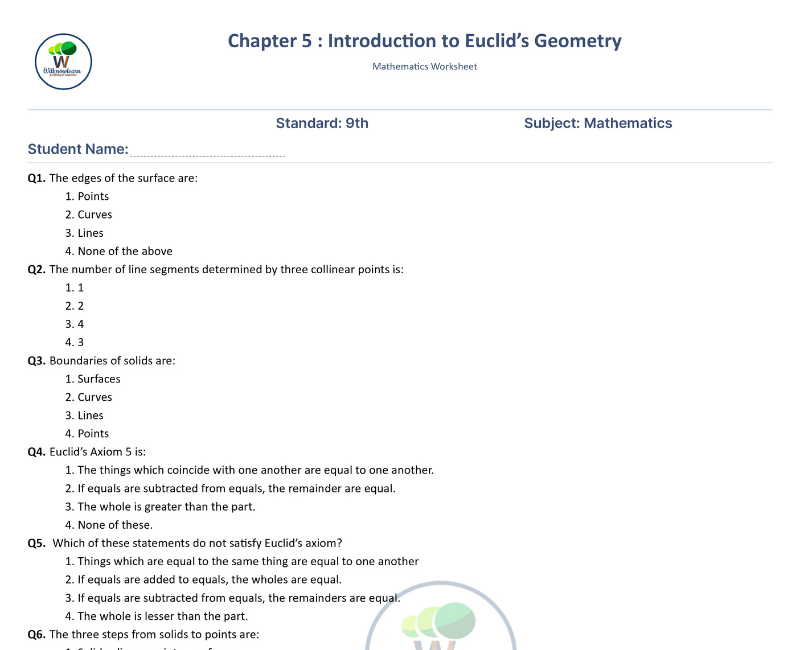
Introduction to Euclids Geometry Class 9 Maths Worksheet with Quiz and Activities
In this chapter: definitions, axioms, the five postulates and the proofs built on them. Turn a line about one point and watch it lock once a second point is fixed. On WitKnowLearn you get the Introduction to Euclids Geometry Class 9 online quiz, online activities and interactive games, a euclid lab, a virtual lab and a worksheet-style practice sheet for Class 9 Maths.
Introduction to Euclids Geometry Class 9 Online Quiz
Includes assertion and reason, case study and higher order thinking questions. Tap an answer and the next question comes up.
Introduction to Euclids Geometry Class 9 Activities
👆 Tap a tab to switch: Learn, Games, Labs, Challenges, Virtual Lab and Practice sheet
Introduction to Euclids Geometry: building geometry from the ground up
A short read for Class 9 before you play. These notes cover Introduction to Euclids Geometry: definitions, axioms, postulates, theorems and the first postulate at work.
📖 Definitions and their limits
Euclid began by describing a point as that which has no part and a line as that which has length but no breadth. Each description leans on words that are themselves never defined.
⚖ Axioms and postulates
Axioms are common notions assumed across all of mathematics. Postulates are the five assumptions made about geometry in particular. Neither kind is ever proved.
✅ Theorems built on them
Everything else is a theorem, proved step by step from the definitions, the axioms, the postulates and the results already settled. That is the method the whole subject rests on.
Introduction to Euclids Geometry Class 9 Maths Activities
Follow every step on the Concept Map. Earn up to 3 stars in every activity.
This page covers Introduction to Euclids Geometry: definitions, axioms, postulates, theorems and the first postulate at work for Class 9 maths. It covers the definitions of Euclid, the common notions or axioms, the five postulates, the difference between what is assumed and what is proved, and the first results that follow.
The activities are pitched at Class 9 level. Turn a line freely about one point and then watch it lock in place once a second point is fixed, and compare two bars to test the common notions. Explore more Class 9 maths worksheets on WitKnowLearn after this chapter.
Key ideas and facts to know
| Kind of statement | Proved or assumed | Scope |
|---|---|---|
| Axiom | assumed | all of mathematics |
| Postulate | assumed | geometry in particular |
| Theorem | proved | follows from the rest |
How to use this page
- Flip the six cards and try the Euclid Lab in the Learn tab.
- Play the five games and do the hands-on labs, where you drag and move things, to see each idea at work.
- Finish the five challenges to collect up to 15 points.
- Run the virtual experiment, fill in its observation table and choose the conclusion the evidence supports.
- Take the online quiz, with assertion and reason and case study questions, and fill in the practice sheet.
Worked examples
If they had two common points then, by the first postulate, exactly one line passes through those two points, so the two lines would be the same line.
C divides AB into two equal parts, so AC is 6 cm.
This Introduction to Euclids Geometry worksheet for Class 9 maths gives you online activities and interactive games that make the chapter clear. Every activity has a goal, a hint and a short fact, so students learn while they enjoy.
Complete Guide: Class 9 Maths Introduction to Euclids Geometry
This guide is for Class 9 students, parents and teachers. It covers Introduction to Euclids Geometry: definitions, axioms, postulates, theorems and the first postulate at work for Class 9 maths and shows how to use the quiz, labs and games on this page.
Introduction to Introduction to Euclids Geometry
This chapter is about method rather than measurement. It shows how a whole subject can be built from a short list of things assumed and a strict rule for proving everything else.
What is there in this chapter
- The definitions of Euclid
- Axioms or common notions
- The five postulates
- Assumed against proved
- The first postulate at work
- The fifth postulate and what followed
Learning objectives
- Tell an axiom from a postulate.
- State the five postulates in your own words.
- Explain why a theorem must be proved.
- Use the first postulate to settle simple results.
- Reason with assertions and case studies.
Learning outcomes
- I can tell an axiom from a postulate.
- I can state the first postulate.
- I can follow a short geometrical proof.
Introduction to Euclids Geometry Class 9 resources on this page
| Resource | What it gives |
|---|---|
| Online quiz | Assertion and reason, case study and higher order thinking questions with a full review |
| Flip cards | 6 picture cards with one-line rules |
| Euclid Lab | A hands-on lab with 3 rounds |
| Games | 5 interactive games |
| Labs | Interactive labs where you drag, move and watch what happens |
| Virtual Lab | One full experiment with an aim, objectives, a procedure, a six row observation table and a conclusion |
| Challenges | 5 challenges, 15 points in all |
| Practice sheet | A worksheet-style sheet with 16 questions, name and date lines and a live score |
Key facts
| Idea | Rule |
|---|---|
| Postulates | five of them |
| Axiom | a common notion |
| Two points | exactly one line |
| Theorem | always proved |
Types of questions you may see
- Axiom and postulate questions
- Counting lines questions
- Mid point and segment questions
- Reasoning and assertion and reason questions
Solved examples
Each is explained using other terms, such as part and breadth, which are themselves never defined, so the chain of explanation never ends.
Each pair of points gives one line, and four points make six pairs, so six lines.
Common mistakes
| Mistake | Correct idea |
|---|---|
| Treating a postulate as something to be proved | It is assumed at the start |
| Calling every assumed statement a postulate | A common notion is an axiom |
| Forgetting that collinear points determine only one line | Count the pairs only when no three are collinear |
Introduction to Euclids Geometry in daily life
The method of this chapter, starting from agreed assumptions and proving the rest, is the one used in law, in computer science and in every mathematical argument ever written.
Tips for parents and teachers
- Ask your child to try drawing a second line through two fixed pins and see that it cannot be done.
- Discuss which everyday statements are assumed and which ones need an argument.
- Practise one assertion and one case study each week.
Introduction to Euclids Geometry Class 9 FAQs
Who was Euclid?
A Greek mathematician who set out geometry systematically in his book the Elements, which runs to thirteen books.
How did Euclid define a point?
As that which has no part.
How did Euclid define a line?
As that which has length but no breadth.
Why are those definitions criticised today?
Because they explain each term using other terms that are themselves left undefined.
What is an axiom?
A statement assumed without proof and used across all of mathematics, also called a common notion.
What is a postulate?
An assumption made about geometry in particular. Euclid set down five of them.
What is the first postulate?
A straight line may be drawn from any one point to any other point, and exactly one such line exists.
What is a theorem?
A statement that is proved from the definitions, axioms, postulates and theorems already established.
How many lines pass through two distinct points?
Exactly one.
How many points can two distinct lines share?
At most one, since two shared points would make them the same line.
Why is the fifth postulate famous?
Because mathematicians tried for centuries to prove it from the other four and failed, and those attempts led to non Euclidean geometries.
What is the difference between an axiom and a postulate?
An axiom is used throughout mathematics while a postulate is an assumption about geometry alone.
How many lines do three non collinear points determine?
Three, one through each pair.
What can students do on this page?
Students can take an online quiz with assertion and reason and case study questions, play five games, try five online activities, finish five challenges, run the Euclid Lab, run one full virtual experiment with its own observation table, and fill in a 16-question practice sheet with a Show answers button.
Related Class 9 Maths Worksheets
- 🔢Number Systems Class 9 Worksheet
- 🔤Polynomials Class 9 Worksheet
- 📍Coordinate Geometry Class 9 Worksheet
- 📈Linear Equations in Two Variables Class 9 Worksheet
- 📐Lines and Angles Class 9 Worksheet
- 🔺Triangles Class 9 Worksheet
- ▱Quadrilaterals Class 9 Worksheet
- ⭕Circles Class 9 Worksheet
- 📏Herons Formula Class 9 Worksheet
- 🧊Surface Area and Volumes Class 9 Worksheet
- 📊Statistics Class 9 Worksheet
 Download


