CLASS 10 SCIENCE • MATERIALS DISCOVERY LAB
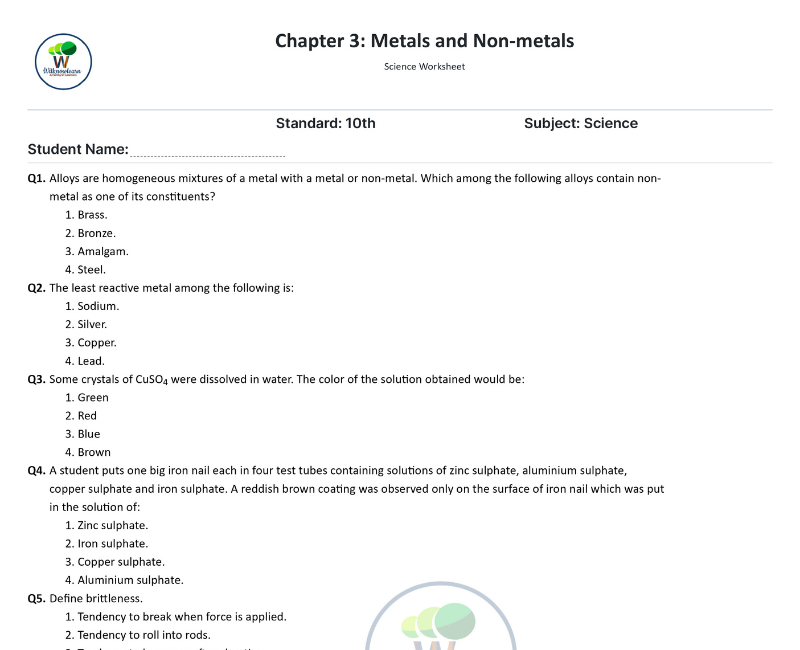
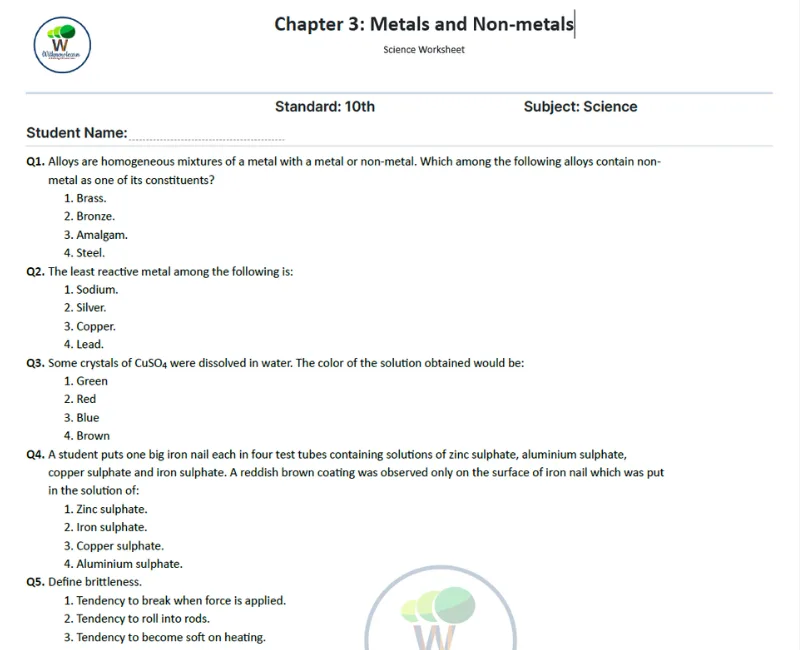
Metals and Non-metals Worksheet
with Online Quiz and Activities
Predict which metal reacts, follow electron transfer and discover why materials behave differently. Learn with virtual tests, labelled diagrams and evidence-based challenges.
Predict the Reaction
Build a reactivity ladder and test metal displacement.
e⁻See the Particles
Connect electron transfer, ion ratios and electrical conduction.
✓Explain the Evidence
Explore extraction, refining, corrosion and material choices.
Metals and Non-metals Online Quiz
Question 1 of 20 • Easy • Answered 0/20
Which property describes drawing a metal into thin wires?
Quiz instructions
Attempt 10 easy, five average and five HOTS questions in 20 minutes. The timer starts with your first answer or navigation. Answers advance automatically except at the final question. Revisit answers with Previous or the numbered buttons. One mark per correct answer and no negative marking. All explanations appear after submission or timeout.
Interactive Metals and Non-metals Games
Reactivity Ladder
Tap the four metals from most reactive to least reactive. Undo lets you revise the order.
Arrange these metals in decreasing reactivity.
Tap the tiles in the requested order.
Virtual Materials Science Activities
Activity instructions
Use the raised selector to switch topics. A game and a learning activity share one active workspace; switching keeps their progress while this page stays open. Extra practice has its own workspace. Diagrams are simplified learning models. Real experiments require teacher-led procedures.
Extra Questions and Scientific Reasoning
Balance the Metal Reactions
Enter the smallest positive whole-number coefficients in the displayed order.
Al + O₂ → Al₂O₃
Enter a numerical answer without units.
There are five games, five learning activities and five extra practice sets, each with five tasks. Reset one question or its entire set using Reset options.
Eight Revision Tips for Students
- Learn general properties together with their exceptions.
- Use the reactivity series to predict displacement.
- Do not apply the metal–acid hydrogen rule to every acid.
- Balance ionic charges to find the simplest formula ratio.
- Distinguish mobile ions from mobile electrons.
- Compare roasting with calcination using the ore and air supply.
- Label impure anode, pure cathode and electrolyte in copper refining.
- Use controls to explain the conditions for rusting.
Five Teaching Tips for Parents and Teachers
- Ask for a counterexample to an overgeneralised property statement.
- Let learners predict displacement before running the virtual test.
- Use ion counts to explain why MgCl₂ contains two chloride ions.
- Switch conductivity states and ask what changed at particle level.
- Use the rusting controls to distinguish evidence from assumption.
Metals and Non-metals Class 10 Notes and Solved Questions
This Metals and Non-metals Class 10 worksheet page brings together written practice, an online quiz, virtual experiments and interactive particle diagrams. Revise physical properties, chemical reactions, the reactivity series, ionic compounds, extraction, refining and corrosion. Use the worksheet download already provided on the page for written work, then practise the concepts above.
Metals and Non-metals Properties and Exceptions
| Property | General trend | Important exception or clarification |
|---|---|---|
| Electrical conduction | Most metals conduct well | Graphite is a conducting non-metal form |
| Appearance | Metals are usually lustrous | Iodine is a lustrous non-metal |
| Physical state | Most metals are solid at room temperature | Mercury is liquid; bromine is a liquid non-metal |
| Mechanical properties | Many metals are malleable and ductile | Sodium and potassium are soft |
| Oxide behaviour | Many metal oxides are basic | Al₂O₃ and ZnO are amphoteric |
Malleability means forming sheets; ductility means drawing wires. These properties should not be confused. Non-metals also have exceptions, including very hard diamond. Chemical identity cannot be established from shine or hardness alone.
Metals and Non-metals Class 10 Reactivity Series
K > Na > Ca > Mg > Al > Zn > Fe > Pb > H > Cu > Hg > Ag > Au
Hydrogen is included as a reference, although it is a non-metal. A more reactive metal can displace a less reactive metal from a suitable salt solution in the school model. Very reactive metals such as sodium also react with water, so they should not be treated as ordinary aqueous displacement demonstrations.
Solved Displacement Example
Predict iron in copper sulphate solution.
Iron lies above copper in the series.
Fe + CuSO₄ → FeSO₄ + Cu.
Reddish-brown copper deposits.
The blue solution changes toward pale green as FeSO₄ forms.
The reverse copper-in-iron-sulphate displacement does not occur under the usual conditions.
Metals Reacting with Oxygen Water and Acids
Magnesium burns to form magnesium oxide. Sodium and calcium react with cold water to form hydroxides and hydrogen. In the school comparison, magnesium reacts with hot water; hot iron reacts with steam to form Fe₃O₄ and hydrogen. Copper does not react with water or steam in that comparison.
| Reaction | Balanced equation |
|---|---|
| Magnesium with oxygen | 2Mg + O₂ → 2MgO |
| Calcium with water | Ca + 2H₂O → Ca(OH)₂ + H₂ |
| Iron with steam | 3Fe + 4H₂O(g) → Fe₃O₄ + 4H₂ |
| Zinc with dilute HCl | Zn + 2HCl → ZnCl₂ + H₂ |
Metals above hydrogen commonly release H₂ with suitable dilute acids such as HCl. Nitric acid usually oxidises the metal without giving hydrogen in this simple pattern. NCERT notes exceptions for magnesium and manganese with very dilute HNO₃. Avoid the claim that every metal with every acid produces hydrogen.
Ionic Bonding and Electron Dot Structures Class 10
In the school electron-transfer model, metals lose electrons to form positive ions and non-metals gain electrons to form negative ions. Electrostatic attraction holds these ions in a lattice. The formula gives the simplest ratio, not a separate molecule.
Solved Example with Magnesium Chloride
Mg → Mg²⁺ + 2e⁻.
Each chlorine atom gains one electron.
2Cl + 2e⁻ → 2Cl⁻.
One Mg²⁺ balances two Cl⁻.
The formula is MgCl₂.
These are electron-bookkeeping steps, not a claim that isolated chlorine atoms are the usual starting reagent.
For Al₂O₃, two Al³⁺ ions give total charge +6 and three O²⁻ ions give −6. Six electrons are transferred per formula-unit ratio in the model.
Why Ionic Compounds Conduct When Molten or Dissolved
Solid ionic compounds have ions fixed in lattice positions and do not conduct through ion movement. When molten, or dissolved if sufficiently soluble, mobile ions can carry charge. Metallic conduction instead involves mobile electrons. Strong attractions between oppositely charged ions also explain the generally high melting points of ionic compounds.
Extraction of Metals Class 10 Flow Chart Explained
| Reactivity group | Broad route | Examples |
|---|---|---|
| High | Electrolytic reduction of appropriate molten compounds | Na, Mg, Al |
| Middle | Convert suitable ore to oxide, then reduce | Zn, Fe, Pb |
| Low | Heating suitable compounds or native occurrence | Hg, Cu, Ag, Au |
An ore is a mineral deposit from which extraction is economically viable under relevant conditions. Gangue refers to unwanted earthy impurities. Ore treatment depends on the actual mineral and economics; a reactivity table is a guide, not a complete industrial recipe.
Roasting and Calcination Difference
Roasting heats a suitable sulphide ore in air to form an oxide. Calcination heats a suitable ore, commonly a carbonate, in limited or no air. They are different pretreatment routes.
Roasting zinc sulphide.
2ZnS + 3O₂ → 2ZnO + 2SO₂.
Calcination of zinc carbonate.
ZnCO₃ → ZnO + CO₂.
Example oxide reduction.
ZnO + C → Zn + CO.
Electrolytic Refining of Copper Labelled Diagram
The virtual activity shows impure copper as the positive anode, a thin pure copper sheet as the negative cathode, and acidified copper sulphate as electrolyte. Copper enters solution from the anode and deposits on the cathode. Insoluble impurities can collect as anode mud; some other impurities remain in solution.
Corrosion Rusting and Prevention Class 10
Ordinary rusting of iron requires oxygen and moisture. The three-tube activity compares air plus water, boiled water protected by oil, and dry air with a drying agent. Rust is expected where both required conditions are available. Painting, oiling, galvanisation and appropriate alloying can reduce corrosion. Aluminium forms a protective oxide layer despite being reactive.
Silver tarnish is mainly silver sulphide in sulphur-containing air. Copper’s green coating is commonly described as basic copper carbonate. Brass contains copper and zinc; bronze mainly copper and tin. Alloying changes properties for particular uses.
Important Questions and Competency Based Practice
- Explain a property exception rather than memorising an absolute rule.
- Infer a reactivity order from displacement observations.
- Draw electron transfer and justify the ion ratio.
- Compare conductivity in solid, molten and dissolved states.
- Choose an extraction route and distinguish roasting from calcination.
- Label the refining setup and explain corrosion controls.
Current Syllabus and Sample Paper Update
The official CBSE Science syllabus for 2026–27 lists material properties, reactivity, ionic compounds, basic metallurgy and corrosion. The official Science sample paper includes comparisons of heat conduction in metal rods and evaluation of a proposed metal displacement observation. Practise reading evidence and controlling experimental variables. The tasks here are original practice, not a claimed list of repeated board questions.
Related Class 10 Science Resources
Frequently Asked Questions
What is the difference between malleability and ductility?
Malleability means forming thin sheets; ductility means drawing thin wires. Many metals show both properties.
What are important exceptions to metal and non-metal properties?
Mercury is a liquid metal at ordinary room temperature. Sodium and potassium are soft metals. Graphite conducts electricity, iodine is lustrous and diamond is very hard despite being non-metal forms.
How do I predict a displacement reaction?
Compare the metals in the reactivity series. A more reactive metal can replace a less reactive metal from a suitable salt solution in the stated school-model conditions.
Why does copper not displace zinc from zinc sulphate?
Copper is less reactive than zinc, so it does not produce the proposed displacement under the usual conditions.
Why is MgCl₂ the formula of magnesium chloride?
Magnesium forms Mg²⁺ and chlorine forms Cl⁻. One magnesium ion needs two chloride ions to balance the charge.
Why do ionic compounds conduct when molten but not as solids?
Molten ions can move and carry charge. In a solid lattice the ions are fixed. Suitable aqueous solutions also conduct through mobile ions.
What are amphoteric oxides?
They react with both acids and bases. Aluminium oxide and zinc oxide are standard Class 10 examples.
How are roasting and calcination different?
Roasting commonly heats sulphide ore in air. Calcination commonly heats carbonate ore in limited or no air. Both can produce oxides for further extraction.
Why are highly reactive metals extracted by electrolysis?
Their compounds can be too stable for reduction by carbon in the school extraction model. Electrical energy drives reduction from suitable molten compounds.
Which electrodes are used in electrolytic copper refining?
Impure copper is the positive anode and a thin pure copper sheet is the negative cathode. The electrolyte is a suitable copper salt solution, commonly acidified copper sulphate.
What conditions are needed for rusting and how can it be prevented?
Ordinary rusting needs oxygen and moisture. Protective coatings, oiling, galvanisation and suitable alloying can reduce corrosion.
Which Metals and Non-metals questions should I practise?
Practise property exceptions, reactivity predictions, electron-transfer diagrams, ionic conductivity, extraction routes, balanced equations, refining labels and interpretation of corrosion experiments. Use verified papers for actual previous-year questions.
 Download