Class 3 Science · CBSE / NCERT
Living and Non-Living Things Class 3 Science Worksheet NCERT with Quiz and Activities
Find out what makes a thing alive. Learn the six signs of life, sort living, non-living and once-living things and test tricky cases like clouds, fire and seeds. Use the Living and Non-Living Things worksheet for Class 3, take the Living and Non-Living Things Class 3 quiz and play the Living and Non-Living Things Class 3 activities online, in line with CBSE and the NCERT book Our Wondrous World.
Living and Non-Living Things Class 3 Online Quiz
Which picture shows a living thing?
Living and Non-Living Things Class 3 Activities
Read the idea, try the lab, then tap Games, Workshops or Challenges to play.
This Living and Non-Living Things worksheet for Class 3 turns the topic into things to tap, sort and build. Test any object in the Life Signs Lab, then play 5 games, 5 workshops and 5 marked challenges, and finish with the practice sheet.
Six signs of life: tap a card to flip it
Life Signs Lab
Tap a picture, then tap Next test to check one sign of life at a time, or Run all tests. A thing is living only if it shows the signs of life by itself.
- ⬜Step 1: Does it grow by itself?
- ⬜Step 2: Does it breathe?
- ⬜Step 3: Does it need food and water?
- ⬜Step 4: Does it produce young ones?
- ⬜Step 5: Does it move by itself?
- ⬜Step 6: Does it feel and respond?
Two Baskets Sort
Game 1 of 5Goal: Put all 10 pictures in the right basket.
How to play: Tap a picture, then tap the Living or Non-living basket.
Ask: does it grow and breathe by itself?
Breathing Bubbles
Game 2 of 5Goal: Pop every bubble that holds something that breathes.
How to play: Tap a bubble to pop it. Leave the non-breathing ones floating.
Plants and animals breathe. Machines and toys do not.
Grown-up and Young One Memory
Game 3 of 5Goal: Match each animal to the name of its young one.
How to play: Flip two cards. A picture and its young-one word stay open when they match.
Living things produce young ones like themselves: a cow has a calf.
Odd One Out
Game 4 of 5Goal: Win 5 rounds.
How to play: In each row of four, tap the one that does not belong.
Round 1 of 5: Tap the odd one.
Three are of one kind (living or non-living). Find the one that is different.
Garden Walk Map
Game 5 of 5Goal: Walk around the garden and collect all 5 living things.
How to play: Use the arrow buttons to move the walker 🚶. Step on a living thing to collect it.
Stones, the bench and the ball do not count. Look for animals and plants.
Life Signs Checklist
Workshop 1 of 5Goal: Tick the correct signs of life for 3 things.
How to play: For each picture, tick every sign it shows, then press Check.
Thing 1 of 3: Cat
A living thing shows all the signs. A non-living thing shows none of them by itself.
Seed to Plant Growth Stepper
Workshop 2 of 5Goal: Grow a seed into a full plant.
How to play: Switch on what the seed needs, then use the + button to move day by day.
A seed needs water, air and sunlight to grow. A pebble never grows.
Needs Kit Builder
Workshop 3 of 5Goal: Pack exactly what each living thing needs to stay alive.
How to play: Tap needs to add or remove them from the kit, then press Check kit.
Kit 1 of 3: what does the fish need?
Every living thing needs air, water and food. Plants also need sunlight to make food.
Natural or Man-made Shelf
Workshop 4 of 5Goal: Label 8 non-living things as natural or man-made.
How to play: Press the right label on every row, then press Check shelf.
Natural things are found in nature. Man-made things are made by people.
Once-Living Trays
Workshop 5 of 5Goal: Put 9 things in three trays: Living, Once living, Never living.
How to play: Drag a picture into a tray, or tap the picture and then tap a tray.
Wood, paper and cotton came from plants, so they are once living.
True or False Blitz
Challenge 1 of 5Goal: Get 3 marks.
How to play: Tap True or False for each statement, then press Submit.
Moving alone does not make a thing living.
Sign of Life Typing
Challenge 2 of 5Goal: Get 3 marks.
How to play: Type one word in each box to finish the fact, then press Submit.
The words are about growing, breathing and feeling.
Count the Scene
Challenge 3 of 5Goal: Get 3 marks.
How to play: Look at the park picture and type the counts.
Count each picture once. Trees and birds are living.
Growing Up in Order
Challenge 4 of 5Goal: Get 3 marks.
How to play: Use the ▲ ▼ buttons to put each growth line from first stage to last, then press Submit.
1. Hen
- Hen
- Egg
- Chick
2. Plant
- Sapling
- Seed
- Sprout
3. Human
- Grown-up
- Child
- Baby
Every living thing starts small and grows bigger.
Why Not Alive?
Challenge 5 of 5Goal: Get 3 marks.
How to play: Each thing below looks alive in some way. Choose the reason it is still non-living.
Look for the sign of life it is missing.
Challenge marks: 0 / 15 (0 of 5 challenges done)
Finish all 5 challenges to see your comment.
Practice sheet
Type your answers in the boxes. For word answers write in small letters. Press Check when you finish.
ALook and write living or non-living
BComplete the sentence with one word
CCount the pictures and write the number
DNatural, man-made or once living
Living and Non-Living Things Class 3 Complete Guide
Everything around a Class 3 child is either living or non-living. A puppy, a neem tree and an ant are alive. A school bag, a stone and a cloud are not. This guide explains the topic in simple words for students, parents and teachers. It goes with the Living and Non-Living Things worksheet for Class 3 on this page and covers the signs of life, the needs of living things, natural and man-made things, once-living things and the tricky cases that confuse many children.
Introduction to NCERT Class 3 Science Living and Non-Living Things
Living and Non-Living Things is a core topic of CBSE Class 3 Science and EVS. In the new NCERT textbook for Grade 3, Our Wondrous World (The World Around Us), the idea runs through chapters about plants, animals and everyday things, for example "Plants and Animals Live Together" and "This World of Things". This page is for Grade 3 students of the CBSE board and any school that follows NCERT. It is not a copy of a single NCERT chapter; it is built around the learning goals that schools test for this topic.
What is there in this topic
- The two big groups of things: living and non-living
- Six signs of life: growth, breathing, need for food and water, producing young ones, moving on their own and feeling changes
- Plants as living things even though they stay in one place
- Natural non-living things (stone, water, sun) and man-made non-living things (chair, car, pencil)
- Once-living things such as wood, paper, cotton and a dry leaf
- Things that seem alive but are not: cloud, fire, car, toy robot, clock
- How living things depend on non-living things like air, water, soil and sunlight
Learning objectives
These objectives are written for this page from the topic's goals; they are not copied from the NCERT book.
- Name the common signs of life and use them to test any object.
- Classify things around home, school and the park as living or non-living.
- Explain why plants are living things.
- Tell natural non-living things from man-made ones.
- Identify once-living things and say where they came from.
- Give reasons why moving things like cars and clouds are still non-living.
Learning outcomes
After finishing this page a child can:
- Sort 10 to 15 everyday objects into living and non-living without help.
- Use the six signs to justify each choice in one sentence.
- List what animals and plants need to stay alive.
- Describe how a seed grows into a plant and an egg into a hen.
- Explain the difference between a living tree and a wooden table made from it.
Living and Non-Living Things Class 3 resources on this page
| Resource | What it does |
|---|---|
| Living and Non-Living Things Class 3 quiz | 20 questions in three levels with an explanation for every answer |
| Life Signs Lab | Run six life tests on 10 different things and see the verdict |
| 5 games | Basket sort, breathing bubbles, young-one memory, odd one out, garden walk map |
| 5 workshops | Checklist, seed growth stepper, needs kit, natural or man-made shelf, once-living trays |
| 5 challenges | Marked out of 3 each, with a combined mark out of 15 |
| Practice sheet | 16 questions in 4 sections with live score, Check and Show answers |
Signs of living things
| Sign of life | What it means | Example |
|---|---|---|
| Growth | They become bigger by themselves | A puppy becomes a dog; a sapling becomes a tree |
| Breathing | They take in air | Humans use their nose, fish use gills, plants use tiny holes in leaves |
| Food and water | They need food and water for energy | A cow eats grass; plants make food using sunlight |
| Young ones | They produce young ones like themselves | A hen lays eggs that hatch into chicks; a mango seed gives a new plant |
| Movement | They move by themselves | A rabbit hops; a sunflower turns towards light |
| Feeling | They sense and respond to changes | We pull our hand from a hot pan; touch-me-not leaves fold when touched |
Non-living things
Non-living things do not grow, breathe, eat or have young ones. They move only when something else moves them. There are two kinds:
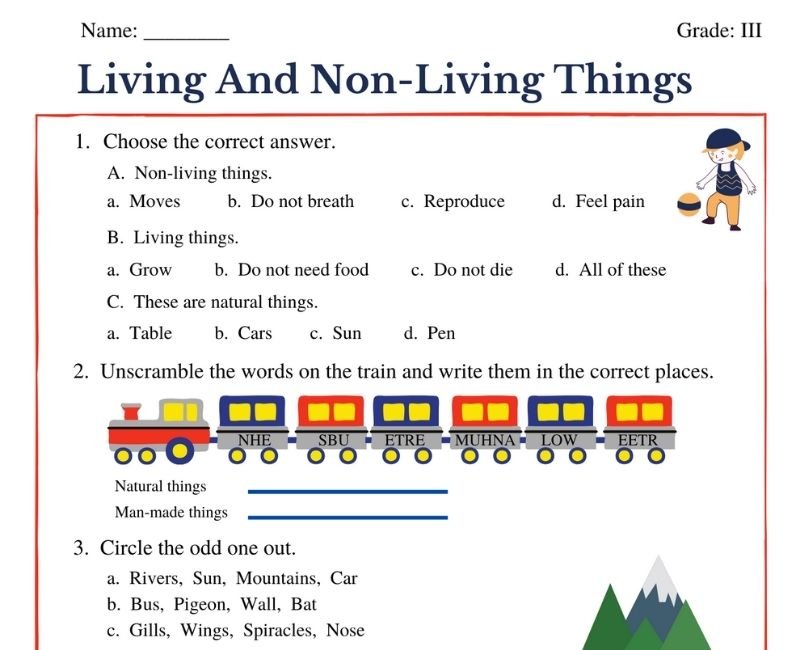
| Natural non-living | Man-made non-living |
|---|---|
| Stone, sand, soil, water, air, sun, moon, cloud, mountain | Chair, pencil, car, bus, kite, plastic bottle, clock, toy robot |
Once-living things
Some non-living things were once part of a living thing. Wood comes from trees, paper from wood, cotton from the cotton plant and a dry leaf from a plant. They are not alive now, so they cannot grow or breathe.
Tricky things that seem alive
| Thing | Why it seems alive | Why it is non-living |
|---|---|---|
| Car or bus | It moves | It needs fuel and a driver; it does not grow or have young ones |
| Cloud | It moves and changes shape | Wind pushes it; it does not breathe or eat |
| Fire | It gets bigger and needs air | It does not grow from inside or produce young ones |
| Toy robot | It walks and talks | It runs on batteries and cannot grow |
| Seed | It looks like a dead thing | It is living; it grows when it gets water, air and warmth |
Types of questions
- Picture sorting: circle or tick the living things
- True or false about signs of life
- Fill in the blanks with a sign of life
- Counting living and non-living things in a picture
- Natural or man-made, once living or never living
- Reason questions: why is a car non-living?
Solved examples
Common mistakes
| Mistake | Correct idea |
|---|---|
| Anything that moves is living | Cars, clouds and fans move but are non-living |
| Plants are non-living because they cannot walk | Plants grow, breathe and make food, so they are living |
| A seed is non-living | A seed is living; it is resting until it gets water |
| Wood is living because it came from a tree | Wood is once living, now non-living |
| Fire is living because it grows | Fire spreads with fuel; it has no young ones |
| Water is living because it flows | Water is a natural non-living thing |
| A toy dog is living like a real dog | The toy cannot eat, breathe or grow |
| Only animals need air | Plants also take in air |
Daily life
Children meet this topic every day. Watering a plant, feeding a pet, watching ants carry food or seeing a chick hatch all show the signs of life. Taking care of living things and keeping non-living things like water and air clean helps all living things around us.
What your child learns from the Living and Non-Living Things worksheet
- To observe carefully and ask "Does it grow? Does it breathe?"
- To sort and classify, a key science skill
- To give reasons instead of guessing
- To care for plants, animals and the environment
Tips for parents and teachers
- Take a 10-minute nature walk and list 5 living and 5 non-living things.
- Grow a bean seed in a wet cotton bowl and note changes every day.
- Use the Life Signs Lab on this page to discuss tricky cases like fire and clouds.
- Ask the child to explain every answer in one full sentence.
- Use the practice sheet's Check button after each attempt and praise effort.
Related Science Worksheets
- Eating Habits of Animals Worksheet Class 3
- Soil Worksheet Class 3
- Light Sound and Force Worksheet Class 3
- Parts of a Plant Worksheet Class 3
- Air Water and Weather Worksheet Class 3
- Our Earth and its Neighbours Worksheet Class 3
- Nesting Habits of Birds Worksheet Class 3
- Human Body Worksheet Class 3
- Safety and First Aid Worksheet Class 3
- Science Measurement Worksheet Class 3
- States of Matter Worksheet Class 3
- Food and Feeding Habits of Animals Worksheet Class 3
Frequently Asked Questions
What are living and non-living things for Class 3?
Living things are things that grow, breathe, need food and water, produce young ones, move by themselves and feel changes. Non-living things do not show these signs by themselves.
What are the six signs of living things?
Growth, breathing, need for food and water, producing young ones, moving by themselves and feeling or responding to changes.
Why are plants living things if they cannot walk?
Plants grow, take in air, make their own food using sunlight and give seeds. Their leaves and flowers also move towards light, so they are living.
Is a seed living or non-living?
A seed is living. It is resting, and when it gets water, air and warmth it grows into a new plant.
Why is a car non-living even though it moves?
A car moves only when it has fuel and a driver. It does not grow, breathe, eat or produce young ones.
What are once-living things?
Things that were part of a living plant or animal before but are not alive now, such as wood, paper, cotton and a dry leaf.
What is the difference between natural and man-made non-living things?
Natural non-living things such as stone, water and the sun are found in nature. Man-made ones such as a chair, pen and bus are made by people.
Does this page have Living and Non-Living Things Class 3 questions and answers?
Yes. The 20-question Living and Non-Living Things Class 3 quiz shows an explanation after every answer, and the practice sheet has a Show answers button for all 16 questions.
Is this worksheet based on NCERT and CBSE?
Yes. It follows the CBSE Class 3 Science syllabus and the NCERT approach used in the Grade 3 book Our Wondrous World.
Can my child use this page on a phone?
Yes. All pictures, activities and the practice sheet are sized for phones, tablets and laptops.
How are the challenges marked?
Each challenge is out of 3 marks and shows Excellent, Good or Need improvement. After all five, you see a total out of 15 with a comment.
What is included on this page?
A 20-question quiz, the Life Signs Lab explorer, 5 games, 5 workshops, 5 marked challenges, a 16-question practice sheet, a complete guide, 12 related Class 3 Science worksheets and these FAQs.
 Download