Class 3 Science · CBSE / NCERT
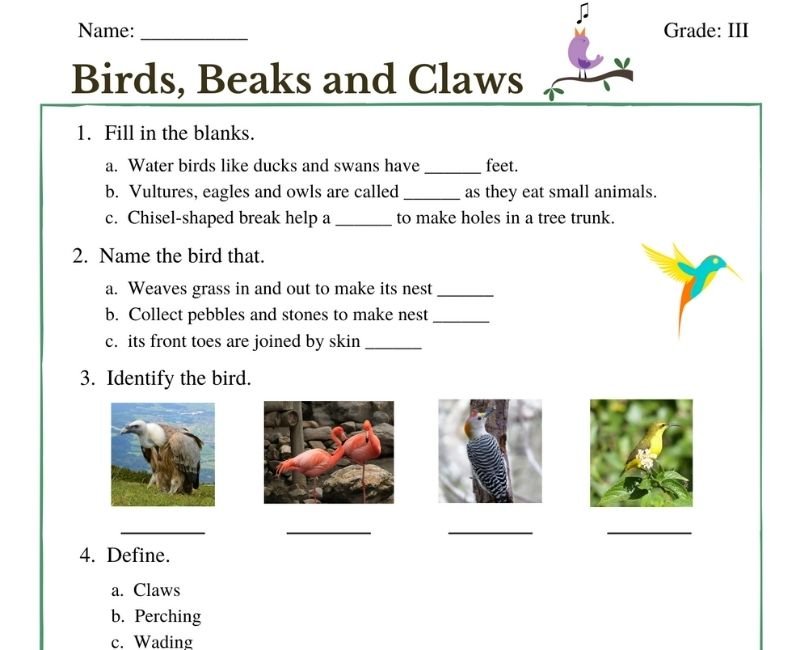
Birds Beaks and Claws Class 3 Science Worksheet NCERT with Quiz and Activities
Why does a parrot have a curved beak, how does a duck swim and why can a woodpecker climb trees? Find out with this Birds Beaks and Claws worksheet for Class 3: take the Birds Beaks and Claws Class 3 quiz, try the bird science labs and play the Birds Beaks and Claws Class 3 activities online, in line with CBSE and the NCERT book Our Wondrous World.
Flip the cards and try the Beak Tools Lab, then tap the Games, Labs or Challenges island.
Birds Beaks and Claws Class 3 Online Quiz
20 questions · tap an answer to move on · full review at the end
Which bird has a short, strong, curved beak to crack hard nuts?
Birds Beaks and Claws Class 3 Activities
Peck, paddle, spot and sort. Earn up to 3 stars in every activity.
This Birds Beaks and Claws worksheet for Class 3 lets children explore like young bird watchers. Flip the fact cards, test beak tools in the Beak Tools Lab, then play the games, do the labs and try the challenges.
Fact cards: tap a card to flip it
Beak Tools Lab
Beaks work like tools. Drag the right tool onto each food (or tap it) and meet the bird whose beak works the same way.
🔧 Beaks are like tools. Look at the food, then drag the tool that can eat it onto the plate.
- 👉Step 1: Crack it!
Food: Nut. Which tool works? - ⬜Step 2: Sip it!
Food: Nectar. Which tool works? - ⬜Step 3: Strain it!
Food: Pond water. Which tool works? - ⬜Step 4: Pick it up!
Food: Seeds. Which tool works? - ⬜Step 5: What did we find?
Finish steps 1 to 4 to unlock.
Beak Sort
Game 1 of 5Goal: Put each bird in the box for its kind of beak.
How to play: Drag each bird into the right box.
Parrots crack, eagles tear, sunbirds sip, woodpeckers chisel, ducks strain, sparrows pick.
Bird or Not?
Game 2 of 5Goal: Pop every bubble that has a BIRD in it.
How to play: Tap a bubble to pop it. Leave the animals that are not birds floating.
Birds have feathers and lay eggs, even if they cannot fly.
What Do Birds Eat?
Game 3 of 5Goal: Match each bird with its food.
How to play: Flip two cards. A bird and its food stay open when they match.
Look at the beak to guess the food.
Nest Match
Game 4 of 5Goal: Help each bird find its own nest.
How to play: Drag each bird onto its nest.
The tailorbird sews leaves. The weaver bird weaves grass. The woodpecker drills a hole.
Woodpecker Peck
Game 5 of 5Goal: Help the woodpecker catch 8 insects hiding in the bark.
How to play: Press Start. When an insect peeps out of a hole, tap it quickly before it hides!
Insects caught: 0 / 8
Keep your eyes on all the holes.
Waterproof Feather Lab
Workshop 1 of 5Goal: Find out why ducks stay dry in water.
How to play: Drag the water dropper onto each of the three things and watch what the drop does.
Look for the thing where the drop rolls off.
Webbed Feet Race
Workshop 2 of 5Goal: Find out which feet are best for swimming.
How to play: Drag a foot onto the duck. Then swipe left across the water (or tap Paddle) to swim to the island. Try both feet.
Pick a foot first.
Webbed feet push more water with each stroke.
Label a Bird
Workshop 3 of 5Goal: Name the parts of a bird.
How to play: Drag each label onto the box that points to that part.
The beak is at the front of the head. The claws hold the branch.
Perfect Perch Lab
Workshop 4 of 5Goal: Find the best place for each bird’s feet.
How to play: Drag each bird to the place where its feet work best.
Perching feet grip branches. Climbing feet grip bark. Webbed feet swim. Scratching feet dig. Talons grab prey.
Bird Watching Lab
Workshop 5 of 5Goal: Spot 6 birds hiding in the park.
How to play: Move the binoculars around the park (move your mouse or drag your finger). When a bird is in view, tap it to write it in your notebook.
- 📒 My bird notebook
Look in the trees, by the pond and in the sky.
Bird Detective
Challenge 1 of 5Goal: Get 3 marks.
How to play: For each question, tap the right picture, then press Submit.
1. Which bird has a hooked beak for tearing meat?
2. Which bird has webbed feet?
3. Which bird cannot fly?
Hooked beak: tears meat. Webbed feet: swims. Ostrich: runs.
Swipe: True or False?
Challenge 2 of 5Goal: Get 3 marks.
How to play: Drag each card to ⬅ False or True ➡. You can also tap the card, then tap a side.
Birds have feathers. Bats have fur.
Count at the Lake
Challenge 3 of 5Goal: Get 3 marks.
How to play: Look at the picture and type the numbers.
Bats, butterflies and bees are not birds.
From Egg to Hen
Challenge 4 of 5Goal: Get 3 marks.
How to play: Drag the three pictures into the boxes in the order they happen. Each picture can be placed once.
What comes out of an egg?
Tap the Bird Part
Challenge 5 of 5Goal: Get 3 marks.
How to play: Read the question and tap the right part of the bird. Your first tap counts.
Question 1 of 3: Tap the part the bird uses to pick up food.
Beak in front, wings on the body, claws on the branch.
Challenge marks: 0 / 15 (0 of 5 challenges done)
Finish all 5 challenges to see your comment.
Practice sheet
Type your answers in the boxes. For word answers write in small letters. Press Check when you finish.
ALook at the bird and write its kind of beak
BComplete the sentence with one word
CCount and write the number
DCan this bird fly? Write yes or no
Birds Beaks and Claws Class 3 Complete Guide
Birds come in many shapes and sizes, and their beaks and claws tell us how they live. This guide explains it in simple words for Class 3 students, parents and teachers. It goes with the Birds, Beaks and Claws worksheet for Class 3 on this page and covers the features of birds, kinds of beaks, kinds of feet and claws, nests, eggs and birds that cannot fly.
Introduction to NCERT Class 3 Science Birds, Beaks and Claws
Book: Our Wondrous World (The World Around Us), the NCERT textbook for Grade 3. Topic: Birds, Beaks and Claws. Board: CBSE and other schools that follow NCERT. The new NCERT book builds this topic through watching the birds around the school and home. This page is built around the learning goals schools test for the topic; it is not a copy of a single chapter.
What is there in this topic
- Features of birds: feathers, wings, beak, claws, eggs
- Kinds of beaks and the food they suit
- Kinds of feet and claws and where birds live
- Birds' nests
- Birds that cannot fly
- Animals that fly but are not birds
Learning objectives
These objectives are written for this page from the topic's goals; they are not copied from the NCERT book.
- List the features that all birds share.
- Match beak shapes to the food birds eat.
- Match feet and claws to how birds move and feed.
- Name different kinds of nests and the birds that make them.
- Give examples of birds that cannot fly.
Learning outcomes
After this page a child can:
- Say why a parrot, an eagle and a duck have different beaks.
- Explain how webbed feet help a duck swim.
- Label the beak, head, wing, tail and claws of a bird.
- Explain why a bat is not a bird.
- Describe the nests of the tailorbird, weaver bird and woodpecker.
Birds, Beaks and Claws Class 3 resources on this page
| Resource | What it does |
|---|---|
| Birds, Beaks and Claws Class 3 quiz | 20 questions in three levels with a full answer review |
| Flip cards | Six cards: feathers, beaks, feet, talons, nests and birds that cannot fly |
| Beak Tools Lab | Use a nutcracker, straw, strainer and tweezers to see how beaks work |
| 5 games | Beak sort, bird or not, what birds eat, nest match, woodpecker peck |
| 5 science labs | Waterproof feather, webbed feet race, label a bird, perfect perch, bird watching |
| 5 challenges | Marked out of 3 each with a total out of 15 |
| Practice sheet | 16 questions with pictures, word banks and a live score |
Kinds of beaks
| Beak | Shape | Food | Birds |
|---|---|---|---|
| Cracking | Short, strong, curved | Nuts, hard seeds, fruits | Parrot |
| Tearing | Sharp and hooked | Flesh of small animals | Eagle, vulture, kite |
| Sucking | Long, thin, curved | Nectar | Sunbird, hummingbird |
| Chiselling | Strong, pointed | Insects under bark | Woodpecker |
| Straining | Flat and broad | Small plants and insects in water | Duck, swan |
| Picking | Short and pointed | Seeds and grains | Sparrow, hen, pigeon |
| Catching fish | Long and pointed | Fish and frogs | Kingfisher, heron |
Kinds of feet and claws
| Feet | What they do | Birds |
|---|---|---|
| Perching | Three toes in front and one behind wrap round branches | Sparrow, crow, pigeon |
| Climbing | Two toes in front and two behind grip bark | Woodpecker, parrot |
| Swimming (webbed) | Skin joins the toes to make paddles | Duck, swan, penguin |
| Scratching | Strong toes dig the soil | Hen, peacock |
| Grasping (talons) | Sharp, curved claws catch prey | Eagle, owl, vulture |
| Wading | Long legs and toes for shallow water | Heron, crane |
Nests
Birds build nests to lay eggs and keep their chicks safe. The tailorbird stitches leaves together. The weaver bird weaves a hanging nest of grass. The woodpecker drills a hole in a tree trunk. Crows build nests of twigs on branches. Some birds, like the koel, lay eggs in other birds' nests.
Types of questions
- Match the bird to its beak or feet
- Name the kind of beak
- Label a bird
- Can it fly? Yes or no
- True or false
- Reason questions about beaks, feet and feathers
Solved examples
Common mistakes
| Mistake | Correct idea |
|---|---|
| Anything that flies is a bird | Bats and insects fly but are not birds; birds have feathers |
| All birds can fly | Ostriches, emus and penguins cannot fly |
| All beaks are the same | Each beak suits the food the bird eats |
| A penguin is a fish | A penguin is a bird that swims |
| A woodpecker eats wood | It eats insects hiding under the bark |
| Birds live in nests all year | Most birds use nests only to lay eggs and raise chicks |
Daily life
We see sparrows pecking grains, crows on branches, pigeons on rooftops, ducks in ponds and parrots eating fruit. We can keep water bowls for birds in summer and never disturb their nests.
What your child learns from the Birds, Beaks and Claws worksheet
- To observe birds closely
- To link body parts to food and habitat
- To care for birds and their nests
- To sort and compare like a scientist
Tips for parents and teachers
- Watch birds for 10 minutes and note their beaks and feet.
- Try picking up food with tweezers, a straw and a spoon like beaks.
- Put out a bowl of water and some grains for birds.
- Look at a feather with a magnifying glass.
- Let the child retry the challenges to earn 3 stars.
Related Science Worksheets
- Living and Non-Living Things Worksheet Class 3
- Eating Habits of Animals Worksheet Class 3
- Soil Worksheet Class 3
- Light Sound and Force Worksheet Class 3
- Parts of a Plant Worksheet Class 3
- Air Water and Weather Worksheet Class 3
- Sun Moon and Stars Worksheet Class 3
- Human Body Worksheet Class 3
- Safety and First Aid Worksheet Class 3
- Science Measurement Worksheet Class 3
- States of Matter Worksheet Class 3
- Food and Feeding Habits of Animals Worksheet Class 3
Frequently Asked Questions
What are the features of birds for Class 3?
Birds have feathers, two wings, two legs, a beak and claws. All birds lay eggs. Most birds can fly.
Why do birds have different beaks?
Each beak is shaped for the food the bird eats: parrots crack nuts, eagles tear meat, sunbirds sip nectar, woodpeckers chisel bark, ducks strain water and sparrows pick seeds.
Why do ducks have webbed feet?
A duck's toes are joined by skin. These webbed feet work like paddles and help it swim.
What are claws used for?
Birds use claws to hold branches, climb trees, scratch the ground and catch prey. An eagle's sharp, curved claws are called talons.
Which bird has a beak like a chisel?
The woodpecker. Its strong, pointed beak drills holes in tree bark to find insects.
Which birds cannot fly?
The ostrich, emu, kiwi and penguin cannot fly. The ostrich runs fast and the penguin swims.
Is a bat a bird?
No. A bat can fly, but it has fur instead of feathers and gives birth to babies, so it is a mammal, not a bird.
Does this page have Birds Beaks and Claws Class 3 questions and answers?
Yes. The 20-question Birds Beaks and Claws Class 3 quiz shows the correct answer and a reason for every question at the end, and the practice sheet has a Show answers button for all 16 questions.
Is this worksheet based on CBSE and NCERT?
Yes. It follows the CBSE Class 3 Science syllabus and the NCERT approach used in the Grade 3 book Our Wondrous World.
What experiments can children do on this page?
They can test beak tools on food, drop water on a duck feather, race with webbed feet, label a bird, put birds where their feet work best and spot birds with binoculars, all on the screen.
Can my child use these activities on a phone?
Yes. All drag activities work with a finger on phones and tablets and with a mouse on computers. Tapping also works.
What is included on this page?
A 20-question quiz with review, flip cards, the Beak Tools Lab, 5 games, 5 science labs, 5 marked challenges, a 16-question practice sheet, a complete guide, 12 related Class 3 Science worksheets and these FAQs.
 Download