Class 3 Science · CBSE / NCERT
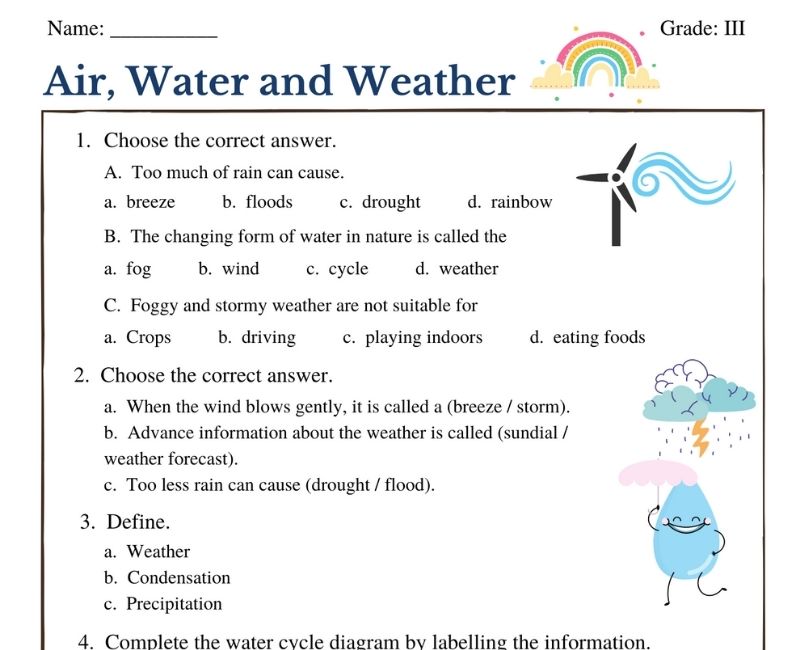
Air Water and Weather Class 3 Science Worksheet NCERT with Quiz and Activities
Can you see air, where does rain come from and why do clothes dry faster on a windy day? Explore it all with this Air Water and Weather worksheet for Class 3: take the Air Water and Weather Class 3 quiz, try the weather science labs and play the Air Water and Weather Class 3 activities online, in line with CBSE and the NCERT book Our Wondrous World.
Flip the cards and try the Water Cycle Lab, then tap the Games, Labs or Challenges island.
Air Water and Weather Class 3 Online Quiz
20 questions · tap an answer to move on · full review at the end
Which of these do we use on a rainy day?
Air Water and Weather Class 3 Activities
Blow, pour, catch and measure. Earn up to 3 stars in every activity.
This Air Water and Weather worksheet for Class 3 lets children explore like young weather scientists. Flip the fact cards, make it rain in the Water Cycle Lab, then play the games, do the labs and try the challenges.
Fact cards: tap a card to flip it
Water Cycle Lab
Drag the sun, the cool air and the wind onto the sky (or tap them) in the right order and watch the water cycle make rain.
🌊 Make it rain: heat the sea with the sun, cool the vapour into a cloud, then let the wind blow the cloud to the hills.
- ☀️Step 1: Heat the sea
Drag the sun onto the sky. - ❄️Step 2: Make a cloud
Drag the cool air onto the sky. - 💨Step 3: Blow the cloud
Drag the wind onto the sky. - ⬜Step 4: What did we find?
Finish steps 1 to 3 to unlock.
Challenge marks: 0 / 15 (0 of 5 challenges done)
Finish all 5 challenges to see your comment.
Practice sheet
Type your answers in the boxes. For word answers write in small letters. Press Check when you finish.
ALook at the symbol and write the weather
BComplete the sentence with one word
CCount and write the number
DWrite solid, liquid or gas
Air Water and Weather Class 3 Complete Guide
Air, water and weather are all around us every day. This guide explains them in simple words for Class 3 students, parents and teachers. It goes with the Air, Water and Weather worksheet for Class 3 on this page and covers what air is and why we need it, wind, sources and uses of water, the three forms of water, the water cycle, clean drinking water, saving water, kinds of weather and weather instruments.
Introduction to NCERT Class 3 Science Air, Water and Weather
Book: Our Wondrous World (The World Around Us), the NCERT textbook for Grade 3. Topic: Air, Water and Weather. Board: CBSE and other schools that follow NCERT. The new NCERT book builds these ideas through observing the sky, water and weather around the child. This page is built around the learning goals schools test for the topic; it is not a copy of a single chapter.
What is there in this topic
- Air is everywhere and takes up space
- Uses of air and moving air (wind, breeze, storm)
- Sources and uses of water
- Three forms of water: ice, water and water vapour
- The water cycle: evaporation, condensation and rain
- Cleaning water and saving water
- Kinds of weather, weather symbols and instruments
Learning objectives
These objectives are written for this page from the topic's goals; they are not copied from the NCERT book.
- Show that air is present everywhere and takes up space.
- Give uses of air and wind in daily life.
- Name sources of water and ways to save it.
- Describe the water cycle in three steps.
- Read weather symbols and a simple weather chart.
- Name the thermometer, rain gauge and wind vane and say what each measures.
Learning outcomes
After this page a child can:
- Explain why an "empty" glass pushed into water stays dry inside.
- Choose the right clothes for sunny, rainy and cold days.
- Put evaporation, condensation and rain in order.
- List the steps to make muddy water clean: settle, pour, filter, boil.
- Count sunny and rainy days on a weather chart.
Air, Water and Weather Class 3 resources on this page
| Resource | What it does |
|---|---|
| Air, Water and Weather Class 3 quiz | 20 questions in three levels with a full answer review |
| Flip cards | Six cards on air, wind, water sources, forms of water, weather and weather tools |
| Water Cycle Lab | Use the sun, cool air and wind to make it rain on the hills |
| 5 games | Weather wardrobe, wind power bubbles, weather symbol memory, label the water cycle, catch the rain |
| 5 science labs | Air takes space, wind strength, drying clothes, clean water, weather station |
| 5 challenges | Marked out of 3 each with a total out of 15 |
| Practice sheet | 16 questions with pictures, a word bank and a live score |
Air
Air is all around us. We cannot see it, but we can feel it when it moves. Air takes up space: a balloon gets bigger when we blow air into it. All living things need air to breathe. Air also helps dry clothes, fly kites, move sailboats and turn windmills.
| Moving air | What it is like |
|---|---|
| Breeze | A gentle, pleasant wind |
| Strong wind | Makes branches sway and flags flap |
| Storm | A very strong wind, often with rain; it can break trees |
Water
| Idea | Details |
|---|---|
| Sources of water | Rain, rivers, lakes, ponds, wells, springs and the sea |
| Uses of water | Drinking, cooking, bathing, washing, farming |
| Three forms | Solid (ice), liquid (water), gas (water vapour or steam) |
| Cleaning water | Settle (sedimentation), pour off (decantation), filter (filtration), boil to kill germs |
Weather
Weather is what the air outside is like at a time: sunny, cloudy, rainy, windy, stormy, foggy or snowy. It can change from day to day. We use a thermometer to measure how hot or cold it is, a rain gauge to measure rainfall and a wind vane to find the direction of the wind.
| Weather | What we wear or carry |
|---|---|
| Sunny and hot | Cotton clothes, cap, sunglasses |
| Rainy | Umbrella, raincoat, gumboots |
| Cold | Sweater, gloves, woollen cap |
Types of questions
- Fill in the blanks about air and water
- Read weather symbols
- Order the steps of the water cycle
- Solid, liquid or gas
- Count days on a weather chart
- Reason questions about drying, evaporation and saving water
Solved examples
Common mistakes
| Mistake | Correct idea |
|---|---|
| An empty glass has nothing in it | It is full of air |
| Clouds are made of smoke or cotton | Clouds are made of tiny water drops |
| Water turns to ice when heated | Water turns to ice when cooled; it turns to vapour when heated |
| Clear water is always safe to drink | Clear water can still have germs; boil or purify it |
| Weather and season mean the same | Weather changes daily; a season lasts a few months |
| A wind vane measures wind speed | A wind vane shows wind direction |
Daily life
We dry clothes in the sun and wind, carry umbrellas in the rain, store rainwater in tanks, boil or filter drinking water, check the weather report before a trip and close taps to save water.
What your child learns from the Air, Water and Weather worksheet
- To observe the sky and the weather every day
- To test ideas with simple experiments
- To use water carefully and keep it clean
- To dress and plan for the weather
Tips for parents and teachers
- Push an upside-down glass with a tissue inside into a bucket of water.
- Keep a weather chart with symbols for one week.
- Dry two wet handkerchiefs, one in the sun and one in the shade.
- Breathe on a cold mirror to see condensation.
- Let the child retry the challenges to earn 3 stars.
Related Science Worksheets
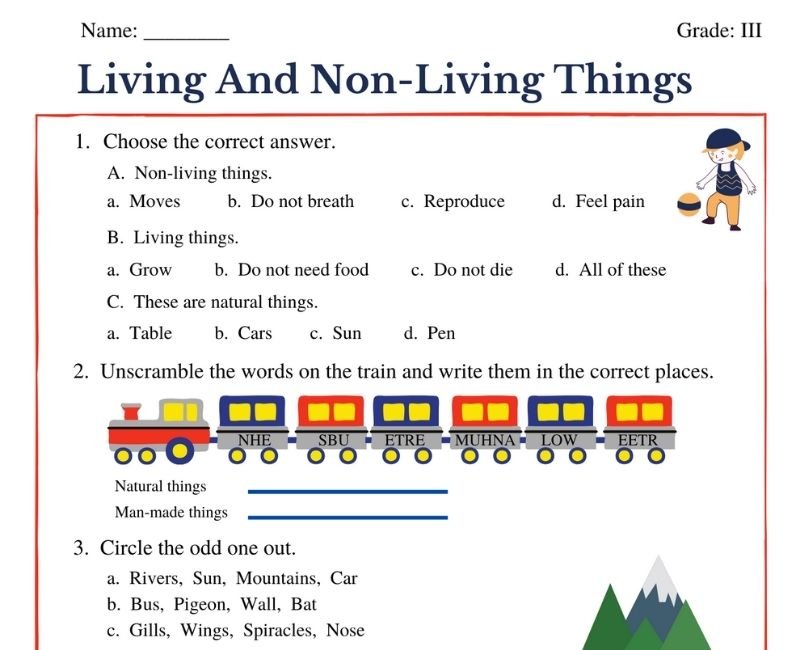
- Living and Non-Living Things Worksheet Class 3
- Eating Habits of Animals Worksheet Class 3
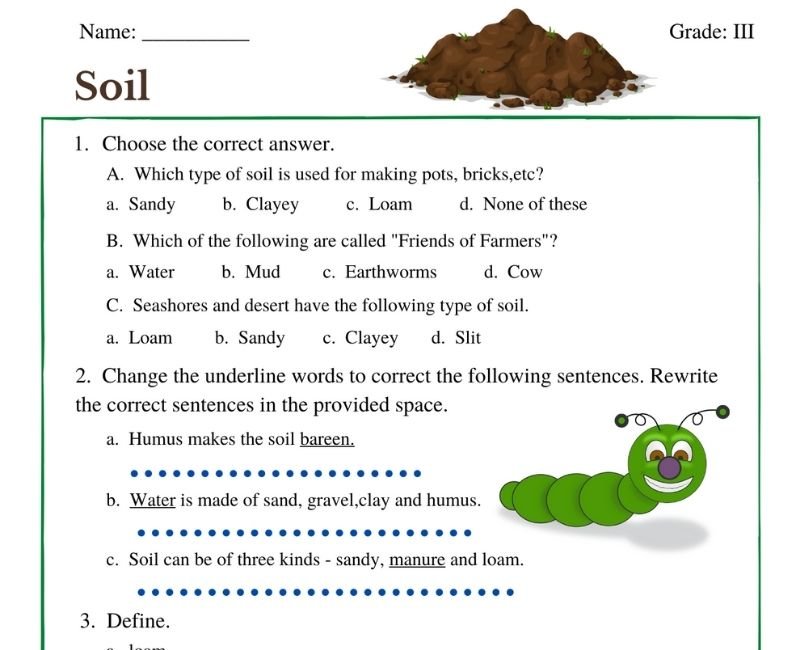
- Soil Worksheet Class 3
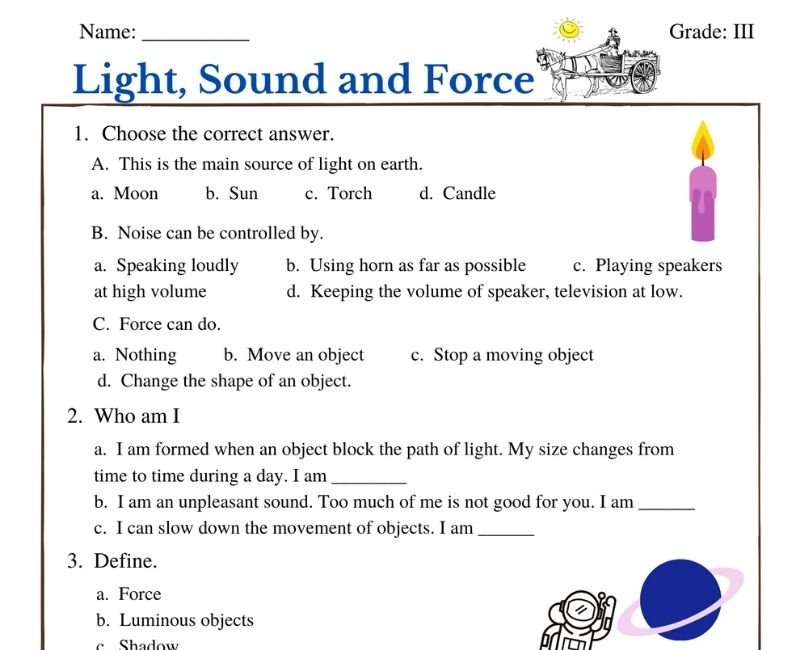
- Light Sound and Force Worksheet Class 3
- Parts of a Plant Worksheet Class 3
- Our Earth and its Neighbours Worksheet Class 3
- Nesting Habits of Birds Worksheet Class 3
- Human Body Worksheet Class 3
- Safety and First Aid Worksheet Class 3
- Science Measurement Worksheet Class 3
- States of Matter Worksheet Class 3
- Food and Feeding Habits of Animals Worksheet Class 3
Frequently Asked Questions
What is air for Class 3?
Air is all around us. We cannot see it but we can feel it when it moves. It takes up space and all living things need it to breathe.
What is wind?
Wind is moving air. A gentle wind is a breeze and a very strong wind is a storm.
What are the sources of water?
Rain, rivers, lakes, ponds, wells, springs and the sea are sources of water. Rain is the main source that fills all the others.
What are the three forms of water?
Water can be solid (ice), liquid (water) or gas (water vapour or steam).
What is the water cycle for Class 3?
The sun heats water and it rises as vapour (evaporation). The vapour cools to form clouds (condensation). Water falls as rain and flows back to the sea, and the cycle repeats.
How can we make muddy water clean?
Let the mud settle, pour off the clean water on top, filter it and then boil it to kill germs.
What instruments are used to study weather?
A thermometer measures how hot or cold it is, a rain gauge measures rainfall and a wind vane shows the direction of the wind.
Does this page have Air Water and Weather Class 3 questions and answers?
Yes. The 20-question Air Water and Weather Class 3 quiz shows the correct answer and a reason for every question at the end, and the practice sheet has a Show answers button for all 16 questions.
Is this worksheet based on CBSE and NCERT?
Yes. It follows the CBSE Class 3 Science syllabus and the NCERT approach used in the Grade 3 book Our Wondrous World.
What experiments can children do on this page?
They can make it rain in the Water Cycle Lab, push a glass into water to see air take up space, change the wind strength, dry wet shirts, clean muddy water and set up a weather station, all on the screen.
Can my child use these activities on a phone?
Yes. All drag activities work with a finger on phones and tablets and with a mouse on computers. Tapping also works.
What is included on this page?
A 20-question quiz with review, flip cards, the Water Cycle Lab, 5 games, 5 science labs, 5 marked challenges, a 16-question practice sheet, a complete guide, 12 related Class 3 Science worksheets and these FAQs.
 Download