Class 3 Science · CBSE / NCERT
Light Sound and Force Class 3 Science Worksheet NCERT with Quiz and Activities
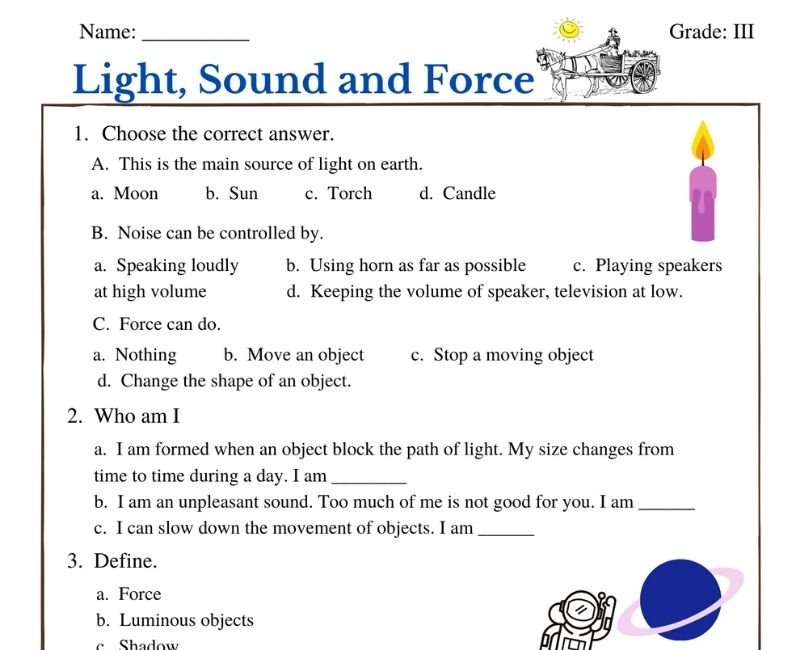
Why do shadows change, how does a drum make sound and why does a ball stop rolling? Explore light, sound and force with this Light Sound and Force worksheet for Class 3: take the Light Sound and Force Class 3 quiz, try the science labs and play the Light Sound and Force Class 3 activities online, in line with CBSE and the NCERT book Our Wondrous World.
Flip the cards and try the Shadow Lab, then tap the Games, Labs or Challenges island.
Light Sound and Force Class 3 Online Quiz
20 questions · tap an answer to move on · full review at the end
Which of these gives out its own light?
Light Sound and Force Class 3 Activities
Shine, tap, push and test. Earn up to 3 stars in every activity.
This Light Sound and Force worksheet for Class 3 lets children explore like young scientists. Flip the fact cards, make shadows in the Shadow Lab, then play the games, do the labs and try the challenges.
Fact cards: tap a card to flip it
Shadow Lab
Drag an object onto the stand (or tap it). Then drag the torch nearer and farther. Try all three objects to see how shadows change.
🔦 Torch: drag the torch left or right along its track (or tap the arrows on it).
- 📦Step 1: Put an object on the stand
Drag clear glass, frosted glass or the brick wall onto the stand. - 🔦Step 2: Move the torch
Drag the torch nearer to and farther from the object. - 🔁Step 3: Try all three objects
Tried 0 of 3. - ⬜Step 4: What did we find?
Finish steps 1 to 3 to unlock.
Challenge marks: 0 / 15 (0 of 5 challenges done)
Finish all 5 challenges to see your comment.
Practice sheet
Type your answers in the boxes. For word answers write in small letters. Press Check when you finish.
ALook and write luminous or non-luminous
BComplete the sentence with one word
CCount and write the number
DWrite push or pull
Light Sound and Force Class 3 Complete Guide
Light helps us see, sound helps us hear and force helps us move things. This guide explains all three in simple words for Class 3 students, parents and teachers. It goes with the Light, Sound and Force worksheet for Class 3 on this page and covers luminous and non-luminous objects, how light travels, shadows, transparent, translucent and opaque materials, how sound is made, loud and soft sounds, push and pull, friction, gravity and magnets.
Introduction to NCERT Class 3 Science Light, Sound and Force
Book: Our Wondrous World (The World Around Us), the NCERT textbook for Grade 3. Topic: Light, Sound and Force. Board: CBSE and other schools that follow NCERT. The new NCERT book builds these ideas through everyday play and observation. This page is built around the learning goals schools test for the topic; it is not a copy of a single chapter.
What is there in this topic
- Luminous and non-luminous objects
- Light travels in straight lines
- Transparent, translucent and opaque things
- Shadows and how they change
- Sound is made by vibration; loud, soft, pleasant sounds and noise
- Push and pull, and what a force can do
- Friction, gravity and magnets
Learning objectives
These objectives are written for this page from the topic's goals; they are not copied from the NCERT book.
- Sort objects into luminous and non-luminous.
- Classify materials as transparent, translucent or opaque.
- Explain how a shadow forms and where it falls.
- Explain that sound is made when something vibrates.
- Identify pushes and pulls in daily life and what they can change.
- Describe friction and gravity in simple words and test which things a magnet attracts.
Learning outcomes
After this page a child can:
- Name three luminous and three non-luminous objects.
- Predict which side a shadow will fall.
- Say how a drum, a guitar and a flute make sound.
- Label everyday actions as push or pull.
- Explain why a ball rolls farther on a smooth floor than on grass.
Light, Sound and Force Class 3 resources on this page
| Resource | What it does |
|---|---|
| Light, Sound and Force Class 3 quiz | 20 questions in three levels with a full answer review |
| Flip cards | Six cards on light makers, see-through materials, sound, push and pull, magnets |
| Shadow Lab | Move a torch and test three materials to see how shadows form |
| 5 games | Light makers sort, loud sound bubbles, music memory, shadow match, torch hunt |
| 5 science labs | Mirror light, water bottle music, push and pull, ramp friction, magnet test |
| 5 challenges | Marked out of 3 each with a total out of 15 |
| Practice sheet | 16 questions with pictures, a word bank and a live score |
Light
| Idea | Meaning | Examples |
|---|---|---|
| Luminous | Gives out its own light | Sun, stars, candle flame, lit bulb, firefly |
| Non-luminous | Seen only when light falls on it | Moon, mirror, book, chair |
| Transparent | Lets light pass through clearly | Clear glass, clean water |
| Translucent | Lets some light through | Frosted glass, butter paper |
| Opaque | Lets no light through | Wall, wood, book |
Sound
Sound is made when something vibrates. A drum skin shakes when hit, a guitar string when plucked and the air inside a flute when blown. The vibrations travel through air to our ears. Loud sounds like thunder and horns can hurt our ears; soft sounds like a whisper are gentle. Unpleasant loud sound is called noise; pleasant sound is music.
Force
| Force | What it does | Example |
|---|---|---|
| Push | Moves something away from you | Kicking a ball, pressing a bell |
| Pull | Brings something towards you | Opening a drawer, drawing water from a well |
| Friction | Slows down moving things | A ball stops rolling on grass |
| Gravity | Pulls things down towards the Earth | A ball thrown up falls back |
| Magnetic force | Pulls iron and steel | A magnet picks up pins and nails |
Types of questions
- Luminous or non-luminous
- Transparent, translucent or opaque
- Where will the shadow fall?
- How does this instrument make sound?
- Push or pull
- Reason questions about friction and gravity
Solved examples
Common mistakes
| Mistake | Correct idea |
|---|---|
| The moon makes its own light | The moon reflects sunlight |
| A mirror is luminous because it shines | A mirror only reflects light |
| Shadows are on the same side as the light | Shadows fall on the opposite side |
| Glass makes a dark shadow | Clear glass lets light through and makes almost no shadow |
| Sound can be made without movement | Sound always needs a vibration |
| Opening a drawer is a push | It is a pull |
| Friction makes things go faster | Friction slows things down |
| Magnets attract all metals | Magnets attract iron and steel, not aluminium or gold |
Daily life
We use light from bulbs and torches, reflectors on bicycles, music from instruments, door handles to pull, swings to push, brakes that use friction and fridge magnets every day.
What your child learns from the Light, Sound and Force worksheet
- To observe light, shadows and sounds around them
- To test ideas with simple experiments
- To link forces to everyday actions
- To use materials and sounds safely
Tips for parents and teachers
- Make shadow puppets with a torch on a wall.
- Fill glasses with different water levels and tap them.
- Roll a toy car on a floor, a mat and a carpet and compare.
- Test household things with a fridge magnet.
- Let the child retry the challenges to earn 3 stars.
Related Science Worksheets
- Living and Non-Living Things Worksheet Class 3
- Eating Habits of Animals Worksheet Class 3
- Soil Worksheet Class 3
- Parts of a Plant Worksheet Class 3
- Air Water and Weather Worksheet Class 3
- Our Earth and its Neighbours Worksheet Class 3
- Nesting Habits of Birds Worksheet Class 3
- Human Body Worksheet Class 3
- Safety and First Aid Worksheet Class 3
- Science Measurement Worksheet Class 3
- States of Matter Worksheet Class 3
- Food and Feeding Habits of Animals Worksheet Class 3
Frequently Asked Questions
What is light for Class 3?
Light is what helps us see. It comes from luminous objects like the sun, a candle and a bulb, and it travels in straight lines.
What are luminous and non-luminous objects?
Luminous objects give out their own light, like the sun and a candle. Non-luminous objects, like the moon and a mirror, are seen only when light falls on them.
What are transparent, translucent and opaque objects?
Transparent things like clear glass let light through clearly. Translucent things like frosted glass let some light through. Opaque things like a wall let no light through.
How is a shadow formed?
A shadow forms when an opaque object blocks light. It falls on the side away from the light, and it gets bigger when the light comes closer.
How is sound produced?
Sound is produced when something vibrates, such as a drum skin, a guitar string or the air inside a flute.
What is force?
A force is a push or a pull. It can start or stop movement, change speed, change direction or change the shape of an object.
What is friction?
Friction is a force that slows down things that rub against each other, like a ball rolling on grass.
Does this page have Light Sound and Force Class 3 questions and answers?
Yes. The 20-question Light Sound and Force Class 3 quiz shows the correct answer and a reason for every question at the end, and the practice sheet has a Show answers button for all 16 questions.
Is this worksheet based on CBSE and NCERT?
Yes. It follows the CBSE Class 3 Science syllabus and the NCERT approach used in the Grade 3 book Our Wondrous World.
What experiments can children do on this page?
They can move a torch to make shadows, bounce light with a mirror, make music with water bottles, push and pull a cart, roll a ball down ramps and test objects with a magnet, all on the screen.
Can my child use these activities on a phone?
Yes. All drag activities work with a finger on phones and tablets and with a mouse on computers. Tapping also works.
What is included on this page?
A 20-question quiz with review, flip cards, the Shadow Lab, 5 games, 5 science labs, 5 marked challenges, a 16-question practice sheet, a complete guide, 12 related Class 3 Science worksheets and these FAQs.
 Download