Class 3 Science · CBSE / NCERT
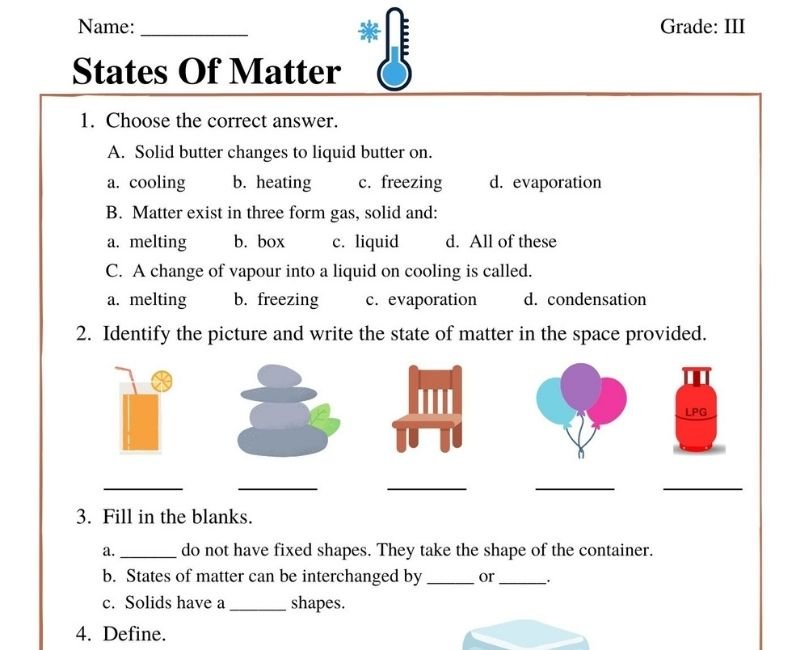
States of Matter Class 3 Science Worksheet NCERT with Quiz and Activities
Why does ice melt, where do wet clothes dry to and why does a balloon fill with air? Find out with this States of Matter worksheet for Class 3: take the States of Matter Class 3 quiz, try the matter science labs and play the States of Matter Class 3 activities online, in line with CBSE and the NCERT book Our Wondrous World.
Flip the cards and try the Heat and Cool Lab, then tap the Games, Labs or Challenges island.
States of Matter Class 3 Online Quiz
20 questions · tap an answer to move on · full review at the end
Which of these is a solid?
States of Matter Class 3 Activities
Heat, cool, pour and melt. Earn up to 3 stars in every activity.
This States of Matter worksheet for Class 3 lets children explore like real scientists. Flip the fact cards, heat and cool water in the Heat and Cool Lab, then play the games, do the labs and try the challenges.
Fact cards: tap a card to flip it
Heat and Cool Lab
Drag the fire or the cold onto the beaker (or tap them). Turn ice into water and steam, then cool it back into water and ice.
🧪 Heat it or cool it: drag the fire or the cold onto the beaker and watch the water change from solid to liquid to gas and back.
- 🧊Step 1: Heat the ice
Melting is next. - ♨️Step 2: Heat the water
Evaporation is next. - 💧Step 3: Cool the steam
Condensation is next. - ❄️Step 4: Cool the water
Freezing is next. - ⬜Step 5: What did we find?
Finish steps 1 to 4 to unlock.
Challenge marks: 0 / 15 (0 of 5 challenges done)
Finish all 5 challenges to see your comment.
Practice sheet
Type your answers in the boxes. For word answers write in small letters. Press Check when you finish.
AWrite solid, liquid or gas
BComplete the sentence with one word
CCount and write the number
DWrite yes or no
States of Matter Class 3 Complete Guide
Everything around us is made of matter: the air we breathe, the water we drink and the chair we sit on. This guide explains states of matter in simple words for Class 3 students, parents and teachers. It goes with the States of Matter worksheet for Class 3 on this page and covers what matter is, solids, liquids and gases, their properties, tiny particles and how heating and cooling change one state into another.
Introduction to NCERT Class 3 Science States of Matter
Book: Our Wondrous World (The World Around Us), the NCERT textbook for Grade 3. Topic: States of Matter. Board: CBSE and other schools that follow NCERT. The new NCERT book builds this topic through observing water, ice and air in daily life. This page is built around the learning goals schools test for the topic; it is not a copy of a single chapter.
What is there in this topic
- What is matter
- Three states: solid, liquid and gas
- Properties of each state: shape and space
- Tiny particles in each state
- Changes of state: melting, freezing, evaporation, condensation
- Water in all three states
Learning objectives
These objectives are written for this page from the topic's goals; they are not copied from the NCERT book.
- Define matter as anything that has weight and takes up space.
- Sort things into solids, liquids and gases.
- Describe the shape and particles of each state.
- Name the change when ice melts, water freezes, water evaporates and vapour condenses.
- Give everyday examples of each change.
Learning outcomes
After this page a child can:
- Explain why water takes the shape of a glass but a stone does not.
- Say what happens to ice when it is heated, and to water when it is cooled.
- Explain why wet clothes dry and why drops form on a cold glass.
- Draw particles in a solid, a liquid and a gas.
- Explain how salt is made from sea water.
States of Matter Class 3 resources on this page
| Resource | What it does |
|---|---|
| States of Matter Class 3 quiz | 20 questions in three levels with a full answer review |
| Flip cards | Six cards: solids, liquids, gases, melting and freezing, evaporation and condensation, particles |
| Heat and Cool Lab | Heat ice to water to steam, then cool it back to water and ice |
| 5 games | Solid liquid or gas, liquid bubbles, matter memory, changes around us, kitchen matter hunt |
| 5 science labs | Shape shifter, melting race, salt from sea water, cold glass, particle lab |
| 5 challenges | Marked out of 3 each with a total out of 15 |
| Practice sheet | 16 questions with pictures, a word bank and a live score |
Solids, liquids and gases
| State | Shape | Particles | Examples |
|---|---|---|---|
| Solid | Fixed shape and size | Tightly packed; only wiggle | Stone, book, ice, chair |
| Liquid | Takes the shape of its container; fixed amount | Close but can slide past each other | Water, milk, juice, honey, oil |
| Gas | No fixed shape; fills all the space | Far apart and move fast | Air, steam, water vapour |
Changes of state
| Change | From → to | Caused by | Example |
|---|---|---|---|
| Melting | Solid → liquid | Heating | Ice cream melting in the sun |
| Freezing | Liquid → solid | Cooling | Water turning into ice in a freezer |
| Evaporation | Liquid → gas | Heating | Wet clothes drying; boiling water |
| Condensation | Gas → liquid | Cooling | Drops on a cold glass; mist on a mirror |
Types of questions
- Solid, liquid or gas
- Name the change of state
- Fill in the blanks
- Yes or no questions about shape
- Particle pictures
- Reason questions about melting, drying and condensation
Solved examples
Common mistakes
| Mistake | Correct idea |
|---|---|
| Air is nothing | Air is matter: a gas that takes up space |
| A liquid changes amount in a new container | Only its shape changes; the amount stays the same |
| Sand is a liquid because it can be poured | Each grain of sand is a solid with a fixed shape |
| Steam and smoke are the same | Steam is water vapour; smoke has tiny solid bits |
| Drops on a cold glass leak through it | They come from water vapour in the air |
| Melting and dissolving are the same | Melting needs heat; dissolving is mixing into a liquid |
Daily life
We freeze water to make ice, melt butter for cooking, boil water for tea, dry clothes in the sun, see dew on grass in the morning and watch our breath fog up a cold window.
What your child learns from the States of Matter worksheet
- To observe changes in everyday things
- To link heating and cooling to changes of state
- To sort and compare like a scientist
- To explain why things happen
Tips for parents and teachers
- Freeze water in an ice tray and watch it melt on a plate.
- Pour the same water into a tall glass and a flat dish.
- Put ice in a glass and watch drops form outside.
- Leave salty water in a dish in the sun for a few days.
- Let the child retry the challenges to earn 3 stars.
Related Science Worksheets
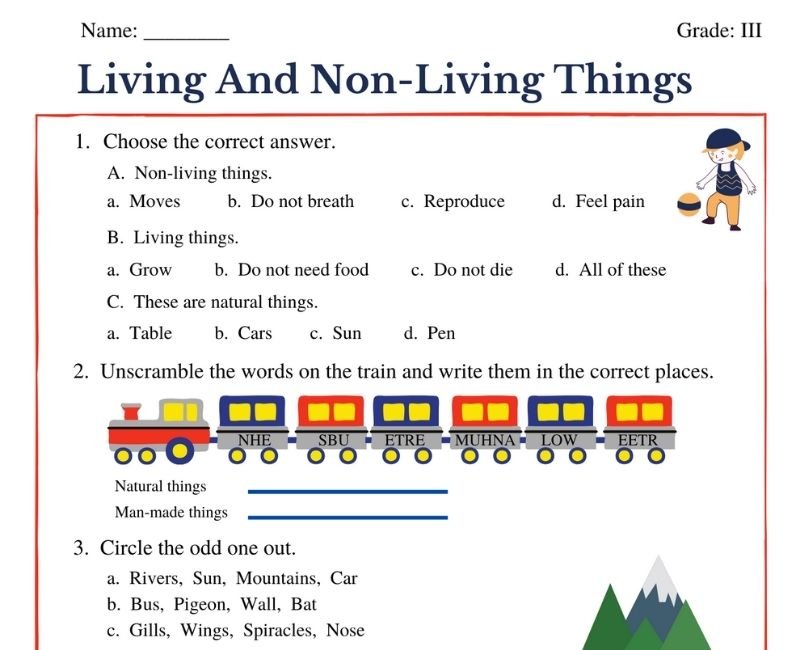
- Living and Non-Living Things Worksheet Class 3
- Eating Habits of Animals Worksheet Class 3
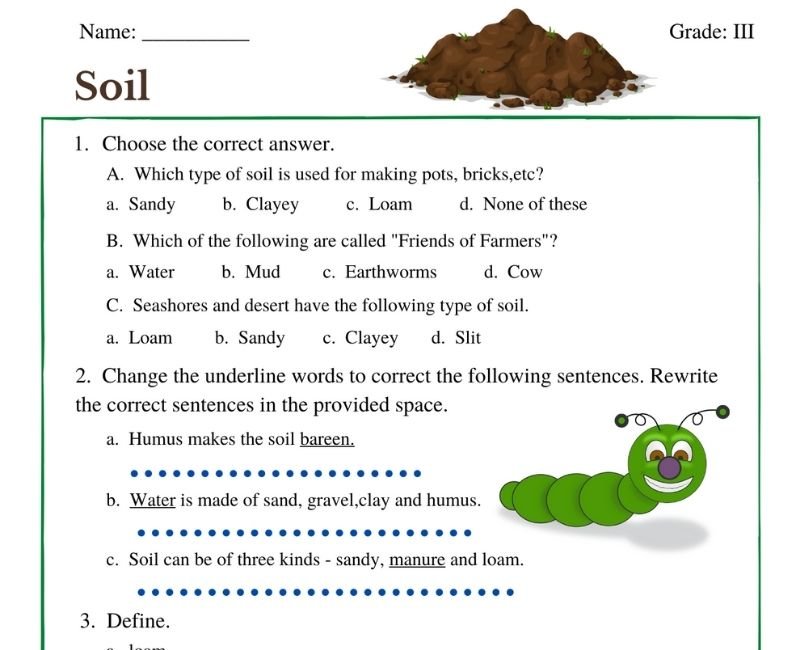
- Soil Worksheet Class 3
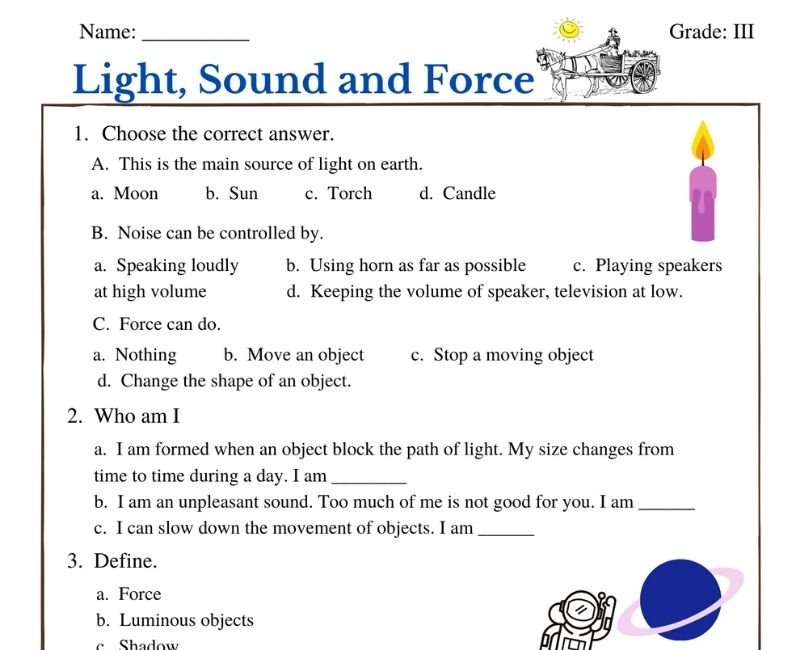
- Light Sound and Force Worksheet Class 3
- Parts of a Plant Worksheet Class 3
- Air Water and Weather Worksheet Class 3
- Sun Moon and Stars Worksheet Class 3
- Birds Beaks and Claws Worksheet Class 3
- Parts of the Body Worksheet Class 3
- Safety and First Aid Worksheet Class 3
- Science Measurement Worksheet Class 3
- Food and Feeding Habits of Animals Worksheet Class 3
Frequently Asked Questions
What is matter for Class 3?
Matter is anything that has weight and takes up space. Air, water, stones and our body are all matter.
What are the three states of matter?
Solid, liquid and gas. A stone is a solid, water is a liquid and air is a gas.
What are the properties of solids, liquids and gases?
Solids have a fixed shape. Liquids flow and take the shape of their container. Gases have no fixed shape and fill all the space.
What is melting and freezing?
Melting is a solid changing into a liquid when heated, like ice into water. Freezing is a liquid changing into a solid when cooled, like water into ice.
What is evaporation?
Evaporation is a liquid changing into a gas, like water drying from wet clothes or boiling into steam.
What is condensation?
Condensation is a gas changing into a liquid when it cools, like water drops forming on a cold glass.
In which three states can we find water?
As solid ice, liquid water and gas (water vapour or steam).
Does this page have States of Matter Class 3 questions and answers?
Yes. The 20-question States of Matter Class 3 quiz shows the correct answer and a reason for every question at the end, and the practice sheet has a Show answers button for all 16 questions.
Is this worksheet based on CBSE and NCERT?
Yes. It follows the CBSE Class 3 Science syllabus and the NCERT approach used in the Grade 3 book Our Wondrous World.
What experiments can children do on this page?
They can heat and cool water through all three states, pour water into different containers, race things melting in the sun, make salt from sea water, watch drops form on a cold glass and see particles move, all on the screen.
Can my child use these activities on a phone?
Yes. All drag activities work with a finger on phones and tablets and with a mouse on computers. Tapping also works.
What is included on this page?
A 20-question quiz with review, flip cards, the Heat and Cool Lab, 5 games, 5 science labs, 5 marked challenges, a 16-question practice sheet, a complete guide, 12 related Class 3 Science worksheets and these FAQs.
 Download