First, Second, Third: Find Your Place! 🏅🚂🌈
20 quiz questions and 10 interactive ordinal activities. Arrange a train, seat animal friends, swap places and explore first to tenth!
📝 Ordinal Numbers Quiz for UKG
⏱ Time Left: 20:00
Question 1 of 20 • Answered: 0/20
Which word means 1st?
Question navigation — green means answered.
🎮 Ordinal Numbers Games for UKG
1. 🏅 Explore First to Tenth
Choose an ordinal. Count the letter cards from the left to find the highlighted place.
1st — First
Card A is first from the left.
2. 🎨 Mark the Requested Seat
Count seats from the left. Tap the requested position.
Mark the second seat from the left.
Ready to play!
3. 🃏 Ordinal Word Memory
Match each short ordinal form with its word.
Find four matching pairs.
4. 🚂 Build the Ordinal Train
Arrange ordinal tickets from 1st to 5th.
🚂 Empty train
Ready to play!
5. 📮 Deliver Position Mail
Select a short-form envelope, then its matching word mailbox.
Ready to play!
🧠 First to Tenth Activities for SR KG
6. 🪑 Seat the Animal Friends
From the left: Dog 1st, Bear 2nd, Cat 3rd, Frog 4th, Fox 5th. Choose an animal, then its seat.
Ready to play!
7. 🔄 Repair the Letter Queue
Use swaps to make this order from the left: C, A, B, E, D.
Ready to play!
8. 🚩 Move the Starting Flag
Keep the animal row fixed. Change the starting end and watch Dog’s ordinal position.
Dog is second from the left.
9. 🔧 Repair Position Strips
Complete each gap in ordinal order.
First → ? → Third
Fourth → ? → Sixth
Eighth → ? → Tenth
Ready to play!
10. ✍️ Trace Ordinal Forms
Choose 1st to 10th. Trace the ordinal with the red pen. Undo removes the latest stroke; Clear keeps the guide.
Ready to play!
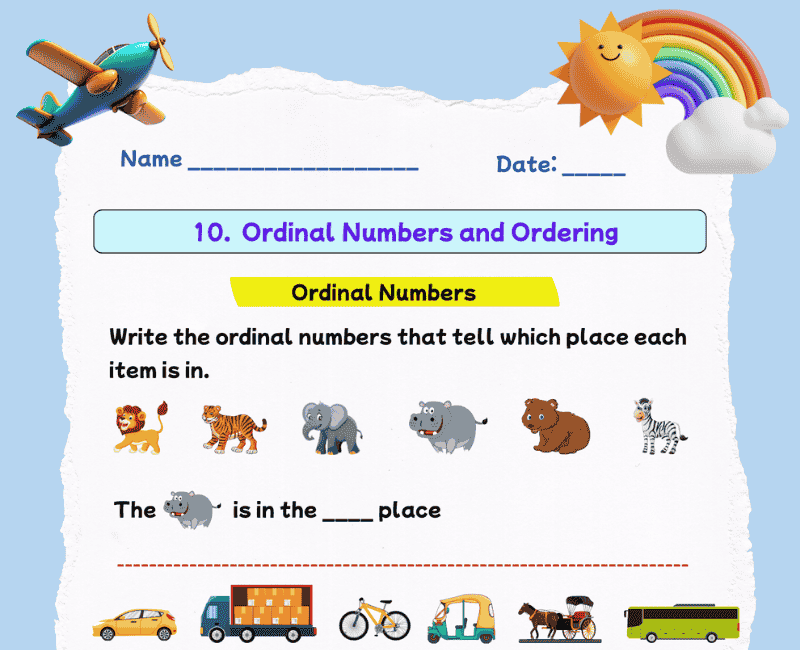
📄 Ordinal Numbers Worksheet for UKG and SR KG
Use the existing download option on this page for the printable worksheet. Add these online position games to your paper practice.
📖 Read the first to tenth learning guide
An ordinal numbers worksheet for UKG helps children describe position in an ordered group. UKG is also called Senior KG or SR KG. Ordinal numbers worksheets for SR KG introduce first, second, third, fourth, fifth, sixth, seventh, eighth, ninth and tenth through clear pictures, matching and everyday classroom situations.
Separate position from quantity. Five tells how many objects there are, while fifth identifies one object's place in an order. Show five toys, count all of them and then point to the fifth toy from a stated starting end. Use the same collection to ask both questions so children hear the difference.
Start with first, second and third before extending to tenth. Place a few familiar toys in a line, mark the starting point and say each position aloud. A simple train or queue provides an easy example. Add more positions when the earlier words are familiar rather than asking children to memorise ten new words at once.
Connect ordinal words with their written forms: first is 1st, second is 2nd and third is 3rd. From fourth to tenth, the forms in this range use th: 4th, 5th, 6th, 7th, 8th, 9th and 10th. Offer matching cards so children can pair the word and symbol without needing to spell every word independently.
Direction matters in ordinal numbers 1 to 10 activities. The second object from the left may be fourth from the right in a line of five. Always state where to start and keep the objects in one visible row. An arrow or flag makes the instruction clear and helps children check their answer.
Explore how positions change when the order changes. If a new child joins the front of a queue, the child who was second becomes third. Swapping two cards changes their places without changing the number of cards. These practical tasks develop reasoning beyond reciting first to tenth.
Use ordinal language during familiar routines: the first step of an activity, the third book on a shelf or the fifth seat from a marked end. A race example should use a stated finishing order rather than asking children to guess places from an unclear picture. Keep the focus on the order being described.
The twenty-question quiz and ten interactive ordinal numbers games provide additional practice alongside the printable worksheet. Children can place animals in seats, arrange ordinal tickets, match memory pairs, change the starting direction and trace 1st to 10th. An adult can read prompts and review writing using the classroom handwriting model.
💬 Ordinal Numbers Worksheet FAQs
😊 What are ordinal numbers for kindergarten?
Ordinal numbers describe position in an order, such as first, second or third. They answer a question such as “Which place?”
😊 What are the ordinal numbers from 1st to 10th?
They are first, second, third, fourth, fifth, sixth, seventh, eighth, ninth and tenth.
😊 What is the difference between cardinal and ordinal numbers?
Cardinal numbers tell how many: five toys. Ordinal numbers tell position: the fifth toy from the left.
😊 How do I teach ordinal numbers to a UKG child?
Begin with three familiar objects in a line. Mark the starting end and name first, second and third before gradually adding more positions.
😊 How do I write first, second and third in short form?
Write first as 1st, second as 2nd and third as 3rd. Pair each form with its word during matching practice.
😊 Why must the starting direction be clear?
The same object can have different positions when counted from opposite ends. State from the left, from the right or another clear starting point.
😊 Can an object be second and fourth at the same time?
Yes, with different starting ends. In a line of five objects, the second from the left is fourth from the right.
😊 How do ordinal positions change when someone joins the front?
Each original person moves back one place. The person who was first becomes second, and the person who was second becomes third.
😊 What everyday activities help children learn ordinals?
Use toy queues, books on a shelf, seats in a row and steps in a familiar routine. Always explain the order and starting point.
😊 How do I download the ordinal numbers worksheet for UKG?
Use the existing download option on this page. The quiz and games provide additional practice alongside the printable worksheet.
 Download