Hop in Equal Steps! 🐸🔢🌈
20 quiz questions and 10 interactive skip-counting games. Count equal groups, build number trains, repair patterns and hop along a number route!
📝 Skip Counting by 2s, 3s and 5s Quiz for UKG
⏱ Time Left: 20:00
Question 1 of 20 • Answered: 0/20
Count by 2s. What comes next?
Question navigation — green means answered.
🎮 Skip-counting Games for UKG
1. 🔎 Explore Equal Groups
Choose a step. Add or remove one complete group and watch the total.
2
1 groups of 2 make 2.
2. 👆 Touch-count Equal Groups
Tap each complete group once. Say the running total.
Count four groups in 2s.
Ready to play!
3. 🃏 Total and Pattern Memory
Match each total with its equal-addition card.
Find four pairs.
4. 🚂 Build Skip-counting Trains
Choose a step and arrange five tickets in counting order.
🚂 Empty train
Ready to play!
5. 📮 Deliver Equal-group Mail
Choose a total envelope, then its matching group description.
Ready to play!
🧠 Counting in 2s, 3s and 5s Activities for SR KG
6. 🏗️ Build Group Targets
Add or remove one equal group to reach each target total.
Group size 2 • Target 10 • Current 0
Ready to play!
7. 🔧 Repair Skip-counting Strips
Keep the stated step size through every gap.
2s: 2 → 4 → ? → 8
3s: 3 → 6 → ? → 12
5s: 5 → 10 → ? → 20
Ready to play!
8. 🐸 Hop Back by Equal Steps
Choose a step. Make five backward hops from the starting number.
🐸 20
Ready to play!
9. 🧺 Collect the 5s Cards
Select every card in the pattern 5, 10, 15, 20, 25.
Ready to play!
10. 🪨 Follow Equal-step Stones
Choose 2s, 3s or 5s. Start at zero and follow neighbouring stones in equal jumps.
Ready to play!
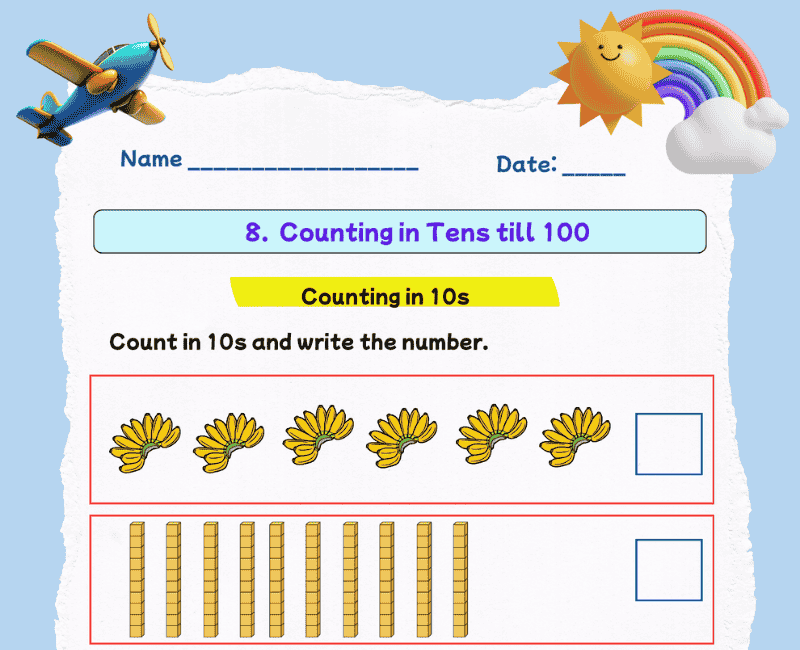
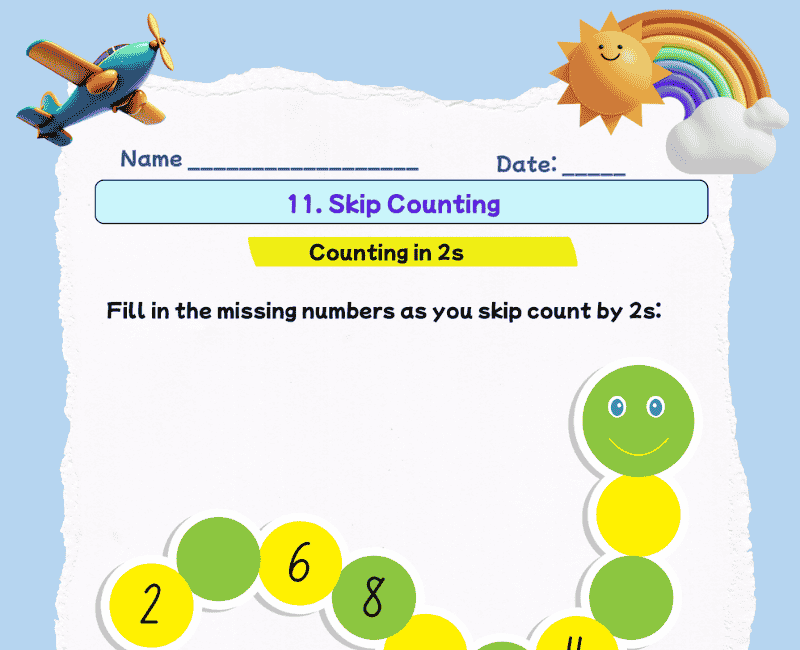
📄 Skip Counting by 2s, 3s and 5s Worksheet for UKG
Use the existing download option on this page for the printable worksheet. Combine paper practice with these online equal-group and number-pattern games.
📖 Read the skip-counting learning guide
A skip counting by 2s, 3s and 5s worksheet for UKG helps children count in equal steps. UKG is also called Senior KG or SR KG. These skip-counting worksheets for SR KG connect short number sequences with equal groups, so children can see what changes at each step rather than simply reciting a list.
Begin with groups that children can check by counting each object. Three pairs of counters contain six counters altogether. After checking that every group has two, count the totals as 2, 4, 6. Explain that three is the number of groups, while six is the total number of counters.
For counting in 3s, arrange small sets of three familiar objects. Add one complete set at a time and say 3, 6, 9, 12, 15. Keep the objects visible while introducing the pattern. If a child needs more support, revisit a shorter sequence before extending it.
Counting in 5s can begin with groups of five counters or fingers on one hand. The sequence from zero continues 5, 10, 15, 20, 25 and 30. These numbers end alternately in 5 and 0. Connect the written pattern with the equal groups instead of relying only on the last digit.
Missing number worksheets for UKG ask children to keep the same step size. In 3, 6, blank, 12, the missing number is 9 because the increase is three each time. Read the full pattern and check both sides of a gap. Mixing steps, such as adding two and then one, changes the intended sequence.
A labelled number track provides another model. Start at zero and make equal jumps of two, three or five. Count the jumps separately from the landing numbers: three jumps of five from zero land at 15. If the starting point changes, use the stated starting value rather than assuming every pattern begins at zero.
Practise backward skip counting only after the forward pattern is familiar. Remove one equal group at a time or move back by the chosen step. For example, 20, 15, 10, 5 decreases by five at every step. Keep the starting point, direction and step size clear.
The twenty-question quiz and ten interactive games provide additional practice alongside the printable worksheet. Children can touch-count complete groups, arrange trains, match quantity cards, build targets and follow step routes. An adult can read prompts, model counting and use real counters to revisit uncertain examples. Short, accurate practice is more useful than rushing through a long chant.
💬 Skip Counting Worksheet FAQs
😊 What is skip counting?
Skip counting means counting in equal steps, such as adding two, three or five each time.
😊 How do I teach skip counting by 2s?
Make equal pairs of objects. Count the running totals as 2, 4, 6, 8 and 10 while pointing to each pair.
😊 What is the counting-by-3s sequence?
From zero, the first five positive landings are 3, 6, 9, 12 and 15. Add three at each step.
😊 How do I teach counting by 5s?
Use equal groups of five counters. Add one group at a time and say 5, 10, 15, 20 and 25.
😊 Must every skip-counting pattern start at zero?
No. Follow the stated starting point. For example, counting in steps of two from 1 gives 1, 3, 5, 7 and 9.
😊 How can children find missing numbers in skip-counting patterns?
Identify the step between neighbouring numbers, continue using that step and check both sides of each gap.
😊 Why does my child say the pattern but struggle to count groups?
Reciting a sequence and connecting it with quantities are different tasks. Use visible equal groups and count one complete group at a time.
😊 What is the difference between groups and total objects?
Four groups of three contain twelve objects. Four tells how many groups there are; twelve tells how many objects altogether.
😊 Can children skip count backward?
Yes. Use a familiar pattern and subtract the same step each time, such as 15, 12, 9, 6, 3.
😊 How do I download the UKG skip-counting worksheet?
Use the existing download option on this page. The quiz and games provide additional practice alongside the printable worksheet.
 Download