Measure, Compare and Explore! 📏⚖️💧
20 quiz questions and 10 interactive measurement activities. Build a measuring row, balance equal weights and fill containers using equal cups!
📝 Measurement Quiz for UKG
⏱ Time Left: 20:00
Question 1 of 20 • Answered: 0/20
Which ribbon is longer?
Question navigation — green means answered.
🎮 Measurement Games for UKG
1. 📏 Build a Measuring Row
Add or remove equal units until they cover the strip exactly. Start at the dotted edge.
Cover strip 1.
Ready to play!
2. 🎯 Fix the Starting Point
Move the measuring row until its left end matches the dotted starting edge.
Ready to play!
3. 💧 Fill to the Cup Target
This tank holds four equal cups when full. Add or remove water to reach each target amount.
Target: 2 cups inside.
Ready to play!
4. ⚖️ Balance the Unit Weights
The left has three identical unit weights. Add or remove weights on the right until balanced.
Ready to play!
5. 🧺 Sort the Measuring Tools
Choose a tool card and send it to its measurement basket.
Ready to play!
🧠 Measuring Activities for SR KG
6. 🪜 Arrange the Length Ladder
Tap ribbon cards from shortest to longest.
Empty ladder
Ready to play!
7. 🃏 Measurement Memory
Match each length statement with its equal-unit picture.
Find four equal-length pairs.
8. 🔍 Explore Unit Size
Keep the strip fixed. Measure it with small units, then large units.
The same strip is 8 small units long.
9. ✅ Collect Fair Measuring Methods
Select every method that measures a straight strip fairly.
Ready to play!
10. 🥤 Compare Container Capacities
Use equal cups to fill A and B completely. Count how many cups each holds.
Ready to play!
📄 Measurements Worksheet for UKG and SR KG
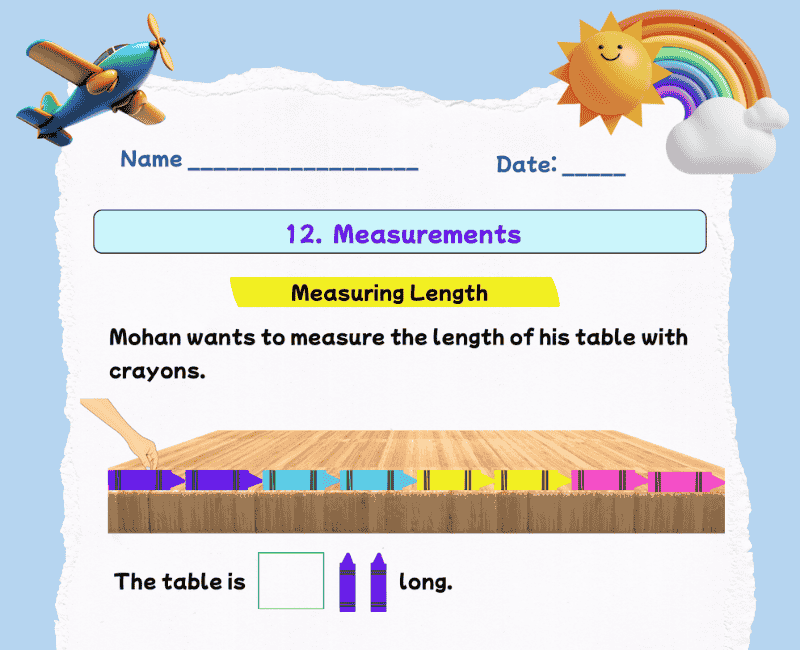
Use the existing download option on this page for the printable worksheet. Combine paper practice with these additional online measurement activities.
📖 Read the early measurement learning guide
A measurements worksheet for UKG introduces ways to compare and describe length, height and weight. UKG is also called Senior KG or SR KG. These measurement activities for SR KG build vocabulary such as longer, shorter, taller, heavier and lighter, then connect comparison with simple measuring tasks.
Begin by asking what feature is being compared. A ribbon can be longer than another ribbon, while a tower can be taller than another tower. Place ribbons with one end aligned and towers on the same surface. Their positions should not mislead children about their actual lengths or heights.
Non-standard measurement uses familiar equal units, such as identical cubes or paper clips. To measure a straight strip, place the units end to end from its starting edge. Leave no gaps or overlaps. Count how many units cover the strip and include the unit in the answer, such as four cubes long.
The unit size matters. The same strip may measure four small units or two larger units. The strip has not changed: the measuring unit has. Keep units identical within one measurement and use the same unit when comparing two measurements directly.
For heavy and light activities, use a balance or suitable objects that children can safely compare with an adult. A balance pan moves down on the heavier side. Do not assume an object weighs more simply because its picture is larger. The online balance activity uses identical model weights so its comparisons are explicit.
Capacity describes how much a container can hold when full. The amount currently inside is a different idea. A partly filled large container can have less water in it than a full small container. Use the same cup to fill and compare containers, counting complete cups without spilling. The online cup models provide stated capacities rather than asking children to guess from appearance.
Use the measurement worksheet for kindergarten alongside classroom objects. Compare two pencils, measure a book with equal cubes or find which of two suitable containers holds more equal cups. Keep the focus on one feature at a time and let children explain what they noticed.
The twenty-question quiz and ten interactive games offer additional practice in comparing, measuring with equal units, ordering lengths, balancing and exploring capacity. An adult can read the short prompts. Return to concrete examples whenever a child needs help connecting a picture or model with the measurement idea.
💬 UKG Measurement Worksheet FAQs
😊 What is measurement for kindergarten children?
It means comparing and describing measurable features, such as length, height, weight and how much a container holds.
😊 What are non-standard units of measurement?
They are familiar units such as identical cubes or paper clips used instead of centimetres or metres. State which unit was used.
😊 How do I teach children to measure length with cubes?
Use identical cubes from one end of the object to the other. Keep them touching, without gaps or overlaps, and count them.
😊 Why should measuring units be the same size?
Mixed-size units do not provide a consistent measure. Use equal units within a measurement and the same unit for a direct comparison.
😊 Why do larger units give a smaller count?
Each larger unit covers more of the object, so fewer units may be needed. The object itself stays the same length.
😊 How can children compare height fairly?
Place the objects on the same surface and compare their top ends. A raised starting level can make a short object appear higher.
😊 Does a bigger object always weigh more?
No. Size alone does not establish weight. Compare suitable objects using a balance or direct experience with adult support.
😊 What is the difference between capacity and the amount inside?
Capacity is how much the container can hold when full. The amount inside describes what it contains now.
😊 How do I teach capacity using cups?
Use the same cup each time, fill containers without spilling and count how many full cups each holds.
😊 How do I download the measurements worksheet for UKG?
Use the existing download option on this page. The online quiz and games provide additional practice alongside the printable worksheet.
 Download